How to Tell if Your Jewelry is Real Gold: A Value Testing Guide
Learn how to tell if your jewelry is real gold with expert testing methods, hallmark decoding, and value assessment frameworks.


The Financial Stakes of Gold Authentication
When navigating the secondary jewelry market, estate sales, or even retail clearance events, knowing how to tell if your jewelry is real gold is the single most important skill for protecting your budget. Gold prices have surged over the last decade, making counterfeit and misrepresented pieces increasingly sophisticated. From a value assessment perspective, purchasing a gold-plated item at solid gold prices isn't just a minor mistake; it is a catastrophic loss of capital. Conversely, accurately identifying a mislabeled high-karat piece can yield massive returns on investment.
Authenticating gold requires moving beyond superficial visual inspections. You must understand the metallurgy of gold alloys, the legal requirements for hallmarking, and the precise physical properties that separate genuine precious metals from base metal imposters. This guide provides a rigorous, budget-focused framework for testing and valuing gold jewelry.
Decoding Hallmarks: The First Line of Defense
The fastest way to assess a piece's baseline value is by examining its hallmark. In the United States, the Federal Trade Commission (FTC) mandates that gold jewelry must be accurately marked with its karat purity. However, counterfeiters frequently stamp fake items with legitimate-looking marks.
Common Karat Stamps and Their Actual Gold Content
Understanding the exact percentage of pure gold in an alloy is critical for calculating melt value. Pure gold is 24 karats, but it is too soft for daily wear, so it is alloyed with metals like copper, silver, and zinc.
| Karat Stamp | Purity (Parts per 1000) | Gold Percentage | Market Value Multiplier |
|---|---|---|---|
| 24K | 999 | 99.9% | 1.00 (Spot Price) |
| 22K | 916 | 91.6% | 0.916 |
| 18K | 750 | 75.0% | 0.750 |
| 14K | 585 | 58.5% | 0.585 |
| 10K | 417 | 41.7% | 0.417 |
Red Flag Stamps: If you see stamps like GP (Gold Plated), GF (Gold Filled), HGE (Heavy Gold Electroplate), or RGP (Rolled Gold Plate), the item has negligible intrinsic melt value. These are base metals with microscopic layers of gold and should be priced as costume jewelry.
At-Home Testing Methods: What Works and What's a Myth
Before spending money on a professional appraisal, you can perform several non-destructive tests at home to filter out obvious fakes. However, from a budget perspective, you must understand the limitations of these methods to avoid false positives.
The Magnet Test (And Its Dangerous Limitations)
Gold is diamagnetic, meaning it will not stick to a magnet. Using a strong neodymium magnet is a great first step. If a heavy gold chain snaps to the magnet, it contains ferromagnetic metals like iron or steel and is undoubtedly fake.
The Catch: Many base metals used in counterfeits, such as copper, brass, and aluminum, are also non-magnetic. A piece passing the magnet test is not guaranteed to be real gold; it merely proves it isn't made of steel. Relying solely on this test is a common budget-draining mistake for novice buyers.
The Ceramic Streak Test
Dragging a piece of gold across an unglazed ceramic plate will leave a streak. Real gold leaves a golden-yellow streak, while pyrite (fool's gold) or brass leaves a dark grey or black streak. Warning: This is a destructive test that will scratch your jewelry, potentially lowering its resale value if it is a polished or numismatic piece.
The Density Test (Water Displacement)
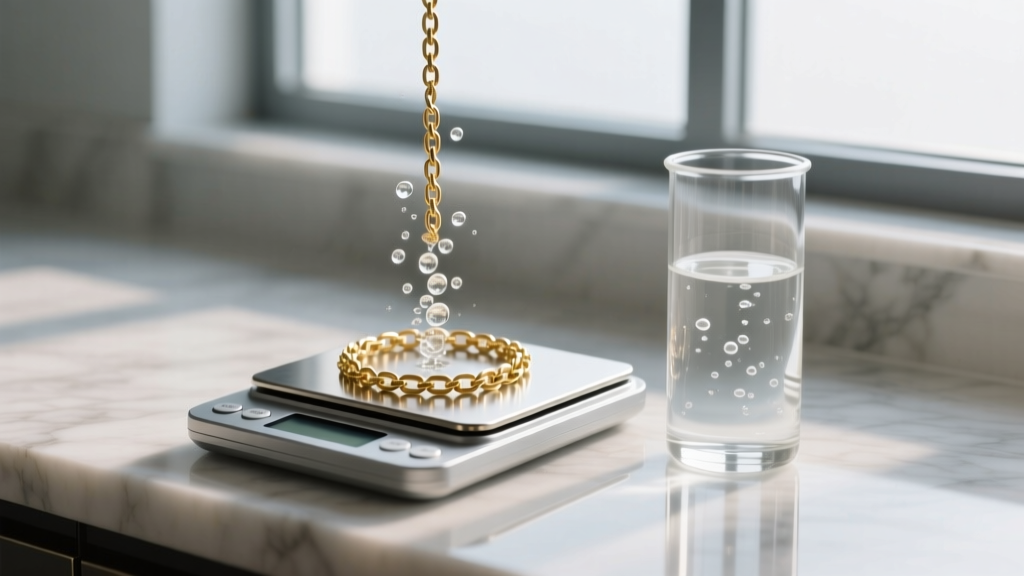
This is the most scientifically rigorous at-home test. Gold is incredibly dense (19.32 g/cm³ for pure 24K). Even 14K gold has a high density of roughly 12.9 to 14.6 g/cm³, depending on the alloy mix. Most counterfeit metals are significantly lighter.
- Weigh the piece: Use a digital jewelry scale to get the exact mass in grams.
- Measure water displacement: Fill a graduated cylinder with water and note the exact starting volume. Tie a piece of thread around the jewelry, submerge it completely, and note the new water level. The difference is the volume in cubic centimeters (cm³).
- Calculate Density: Divide the mass by the volume (Density = Mass / Volume).
If your calculation yields a number close to 13.5 for a 14K piece, you have strong evidence of authenticity. If it yields 8.9 (the density of copper), you are holding a fake.
Professional Appraisal: When to Spend Money to Save Money
When evaluating high-ticket items or heavy bullion jewelry, at-home tests are insufficient. Spending $30 to $50 on a professional assay can save you thousands by preventing a catastrophic purchase or confirming a highly valuable estate find.

XRF (X-Ray Fluorescence) Spectrometry
According to the Gemological Institute of America (GIA), XRF technology is the gold standard for non-destructive metal analysis. An XRF gun shoots X-rays into the metal, exciting the atoms and causing them to emit secondary X-rays. The machine reads these emissions to provide an exact elemental breakdown on a digital screen.
XRF doesn't just tell you if it's real gold; it tells you the exact percentage of copper, silver, and zinc in the alloy. This is crucial for identifying advanced counterfeits, such as tungsten-core gold bars, though XRF has limitations with very thick gold plating over tungsten.
Acid Testing (The Scratch Test)
The traditional jeweler's acid test involves scratching the item on a testing stone to leave a visible streak, then applying drops of nitric acid or aqua regia formulated for specific karats (10K, 14K, 18K, 22K). If the streak dissolves, the metal is below that karat. If it remains bright and unchanged, it meets or exceeds the karat rating. While highly accurate and inexpensive for the jeweler, it is mildly destructive and requires a trained eye to interpret the chemical reactions correctly.
"Never base a high-value purchase on a single testing method. Counterfeiters in 2026 are utilizing cadmium and tungsten alloys that can trick basic electronic testers and superficial acid swabs. Always demand an XRF scan for pieces exceeding $2,000 in melt value."
Budget Framework: Assessing Resale vs. Retail Value
Knowing how to tell if your jewelry is real gold is only half the battle. The second half is understanding how to price it. The jewelry industry operates on massive markups, and understanding the difference between retail value and intrinsic melt value is vital for budget assessment.
Calculating Melt Value
Melt value is the raw cash value of the gold content if it were melted down today. You can calculate this using daily spot prices from markets like Kitco.
- Formula: (Weight in Troy Ounces) x (Purity Percentage) x (Current Spot Price) = Melt Value.
- Example: A 20-gram 14K gold chain. 20 grams = 0.643 Troy Ounces. 14K purity is 58.5%. If spot gold is $2,000/oz, the melt value is: 0.643 x 0.585 x $2,000 = $752.31.
Value Deduction Factors
When buying or selling, you must adjust your budget expectations based on the following physical realities of the piece:
- Solder Joints: Chain links and ring shanks are often repaired or assembled using lower-karat solder. A 14K chain may only assay at 12K overall due to heavy solder use, reducing its melt value.
- Stone Weights: Never pay gold melt prices for the weight of gemstones. If a ring weighs 10 grams but contains a 3-gram quartz stone, you are only buying 7 grams of gold. Always demand the "gold weight only" estimate.
- Hollow vs. Solid: Electroformed or hollow gold jewelry provides a massive visual presence for a low budget, but it dents easily and has a terrible resale value because the actual gold weight is minuscule.
- Brand Premiums: Pieces from heritage houses like Cartier or Van Cleef & Arpels carry immense retail markups. If you buy them at retail, you lose the brand premium the moment you walk out the door. However, in the secondary market, authenticated pieces with original boxes and papers can retain or exceed their retail value.
Final Verdict: Protecting Your Gold Investment
Mastering how to tell if your jewelry is real gold requires a blend of visual inspection, physical testing, and financial math. Start with the hallmark and a neodymium magnet. Progress to the water displacement density test for a highly accurate at-home assessment. Finally, for any significant financial transaction, insist on an XRF spectrometer analysis. By treating gold authentication as a rigorous value assessment rather than a simple visual check, you safeguard your budget against sophisticated counterfeits and ensure you only pay for the precious metal you are actually getting.


