Egyptian Gold Jewelry: Troubleshooting Fakes & Repairs
Learn how to authenticate, repair, and care for Egyptian gold jewelry. Expert troubleshooting for hallmark fakes, high-karat damage, and filigree.

The Allure and the Pitfalls of Egyptian Gold
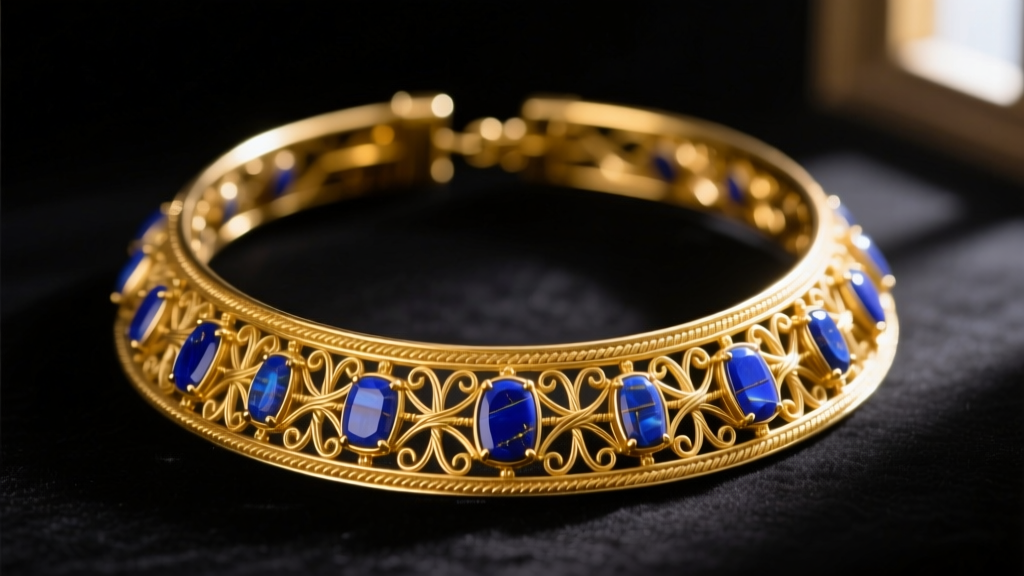
Collecting and wearing Egyptian gold jewelry offers a direct connection to millennia of artisanal mastery. Whether you are acquiring a vintage 21-karat piece from a Cairo souk, an antique Art Deco Egyptian revival bracelet, or a modern high-karat heirloom, the market is fraught with structural vulnerabilities and sophisticated counterfeits. Traditional Middle Eastern goldsmithing heavily favors 21k (87.5% purity) and 24k gold, prioritizing rich color and investment value over structural durability. This creates a unique set of troubleshooting challenges for collectors and jewelers alike.
In this comprehensive guide, we dissect the most common failure modes, authentication hurdles, and restoration protocols for Egyptian gold jewelry. From decoding cryptic assay hallmarks to executing laser repairs on delicate granulation, here is your expert playbook for preserving these historic treasures.
Troubleshooting Authenticity: Spotting Tourist Market Fakes
The tourist markets of Khan el-Khalili and Luxor are notorious for selling heavily plated brass or copper alloys disguised as solid high-karat gold. Counterfeiters have become adept at mimicking traditional Egyptian assay marks, making visual inspection alone insufficient. To properly authenticate Egyptian gold jewelry, you must cross-reference hallmarks with physical metallurgical testing.
Decoding the Assay Office Hallmarks
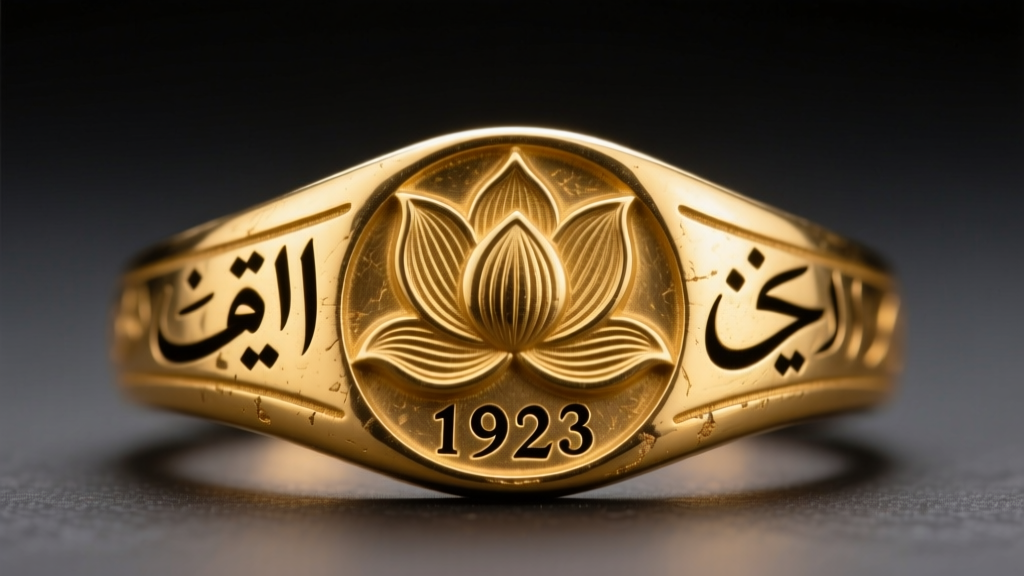
Egyptian gold is stamped by the government assay office, but the symbols have evolved over the decades. A common mistake among novice collectors is assuming a lotus flower stamp guarantees 24k purity. Below is a troubleshooting matrix for verifying authentic Egyptian hallmarks versus common tourist-market forgeries.
| Hallmark Symbol | Meaning & Purity | Common Counterfeit Flaws |
|---|---|---|
| Lotus Flower | 18k Gold (750 Purity) | Cast marks lack crisp petal definition; often stamped on 14k or plated base metals. |
| Camel | 21k Gold (875 Purity) - Vintage | Frequently faked on modern brass; authentic camel stamps feature distinct, sharp leg articulations. |
| Lyre / Harp | Platinum (Rare) | Almost never counterfeited due to the rarity of Egyptian platinum jewelry. |
| Arabic Numerals | Purity (e.g., ٨٧٥ for 875) | Fakes often use Western numerals (875) instead of Eastern Arabic numerals on older vintage pieces. |
The Specific Gravity Verification
If a piece bears a camel stamp (indicating 21k gold) but feels suspiciously light, perform a specific gravity (SG) test. Pure 24k gold has an SG of 19.32 g/cm³. Because 21k gold is alloyed primarily with copper and silver to maintain its yellow hue, its theoretical SG sits around 15.6 g/cm³. If your water displacement test yields an SG below 14.0 g/cm³, the piece is likely a tungsten core or thick gold-plated brass, regardless of the hallmark.
Structural Failures in High-Karat Pieces (21k & 24k)
The very nature of high-karat Egyptian gold jewelry makes it prone to specific mechanical failures. At 87.5% purity, 21k gold has a Vickers hardness of roughly 90 HV—significantly softer than 14k gold (which sits around 130-150 HV). This softness leads to predictable wear patterns that require specialized troubleshooting.
Fixing Bent Filigree and Granulation
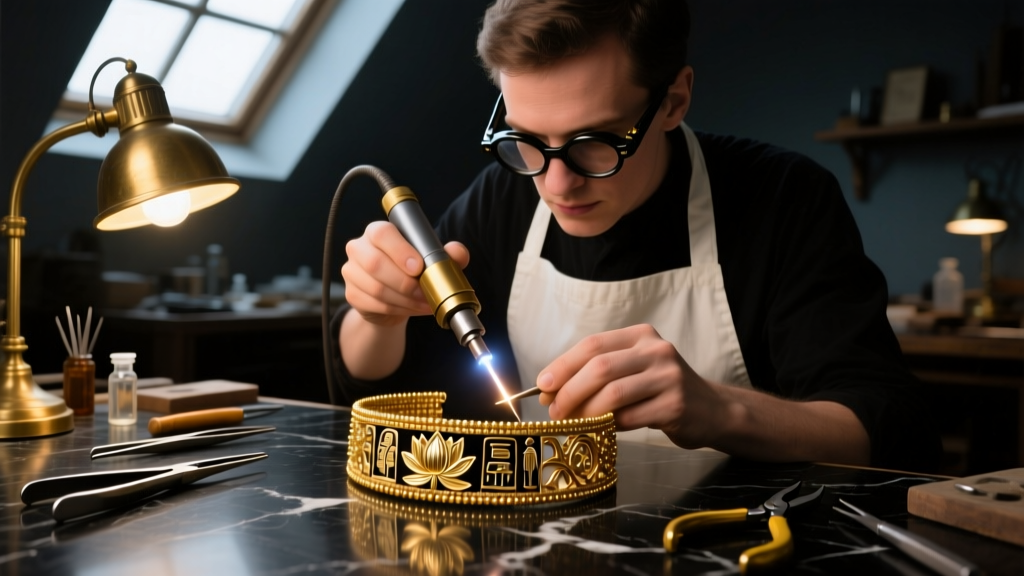
Traditional Egyptian designs often feature intricate wire filigree and granulation (tiny gold spheres fused to a backplate). When a 21k filigree wire bends or a granule detaches, never attempt a traditional torch solder repair. The high thermal conductivity of 21k gold means a torch will rapidly heat the entire piece, melting the delicate granules and destroying the historical integrity of the work.
- The Solution: Use a precision laser welder. Laser welding operates in milliseconds, fusing the 21k wire or granule without transferring heat to the surrounding backplate.
- Filler Wire: You must use 21k or 22k plumb gold filler wire. Using 14k or 18k solder will result in a visible color mismatch and create a galvanic corrosion cell where the lower-karat solder meets the high-karat base, eventually leading to a green/black oxidation line.
Prong and Bezel Wear in Soft Gold
Egyptian jewelry frequently incorporates cabochon turquoise, lapis lazuli, and carnelian. The bezels holding these stones in 21k gold wear down rapidly due to friction against clothing. If a stone becomes loose, do not simply burnish the existing thin gold over the stone; it will tear. Instead, a master jeweler must re-bezel the stone using a custom-drawn 21k gold wire, seamlessly laser-welding it to the original worn bezel wall.
Cleaning and Restoring Patina Without Stripping History
One of the most catastrophic mistakes collectors make is applying modern ultrasonic cleaning methods to antique or vintage Egyptian gold jewelry. The troubleshooting rule here is simple: Never put porous Middle Eastern gemstones in an ultrasonic cleaner.
The Lapis Lazuli and Turquoise Hazard
Egyptian revival and authentic antique pieces heavily feature lapis lazuli (Mohs hardness 5-6) and turquoise (Mohs 5-6). These stones are highly porous. Furthermore, historical Egyptian jewelers often backed thin slices of turquoise with beeswax or natural resins to stabilize them and enhance their color. Ultrasonic cavitation will shatter the lapis and melt the wax backing behind the turquoise, causing the stone to detach and discolor.
Safe Cleaning Protocol for High-Karat Gold
- Initial Dry Brush: Use a soft, natural-bristle baby toothbrush to gently dislodge embedded desert sand or skin oils from filigree crevices.
- Mild Surfactant Soak: Mix a few drops of pH-neutral dish soap (like Dawn) in lukewarm distilled water. Soak the piece for no more than 5 minutes.
- Targeted Agitation: Gently brush the gold framework, strictly avoiding heavy pressure on the gemstone bezels.
- Drying: Blow dry with compressed air to push moisture out from under the stones. Air drying can leave hard water spots that etch into porous carnelian over time.
Sizing Issues: The Challenge of the 21k Shank
Resizing an Egyptian gold ring presents a unique metallurgical hurdle. Because 21k gold is so soft, cutting the shank and stretching it often results in micro-fractures along the solder seam. Furthermore, finding a commercial 21k gold sizing solder is difficult for many Western jewelers who primarily stock 10k, 14k, and 18k solders.
Expert Troubleshooting Tip: If a jeweler proposes sizing your 21k Egyptian ring using 18k yellow gold solder, decline. The 12.5% alloy difference will create a rigid, brittle joint that will snap under the stress of daily wear. The jeweler must custom-alloy a 20k or 21k solder using pure gold, copper, and fine silver to match the exact melting point and tensile strength of the original shank. For more on advanced gold alloy metallurgy, consult the Gemological Institute of America (GIA) guidelines on precious metal properties.
For historically significant or museum-grade antique pieces, sizing should be avoided entirely. Instead, consider adding an inner platinum or 18k white gold sizing band (a "sizing liner") that is friction-fit inside the ring. This preserves the original 21k gold shank while providing the structural rigidity needed to keep the ring securely on your finger.
Final Thoughts on Preservation
Troubleshooting Egyptian gold jewelry requires a paradigm shift from standard Western jewelry repair. You are not just fixing a broken accessory; you are managing a soft, high-purity metal that demands specialized thermal and chemical handling. By insisting on laser welding, matching high-karat solders, and avoiding ultrasonic hazards, you ensure that these stunning artifacts survive for the next generation of collectors. For deeper insights into the historical conservation of ancient and revival gold artifacts, the Victoria and Albert Museum's conservation archives offer invaluable technical resources.