Decoding Chinese Gold Marks on Jewelry: A Beginner's Guide
Learn to decode Chinese gold marks on jewelry. Discover purity stamps, maker's marks, and how to verify authenticity in this beginner-friendly guide.

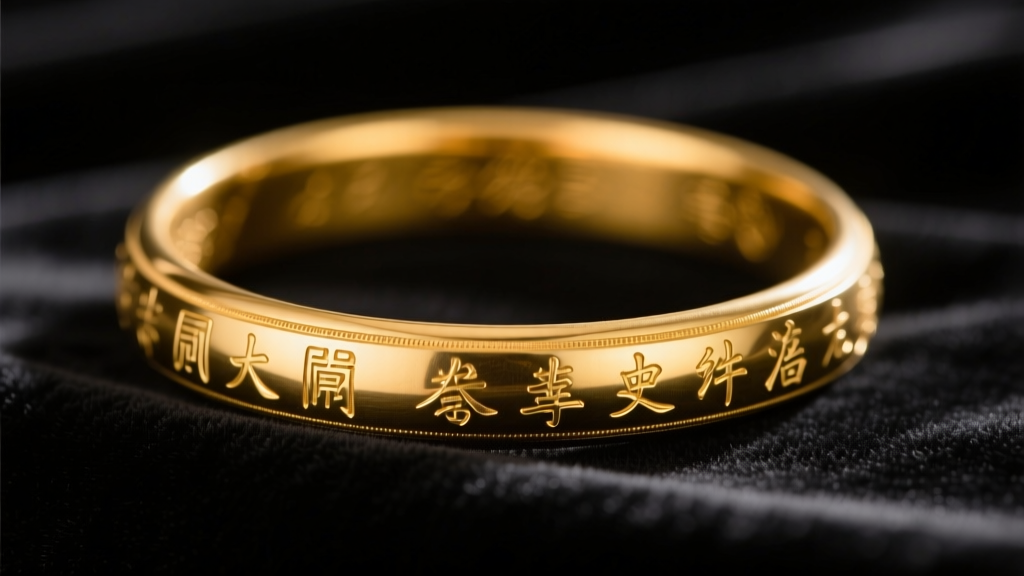
Why Chinese Gold Jewelry Uses Unique Hallmarks
Buying vintage or imported Asian jewelry often leads to confusion when you inspect the inner band or clasp. Unlike Western pieces stamped with familiar 14K or 18K marks, finding Chinese gold marks on jewelry requires understanding a completely different system of purity stamps, character hallmarks, and maker's symbols. In Chinese culture, gold is not merely decorative; it is a deeply ingrained store of wealth and a symbol of prosperity. Because of this, the domestic market heavily favors high-purity 24-karat gold over the durable but less pure 14K or 18K alloys preferred in the West.
For beginners, navigating these stamps can feel like reading a secret code. However, once you understand the national standards and the common characters used by heritage brands, authenticating and valuing these pieces becomes straightforward. According to the Gemological Institute of America (GIA), international hallmarking systems vary wildly, and China's system is uniquely tied to its cultural emphasis on absolute purity and investment-grade metals.
The 2016 National Standard Shift (GB 11887)
To decode Chinese gold marks, you must first understand a massive regulatory shift that occurred in 2016. Prior to May 2016, Chinese jewelers used highly specific marketing terms to denote minute differences in gold purity. You would frequently see stamps like Qian Zu Jin (千足金) for 99.9% pure gold, and Wan Zu Jin (万足金) for 99.99% pure gold.
However, the Chinese government updated the GB 11887-2012 national standard to eliminate consumer confusion. Regulators determined that the visual and physical differences between 99.9% and 99.99% gold were negligible to the average consumer, and the hyper-specific terms were being used as misleading marketing gimmicks to charge massive premiums. Under the revised standard, any gold alloy with a purity of 99.0% or higher must be labeled simply as Zu Jin (足金), meaning 'Pure Gold'.
Expert Insight: While retail tags and certificates were forced to adopt the blanket 'Zu Jin' term post-2016, the physical stamps on the metal itself often still read '999' or '9999'. If you are buying a vintage piece from before 2016, you will frequently encounter the older 'Qian Zu Jin' character stamps alongside the numbers.
Decoding the Numbers: 999, 9999, and Au999
When you inspect the shank of a ring or the clasp of a necklace with a 10x jeweler's loupe, you will likely see a combination of numbers and the chemical symbol for gold (Au). Here is how the numerical Chinese gold marks translate to Western karat standards.
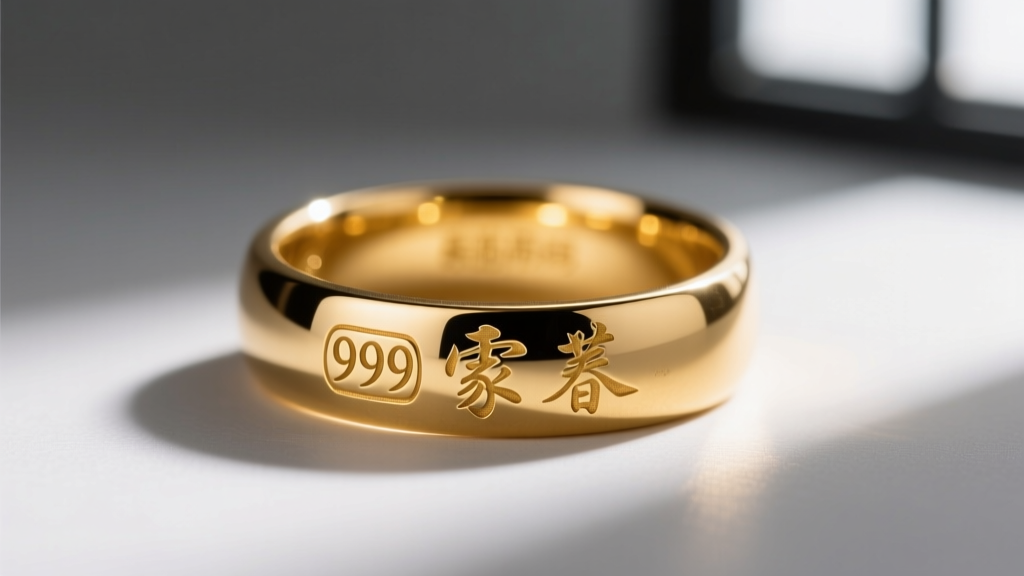
| Chinese Stamp | Millegimal Fineness | Western Karat Equivalent | Common Usage |
|---|---|---|---|
| Au999 / 999 | 99.9% | 24K | Traditional jewelry, wedding bands, investment pieces |
| Au9999 / 9999 | 99.99% | 24K (Ultra-Pure) | Investment bars, highly traditional ceremonial pieces |
| Au750 / G18K | 75.0% | 18K | Modern fashion jewelry, diamond/gemstone settings |
| Au585 / G14K | 58.5% | 14K | Rare in domestic market; mostly found on export pieces |
It is crucial to note that 9999 gold is exceptionally soft. While it sounds superior to 999 gold, it is highly impractical for daily wear rings or intricate prong settings. According to the World Gold Council, the vast majority of high-purity jewelry demand in China is met by 999 gold, which offers the rich, buttery yellow hue of 24K gold with just enough trace alloy to maintain basic structural integrity.
Translating Common Chinese Character Stamps
Numbers only tell half the story. The Chinese characters stamped next to the purity marks provide context about the era of the piece and its exact composition. Here is a quick translation guide for the most common characters you will encounter:
- 足金 (Zu Jin): Pure Gold. The standard stamp for any gold 99.0% and above. This is the most common mark on modern Chinese jewelry.
- 千足金 (Qian Zu Jin): Thousand Pure Gold (99.9%). Found primarily on vintage or pre-2016 pieces. Highly sought after by collectors of antique Asian jewelry.
- 万足金 (Wan Zu Jin): Ten Thousand Pure Gold (99.99%). An older marketing stamp that was banned from retail tags in 2016 but still appears on older investment-grade jewelry.
- 金 (Jin): Simply means 'Gold'. Usually accompanied by a number, such as 18K金 (18K Gold).
Identifying Major Chinese Maker's Marks
Authentic Chinese gold jewelry will almost always feature a maker's mark alongside the purity stamp. These are often stamped in Chinese characters, representing heritage brands that have dominated the market for decades. Recognizing these marks is a massive part of authenticating Chinese gold marks on jewelry.
The 'Big Three' Heritage Brands
- 周大福 (Chow Tai Fook): Founded in 1929, this is arguably the most recognized jewelry brand in China. Their stamp is a hallmark of authenticity and high resale value.
- 老凤祥 (Lao Feng Xiang): Established in 1848, this brand is famous for intricate, traditional designs and is highly prevalent in vintage estate jewelry.
- 周生生 (Chow Sang Sang): Another giant in the industry, known for excellent craftsmanship and modern interpretations of traditional motifs.
If you see a piece stamped with '999' but lacking a recognizable maker's mark, proceed with caution. While some independent artisans produce beautiful work, the absence of a brand stamp in the Chinese market often indicates a piece was produced in an unregulated workshop, increasing the risk of purity discrepancies.
Practical Verification: How to Test Authenticity
Because high-purity 24K gold commands a massive premium, counterfeiters frequently manipulate Chinese gold marks. Here is a professional framework for verifying authenticity without damaging the piece.
1. Visual and Tactile Inspection
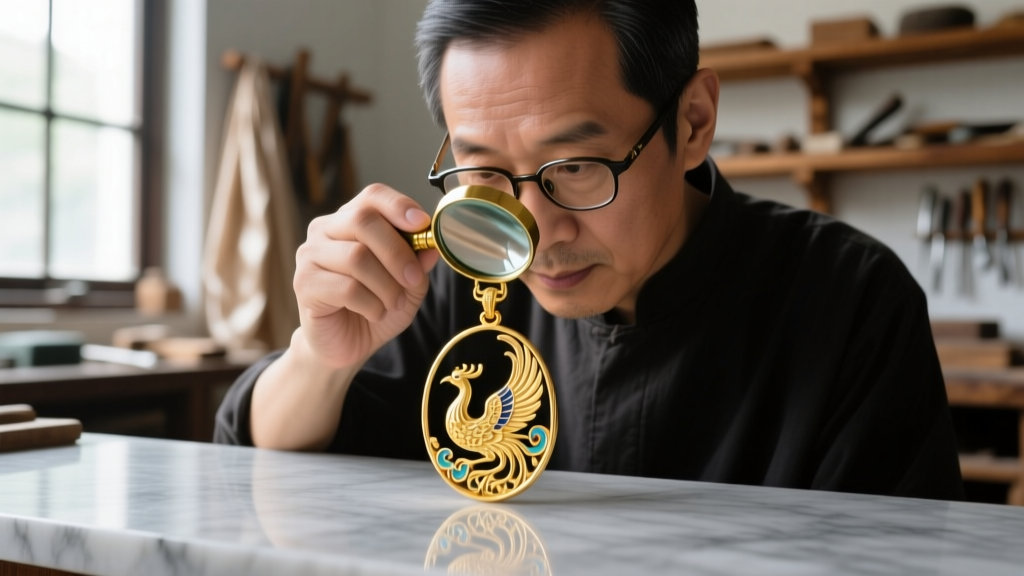
Use a 10x triplet loupe to examine the stamps. Authentic hallmarks from major brands like Chow Tai Fook are struck with heavy hydraulic presses or precision lasers. The edges of the characters should be crisp, deep, and clean. Fakes often feature shallow, sloppy laser etchings or stamped characters that look 'mushy' and poorly defined under magnification.
2. The Magnet and Density Tests
Gold is diamagnetic. If your 999 gold bangle is attracted to a strong neodymium magnet, it contains ferrous metals and is a fake. However, passing the magnet test is not enough, as counterfeiters use non-magnetic metals like copper or tungsten. A specific gravity (water displacement) test can help determine if the density matches pure gold (19.32 g/cm³).
3. XRF Spectrometer Testing
For absolute certainty, take the piece to a professional jeweler or pawn shop equipped with an X-Ray Fluorescence (XRF) spectrometer. This non-destructive test shoots X-rays into the metal and reads the exact elemental breakdown. XRF is critical for spotting modern fakes that use tungsten cores plated in thick 999 gold, or alloys secretly cut with cheap iridium to artificially inflate the weight while dropping the actual gold content.
Summary Checklist for Buyers
When evaluating Chinese gold marks on jewelry, keep this quick checklist in mind to ensure you are making a safe and informed purchase:
- Verify the purity stamp (999, Au999, or Zu Jin) matches the seller's claims.
- Look for a recognized maker's mark (e.g., 周大福) to guarantee origin and resale liquidity.
- Understand that post-2016 pieces will uniformly use 'Zu Jin' on tags, even if the metal is 99.9% pure.
- Avoid 9999 gold for daily-wear rings or gemstone settings due to extreme malleability and prong failure risks.
- Always demand an XRF test for high-value vintage pieces lacking original certificates.
By mastering these unique hallmarks, you unlock access to a beautiful, culturally rich segment of the jewelry market, ensuring you pay exactly for the gold content you are receiving.


