Matte Finish Gold Jewelry Types: An Expert Technical Guide
Explore matte finish gold jewelry types with our expert metallurgical guide. Compare sandblasted, brushed, and hammered textures, karat wear, and care.

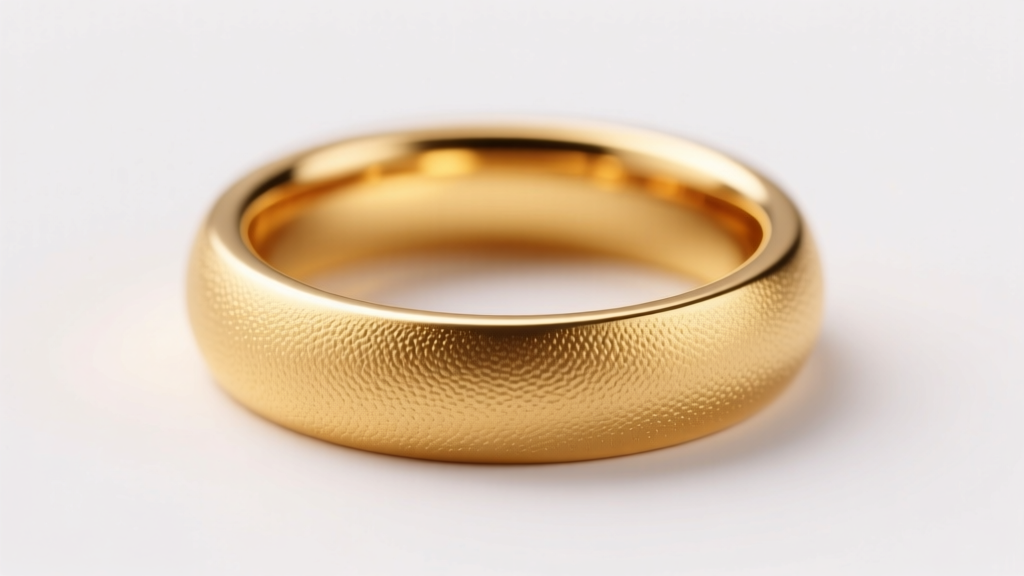
When evaluating fine jewelry, consumers often fixate on karat purity and gemstone clarity, overlooking the profound impact of surface topography. Understanding matte finish gold jewelry types requires moving beyond basic aesthetics into the realm of metallurgy, light physics, and tribology (the study of friction and wear). A matte finish is not merely a lack of polish; it is an engineered manipulation of the gold alloy’s surface at the microscopic level. This technical deep dive explores the exact specifications, manufacturing processes, and long-term wear behaviors of matte gold finishes.
The Physics of Light Scattering in Matte Gold
To classify matte finish gold jewelry types accurately, we must first understand surface roughness, measured in Ra (Roughness average). A mirror-polished gold surface has an Ra value of less than 0.1 µm, allowing for specular reflection where light waves bounce off uniformly. Matte finishes intentionally increase the Ra value to between 1.5 µm and 15.0 µm. This creates microscopic peaks and valleys that cause diffuse reflection, scattering light in multiple directions and eliminating glare. The specific method used to create these micro-abrasions dictates the texture, durability, and maintenance requirements of the piece.
Categorizing Matte Finish Gold Jewelry Types
Jewelers utilize mechanical, pneumatic, and manual techniques to achieve different matte topographies. Below are the four primary classifications used on the bench.
1. Sandblasted (Bead-Blasted) Matte
Sandblasting is a pneumatic process that propels abrasive media at high velocities against the gold surface. For fine jewelry, bench jewelers typically use 120 to 220 mesh aluminum oxide or fine glass beads, propelled at 40 to 80 PSI. The result is a uniform, non-directional, velvet-like texture with an Ra value usually between 4.0 µm and 8.0 µm. Because the process relies on masking (using tape or lacquer to protect polished areas), sandblasting is heavily used in two-tone designs and signet rings. The micro-craters created by the blasting media increase the surface area, which can trap sebum and lotions, requiring regular ultrasonic cleaning.
2. Brushed (Satin) Finish
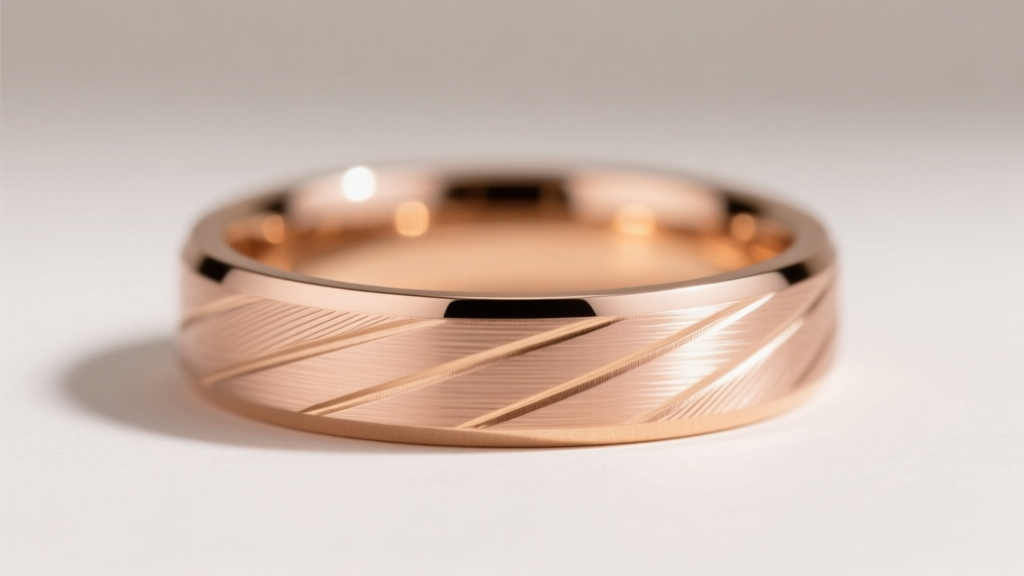
Brushing creates a directional grain pattern. According to Rio Grande, a leading jewelry supplier, this is achieved using abrasive nylon pads (like the industry-standard 3M Scotch-Brite 7447 maroon pad) or fine wire brushes mounted on a polishing lathe. The resulting linear micro-scratches scatter light perpendicular to the grain. Unidirectional brushing yields a sleek, modern satin look, while cross-hatching (brushing in two intersecting directions) creates a more complex, fabric-like light diffusion. Brushed finishes typically sit at a lower Ra value (1.5 µm to 3.0 µm), making them smoother to the touch than heavy sandblasts.
3. Hammered Matte
Unlike abrasive methods that remove metal, hammering displaces it. Using planishing hammers with slightly textured or matte-finished faces, the jeweler strikes the gold to create overlapping, organic divots. Crucially, hammering induces strain hardening (work hardening). The mechanical deformation increases the dislocation density within the gold's crystalline lattice, effectively raising the Vickers Hardness (HV) of the surface layer by 15% to 20%. This makes hammered matte finishes exceptionally durable, though the irregular surface can complicate stone-setting if done after the piece is fully assembled.
4. Florentine (Cross-Hatched Engraved)
The Florentine finish is a subtractive, manual technique executed with a sharp graver. The jeweler engraves a series of parallel lines across the surface, followed by a second series of lines intersecting at exactly 90 degrees. This creates a grid of microscopic pyramids. It is the most labor-intensive matte finish and is highly prized in high-end Italian and Swiss watchmaking for its ability to catch ambient light dynamically without the glare of a polished surface.
Karat Alloy Interactions and Structural Limits
Not all gold alloys respond equally to matte finishing techniques. The alloying metals (copper, silver, zinc, palladium) dictate the hardness and malleability of the piece. The Gemological Institute of America (GIA) notes that karat purity fundamentally alters the mechanical properties of gold. Below is a technical breakdown of how different karats interact with matte finishes.
| Karat | Avg. Vickers Hardness (HV) | Optimal Matte Technique | Wear & Burnishing Rate |
|---|---|---|---|
| 10k Gold | 160 - 180 HV | Heavy Sandblasting, Deep Florentine | Low (Retains texture for years) |
| 14k Gold | 135 - 150 HV | Brushed Satin, Hammered | Moderate (Standard for wedding bands) |
| 18k Gold | 115 - 130 HV | Light Bead-Blast, Hand-Hammered | High (Requires thicker walls for hammered) |
| 24k Gold | 25 - 40 HV | Not Recommended for Matte | Extreme (Burnishes to polish in weeks) |
As the data illustrates, 24k pure gold is far too malleable for matte finishes. The friction from daily wear will rapidly burnish the microscopic peaks, effectively polishing the piece. For matte finish gold jewelry types intended for daily wear (like wedding bands), 14k and 18k alloys provide the necessary structural integrity to maintain their topographical variance.
The Burnishing Effect: Micro-Abrasion and Wear Patterns
A critical reality of matte gold is that it is inherently unstable in high-friction environments. This phenomenon, known as the burnishing effect, occurs when the microscopic peaks of a matte finish are slowly flattened by contact with skin, clothing, and environmental abrasives.
Expert Insight: A sandblasted 18k gold ring worn daily on the dominant hand will typically lose its matte texture on the palmar (bottom) shank within 6 to 12 months, reverting to a semi-polish. The dorsal (top) area, shielded from direct friction, will retain its Ra value significantly longer.
Designers must account for this tribological reality. Matte finishes are best applied to pendants, earrings, and the upper galleries of rings, while the inner shanks and lower profiles should be polished to withstand friction and facilitate easier cleaning.
Bench Protocols for Refinishing and Care
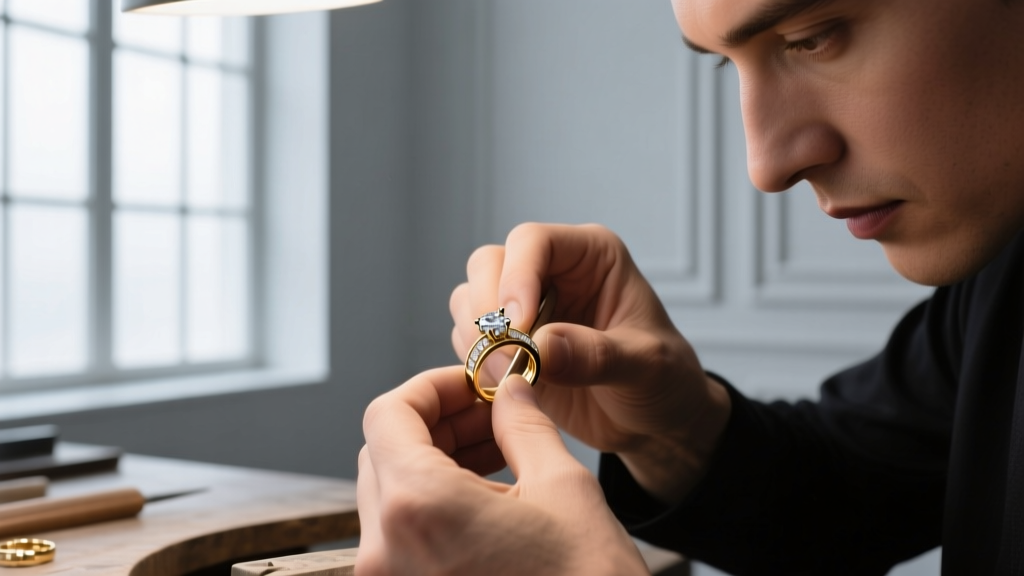
Because matte finishes degrade into a polish over time, maintenance is a key consideration. Re-polishing a ring is straightforward, but re-matting requires specific bench protocols.
- Re-Brushing: To restore a satin finish, the jeweler must first polish out the deep scratches, then apply a fresh grain using a 3M Scotch-Brite radial bristle disc (typically 400 or 600 grit equivalent) mounted on a flex shaft. Consistency in pressure and direction is paramount to avoid a wavy, uneven grain.
- Re-Blasting: Sandblasting requires the complete removal of any stones that might be damaged by aluminum oxide media (such as emeralds or opals). The piece must be thoroughly degreased before blasting to ensure an even, blotch-free texture.
- Ultrasonic Warnings: While ultrasonic cleaners are excellent for removing sebum from the micro-craters of sandblasted gold, they must not be used on pieces with fracture-filled gems or tension settings, as the high-frequency vibrations can loosen the mounts.
Market Pricing and CNC Advancements in 2026
As of 2026, the landscape of matte finish gold jewelry types has been expanded by 5-axis CNC milling and laser ablation. These technologies allow manufacturers to program specific Ra values and create complex, mathematically perfect matte topographies that are impossible to achieve by hand. While traditional hand-hammered and Florentine finishes still command a 20% to 35% labor premium due to the artisan's time, CNC-milled matte textures have become highly accessible, bridging the gap between bespoke artistry and scalable production. When sourcing matte gold, always inquire about the specific technique used, as it directly dictates the piece's long-term aging, structural hardness, and eventual refinishing costs.


