Decoding Gold Jewelry Hallmarks: A Buyer's Guide to Authenticity
Learn to read gold jewelry hallmarks like a pro. Discover what karat stamps, maker's marks, and assay symbols mean before your next purchase.

The DNA of Fine Jewelry: Why Hallmarks Matter
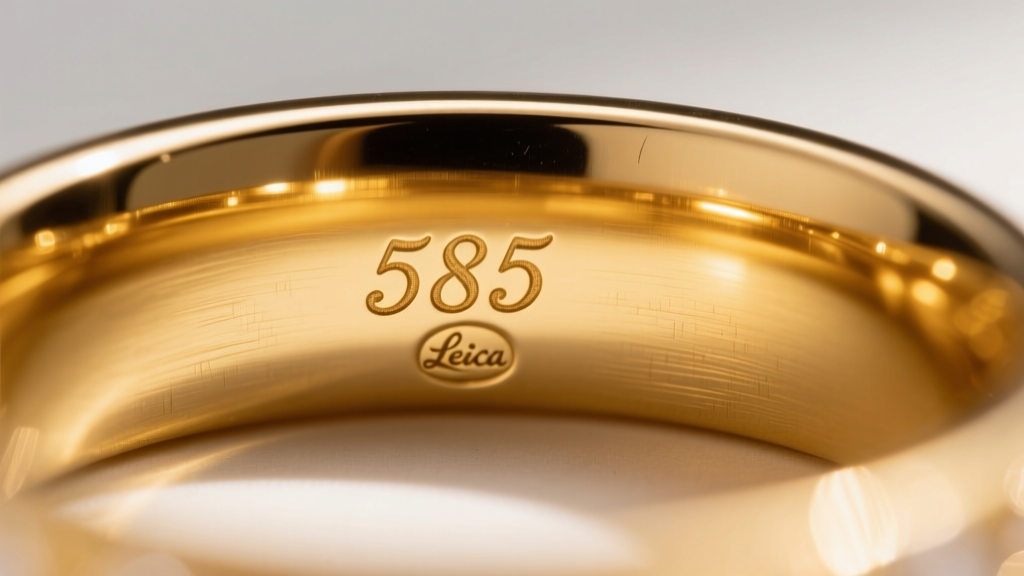
When investing in fine jewelry, the visual appeal of a piece is only half the equation. The true measure of its value, authenticity, and origin lies in a series of microscopic engravings known as gold jewelry hallmarks. Far from being mere decorative afterthoughts, these stamps serve as the legal and metallurgical DNA of your jewelry. They dictate the exact purity of the gold, identify the manufacturer, and in many countries, certify that an independent assay office has verified the metal's composition.
Understanding these marks is non-negotiable for any serious buyer. A piece stamped '18K' in the United States carries a different legal weight than an 18K piece hallmarked in London or Paris. This guide strips away the confusion, providing a masterclass in reading, interpreting, and verifying gold jewelry hallmarks so you can buy with absolute confidence.
The Anatomy of a Gold Hallmark Stamp
A common misconception is that a simple '14K' or '18K' stamp constitutes a full hallmark. In the strictest gemological sense, a true hallmark consists of multiple distinct marks. Here is the breakdown of the elements you should look for under a 10x jeweler's loupe.
Purity Marks: Karat vs. Millesimal Fineness
Purity marks indicate the ratio of pure gold to alloy metals. The United States and parts of Asia primarily use the Karat (K) system, which divides purity into 24 parts. Conversely, Europe and the UK use the Millesimal Fineness system, which denotes parts per thousand.
- 24K / 999: 99.9% pure gold. Extremely soft, rarely used for structural jewelry, mostly reserved for investment bullion or intricate filigree work.
- 22K / 916: 91.6% pure gold. Common in Indian and Middle Eastern bridal jewelry. Offers a rich, deep yellow hue but requires careful handling to avoid bending.
- 18K / 750: 75.0% pure gold. The global standard for luxury fine jewelry. It provides the perfect equilibrium between rich color, high value, and structural durability.
- 14K / 585: 58.5% pure gold. The workhorse of the American jewelry market. Highly resistant to scratching and tarnishing, making it ideal for everyday rings and bracelets.
- 10K / 417: 41.7% pure gold. The minimum karatage that can legally be sold as 'gold' in the US. It is highly durable but has a noticeably paler yellow tone.
Maker's Marks and Assay Symbols
The Maker's Mark (or sponsor's mark) is the registered trademark of the company that manufactured or submitted the piece. In the US, the Federal Trade Commission (FTC) mandates that if a purity stamp is used, a registered maker's mark must accompany it to ensure accountability.
In countries with compulsory hallmarking systems, an Assay Office Mark is also applied. This symbol proves that an independent, government-backed laboratory tested the metal and confirmed it meets the stated purity. For example, The Goldsmiths' Company Assay Office in London uses a leopard's head, while Birmingham uses an anchor, and Edinburgh uses a castle.
Global Hallmarking Standards: A Comparative Guide
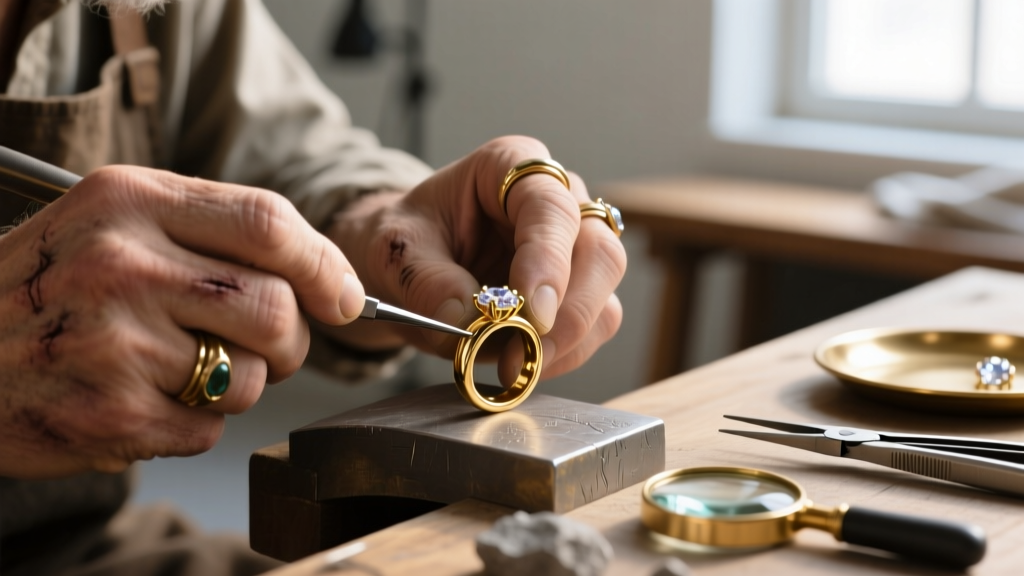
The legal requirements for stamping gold jewelry vary drastically across international borders. A piece purchased on vacation in Italy will look very different under a loupe compared to one bought in New York. Below is a breakdown of the major global hallmarking frameworks.
| Region | System Type | Common Purity Stamps | Legal Requirements & Nuances |
|---|---|---|---|
| United States | Voluntary / FTC Regulated | 14K, 18K, 585, 750 | Purity stamps are optional, but if applied, a registered maker's mark is legally required. No independent assay testing is mandated. |
| United Kingdom | Compulsory (Over 1g) | 375, 585, 750, 916 | The Hallmarking Act 1973 requires three marks: Sponsor, Millesimal Fineness, and Assay Office. A traditional fineness symbol (like a crown for gold) is optional. |
| France | Compulsory (Over 3g) | Eagle Head, Boar Head | Uses pictorial symbols rather than numbers. An Eagle Head denotes 18K (750) gold or higher. A Boar Head was historically used for 14K but is largely phased out. |
| Italy | Voluntary / Manufacturer ID | 750, 585 + Maker ID | Italian gold often features a maker's mark consisting of a number and a province code (e.g., '123 F' for Florence), alongside the millesimal stamp. |
Red Flags: Spotting Fake or Misleading Stamps
Not all stamps are created equal. Counterfeiters and deceptive marketers often use confusing acronyms to make gold-plated or gold-filled items appear as solid gold. When inspecting gold jewelry hallmarks, immediately walk away or demand a massive discount if you see any of the following suffixes or prefixes:
- HGE (Heavy Gold Electroplate) / HGP: This is not solid gold. It indicates a base metal (usually brass) coated with a thin layer of gold. Even 'heavy' plating will eventually wear off, exposing the base metal beneath.
- GP (Gold Plated) / RGP (Rolled Gold Plate): Similar to HGE, these denote a microscopic layer of gold bonded to a cheaper core. They hold virtually no intrinsic scrap value.
- GF (Gold Filled): While gold-filled items contain a much thicker layer of gold than plated items (legally 5% of the total weight in the US), they are still not solid gold and cannot be resized or polished aggressively without risking damage to the gold layer.
- Missing Maker's Mark (US Only): If you are buying a piece in the US stamped '14K' or '18K' but it completely lacks a maker's mark, it is a violation of FTC guidelines. This often indicates mass-produced, imported jewelry with no quality oversight or accountability.
- Worn or Sloppy Stamps: Authentic hallmarks are struck with precision dies. If the numbers are blurred, unevenly spaced, or look like they were scratched in by hand, the piece is likely counterfeit.
How to Verify Gold Purity Beyond the Stamp
While gold jewelry hallmarks are the first line of defense, they are not infallible. Stamps can be faked, or a piece may have been altered (such as a solid gold ring shank being cut and replaced with a plated one). Professional jewelers and savvy buyers rely on secondary verification methods to confirm authenticity.

Non-Destructive Testing Methods
The gold standard for modern verification is X-Ray Fluorescence (XRF) spectrometry. An XRF machine shoots X-rays into the metal, causing the atoms to emit secondary fluorescent X-rays. The machine reads the exact elemental composition, revealing not just the surface karatage, but detecting if a tungsten or lead core is hiding beneath a thick gold shell. According to the Gemological Institute of America (GIA), XRF is the most reliable non-destructive method for assaying precious metals.
Another highly effective non-destructive test is the Specific Gravity (Sigma Metalytics) test. By measuring the electrical conductivity and resistivity of the metal, these machines can instantly flag anomalies. Tungsten, a common metal used in counterfeit gold bars and thick chains, has a specific gravity nearly identical to gold, but its electrical conductivity is vastly different, allowing the machine to catch the fake instantly.
The Acid Test (Touchstone Method)
The traditional acid test remains a staple in pawn shops and jewelry stores. A jeweler rubs the item on a black basalt touchstone, leaving a streak of metal. They then apply varying strengths of nitric acid to the streak. If the streak dissolves, the gold is lower karat than the acid is rated for, or it is plated. While highly accurate, this method is mildly destructive as it requires filing a tiny notch into the piece to test the core metal, bypassing any surface plating.
Expert Tip: Never rely on the 'magnet test' as your sole verification method. While pure gold is diamagnetic (weakly repelled by magnets), many counterfeiters use non-magnetic base metals like copper, brass, or aluminum for their fake chains. A non-magnetic reaction does not guarantee the piece is solid gold.
Your Final Buying Checklist
Before you hand over your credit card for that vintage estate ring or modern luxury chain, run through this rapid-fire checklist to ensure your investment is protected:
- Locate the Stamp: Use a loupe to find the purity mark (e.g., 750, 585) in a discreet area (inside the shank, on the clasp, or on the bail).
- Check for the Maker: Ensure there is a corresponding maker's mark or assay symbol next to the purity stamp.
- Rule out Plating: Scan for deceptive acronyms like HGE, GP, or GF that negate the solid gold claim.
- Inspect for Wear: Look at high-friction areas (like the back of a pendant or the links of a bracelet). If you see a different colored metal peeking through, the piece is plated, regardless of the stamp.
- Request Documentation: For high-value items, ask for a recent appraisal or an XRF printout from the seller verifying the exact metal composition.
Mastering the language of gold jewelry hallmarks transforms you from a vulnerable consumer into an empowered collector. By understanding the intersection of international law, metallurgy, and manufacturer accountability, you ensure that every piece you add to your collection is exactly what it claims to be.


