Fleur De Lis Gold Jewelry: Material Comparison & Casting Guide
Discover how gold karats and casting alloys affect the detail and durability of fleur de lis gold jewelry. Compare 10k, 14k, and 18k properties.

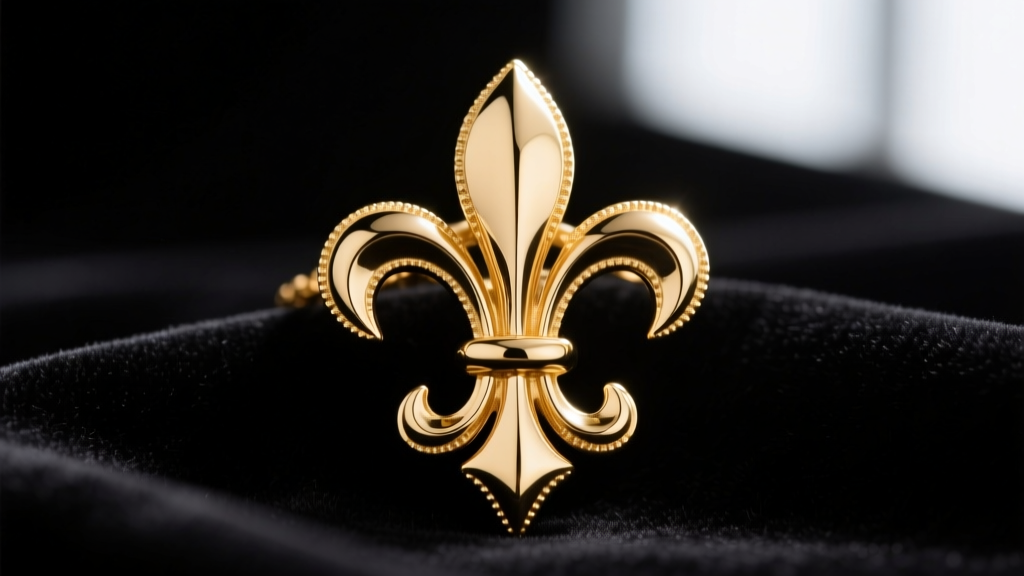
The fleur de lis is far more than a traditional symbol of French heritage, scouting, or New Orleans civic pride; from a metallurgical standpoint, it is a rigorous test of a jeweler’s engineering skill. With its three distinct petals, intricate central stamen, and horizontal base band, this motif requires precise metal flow during casting and careful alloy selection to ensure the details remain crisp over decades of wear. When shopping for fleur de lis gold jewelry, understanding the material properties of different karats, alloy compositions, and manufacturing methods is essential to securing a piece that will last generations.
The Engineering Challenge of the Fleur de Lis Motif
The geometry of a classic fleur de lis presents unique structural challenges. The transition from the thick, horizontal base band to the razor-thin, sweeping tips of the outer petals creates inherent weak points. If the gold alloy is too soft, the petal tips will bend, warp, or snap under minor daily impact. Conversely, if the alloy is too brittle—common in poorly balanced high-copper 10k mixes—the piece can develop micro-fractures at the undercut joints during the quenching or polishing phases.
Furthermore, the Gemological Institute of America (GIA) notes that the specific alloy metals mixed with pure gold drastically alter a piece's tensile strength and color. For a high-relief design like the fleur de lis, the jeweler must also consider sprue placement during the casting process. Master casters attach the sprue (the channel where molten gold enters the mold) to the thickest part of the design—usually the central base band—rather than the delicate outer petals, preventing visible scarring and structural weakening at the tips.
Karat Comparison: 10k vs. 14k vs. 18k for Intricate Castings
Choosing the right karat for a fleur de lis piece requires balancing the rich color of pure gold with the structural integrity needed to hold fine details. Below is a breakdown of how standard gold alloys perform when cast into this specific motif.
| Karat | Pure Gold % | Vickers Hardness (HV) | Best Application | Detail Retention |
|---|---|---|---|---|
| 10k | 41.7% | 130 - 150 HV | Heavy daily wear rings, belt buckles | Excellent (stiff edges) |
| 14k | 58.3% | 120 - 140 HV | Everyday pendants, signet rings | Very Good (balanced) |
| 18k | 75.0% | 110 - 125 HV | Heirloom pieces, earrings, lapel pins | Good (softer edges) |
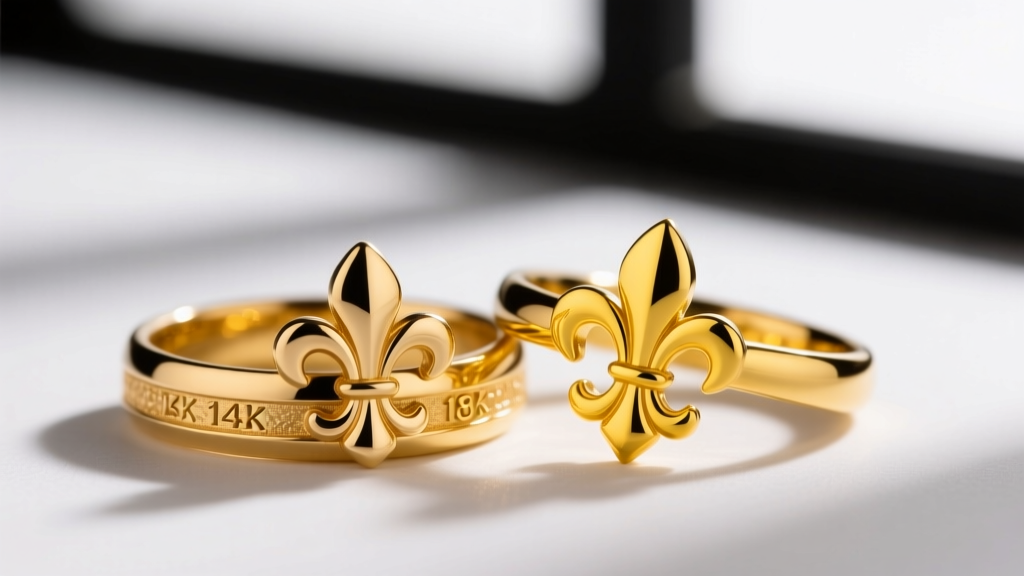
The 10k Reality: Durability vs. Oxidation
10k gold contains only 41.7% pure gold, with the remainder usually comprising copper, zinc, and silver. While its high Vickers hardness makes it excellent for protecting the delicate stamen details from bending, the high copper content makes it prone to oxidation. The deep crevices and undercuts of a fleur de lis trap moisture, lotions, and skin acids, which can accelerate tarnishing and give the recessed areas a dark, muddy appearance over time. If you choose 10k for a fleur de lis signet ring, be prepared for more frequent, rigorous cleaning.
The 14k Sweet Spot: The Industry Standard
14k gold (58.3% pure gold) is the undisputed champion for intricate, everyday jewelry. Alloyed with a precise balance of silver and copper, it offers the tensile strength required to hold the sharp outer petals of the fleur de lis without snapping, while retaining enough malleability to be polished to a brilliant mirror finish. It resists tarnish far better than 10k and maintains a warm, classic yellow hue that honors the historical aesthetic of the motif.
The 18k Compromise: Royal Color, Delicate Edges
18k gold provides a rich, buttery yellow color that elevates the royal origins of the fleur de lis. However, with a Vickers hardness often dropping below 120 HV, the outer petals of an 18k fleur de lis ring are highly susceptible to deformation. If you purchase an 18k piece, it is best reserved for pendants, earrings, or lapel pins where direct physical impact is minimal. For an 18k ring, look for designs where the outer petals are tucked slightly inward or reinforced by a thicker bezel border.
Solid Gold vs. Vermeil vs. Plated: The High-Relief Wear Factor
When evaluating fleur de lis gold jewelry, you must understand the concept of "high-relief wear." The center petal of a traditional fleur de lis protrudes furthest from the base, making it the primary point of contact with clothing, skin, and environmental friction.
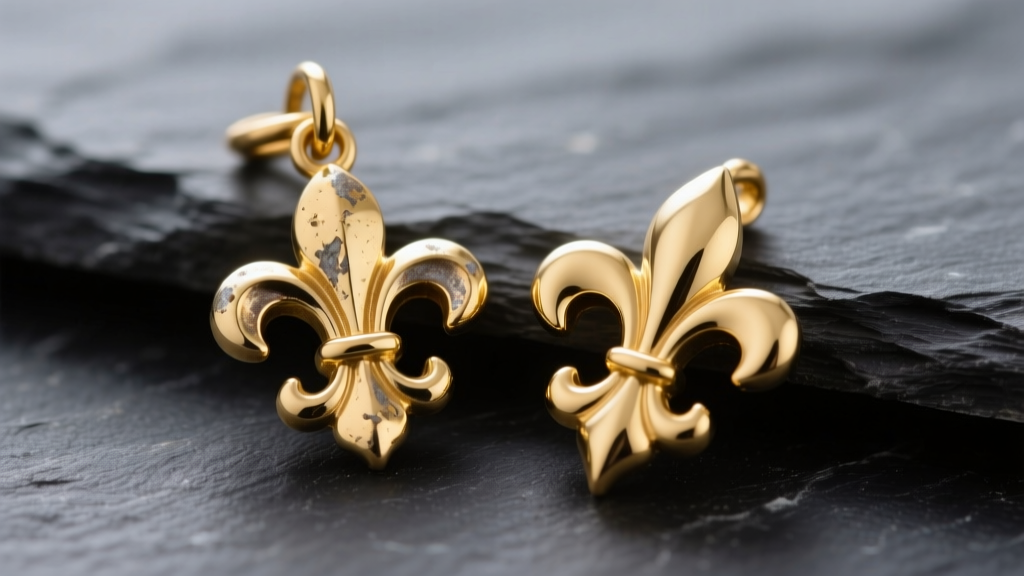
In gold-plated or vermeil jewelry, a microscopic layer of gold (ranging from 0.5 microns in standard plating to 2.5 microns in high-quality vermeil) is electroplated over a base metal like brass or sterling silver. On a flat surface, this layer can last for years. However, on the raised center petal of a fleur de lis, friction wears through this microscopic layer rapidly. It is incredibly common for vermeil fleur de lis pendants to reveal the silver or brass core on the highest relief points within six months of daily wear.
According to the Federal Trade Commission (FTC) Jewelry Guides, gold plating must meet specific thickness standards to be marketed accurately, but even the thickest commercial plating cannot withstand the concentrated friction of a high-relief motif. For a fleur de lis design meant to be worn regularly, solid gold (10k, 14k, or 18k) is the only viable choice to ensure the motif remains uniformly golden over its lifetime.
Manufacturing Methods: Lost-Wax Casting vs. Die Striking
The manufacturing technique used to create your fleur de lis jewelry fundamentally alters the metal's grain structure and final durability.
- Lost-Wax Casting: This is the most common method for 3D, high-relief fleur de lis designs. A wax model is encased in investment plaster, burned out, and replaced with molten gold. This method allows for complex undercuts and deep, dramatic relief. However, the resulting gold has a standard crystalline structure, meaning its hardness relies entirely on the karat alloy chosen.
- Die Striking: This method uses immense hydraulic pressure to stamp a sheet of gold into a hardened steel mold. The extreme pressure compresses the gold's molecular grain structure, significantly increasing its hardness and density. Because die striking cannot achieve deep 3D undercuts, die-struck fleur de lis pieces are usually flatter, "bas-relief" interpretations. If you want a highly durable, flat fleur de lis medallion or dog tag, a die-struck 14k piece will outlast a cast equivalent.
Special Considerations for White Gold Fleur de Lis Pieces
If you prefer the silvery aesthetic of white gold, you must account for rhodium plating. White gold is alloyed with nickel, palladium, or manganese, which gives it a slightly warm, yellowish-gray tint. To achieve a bright, reflective white finish, jewelers electroplate the piece with rhodium.
Just like gold plating, rhodium wears off fastest on high-relief areas. On a white gold fleur de lis, the raised center petal and the outer edges of the base band will be the first areas to show wear, revealing the slightly warmer white gold alloy beneath. Expect to have a white gold fleur de lis ring professionally re-rhodium plated every 12 to 18 months to maintain uniform color across the intricate topography of the design.
Care and Maintenance for High-Relief Gold Motifs
The deep grooves, sharp inner corners, and recessed stamen details of a fleur de lis act as magnets for dead skin cells, soap scum, and hand lotions. Over time, this buildup can dull the gold's luster and make the intricate details look muddy.
To properly clean a solid gold fleur de lis piece, avoid harsh chemical dips. Instead, use a soft-bristled baby toothbrush, warm water, and a single drop of mild, phosphate-free dish soap. Gently agitate the bristles in the deep crevices where the petals meet the base band. Rinse thoroughly and dry with a lint-free microfiber cloth.
A critical warning regarding ultrasonic cleaners: Many New Orleans-style or gothic fleur de lis designs incorporate cold enamel (often black or deep purple) in the recessed background to make the gold petals pop. Ultrasonic cleaners use high-frequency sound waves that will shatter and strip cold enamel instantly. Always inspect your piece for enamel or glued gemstones before using automated cleaning machines. When in doubt, stick to manual brushing to preserve the structural and artistic integrity of your gold jewelry.


