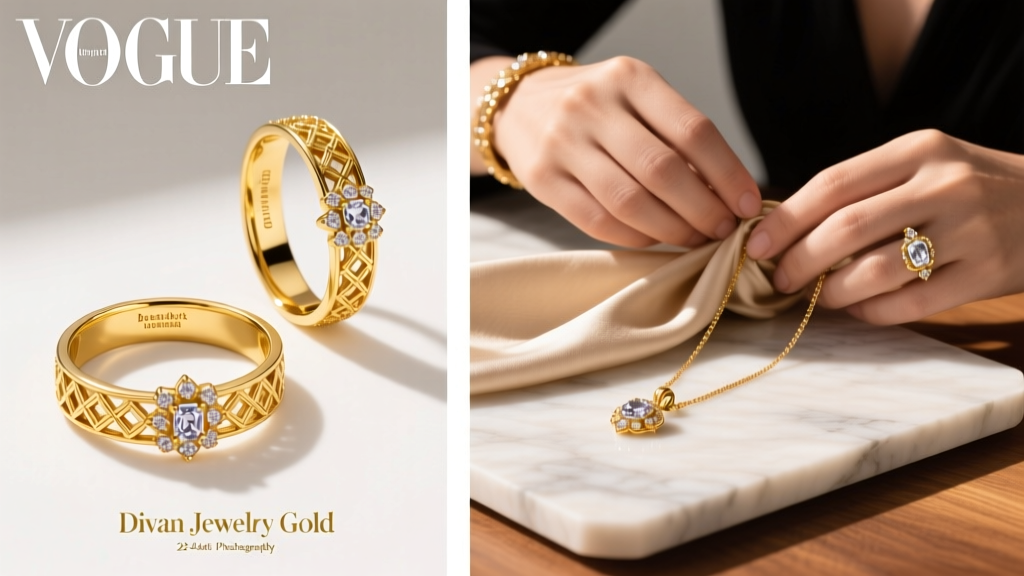
Decoding Gold Jewelry From Italy: Alloys, Hallmarks & Finishes
Discover what makes gold jewelry from Italy unique. We compare 18k Italian alloys, 750 hallmarks, and Florentine finishes against global standards.


When collectors and connoisseurs seek out gold jewelry from Italy, they are not merely purchasing a geographic origin; they are investing in a centuries-old metallurgical tradition. Italian goldsmithing is globally revered not just for its aesthetic brilliance, but for its rigorous material science. From the precise alloy compositions mandated by European law to the proprietary surface finishes that alter how light interacts with the metal, Italian gold operates on a completely different physical level than mass-market alternatives. In this comprehensive material comparison, we decode the specific properties, hallmarking laws, and structural techniques that define authentic Italian gold jewelry.
The Metallurgy of Italian Gold: 18k vs. 14k Alloys
The most defining characteristic of gold jewelry from Italy is its baseline purity. While the United States and parts of Asia heavily favor 14k gold (58.5% pure gold) for its durability and lower price point, the Italian domestic market and its export luxury sectors are overwhelmingly dominated by 18k gold (75.0% pure gold). This 750 standard fundamentally alters the material properties of the jewelry.
Pure 24k gold is too soft for daily wear, possessing a Vickers Hardness (HV) of roughly 25. By alloying 75% gold with 25% copper and silver, Italian metallurgists achieve an 18k yellow gold that sits at approximately 120 to 135 HV. While this is technically softer than a US-standard 14k alloy (which can reach 150 HV due to higher copper and zinc content), Italian manufacturers compensate for this through advanced work-hardening techniques. By subjecting the gold wire to precise tensile drawing and controlled annealing, the crystalline structure of the metal is compressed, dramatically increasing its yield strength without sacrificing the rich, buttery luster that only high-purity gold can provide.
Furthermore, the European Union’s Nickel Directive (94/27/EC) strictly limits nickel release in jewelry. Consequently, Italian white gold is typically alloyed with palladium, silver, and manganese rather than nickel. This results in a metal that is inherently hypoallergenic and possesses a slightly warmer, greyish undertone compared to the stark, nickel-heavy white gold historically produced in North America, requiring a high-quality rhodium flash to achieve a mirror finish.
Decoding the 750 Hallmark and Italian Assay Laws
Authenticating gold jewelry from Italy requires an understanding of the Italian Assay Office system, governed by Law 251/1978. Unlike the US, where hallmarking is largely unregulated and left to the manufacturer's discretion, Italian precious metals are subject to strict state oversight. Every piece must bear two distinct stamps within specific geometric cartouches.
| Attribute | Italian 18k Standard (750) | US 14k Standard (585) |
|---|---|---|
| Gold Purity | 75.0% | 58.3% |
| Primary Alloy Metals | Copper, Silver (Trace Zinc) | Copper, Silver, Zinc, Nickel |
| Vickers Hardness (HV) | 120 - 135 HV (Work Hardened) | 140 - 160 HV |
| Tarnish Resistance | Exceptional | Moderate (Prone to oxidation) |
| Hypoallergenic Profile | High (Nickel-free by EU law) | Variable (May contain nickel) |
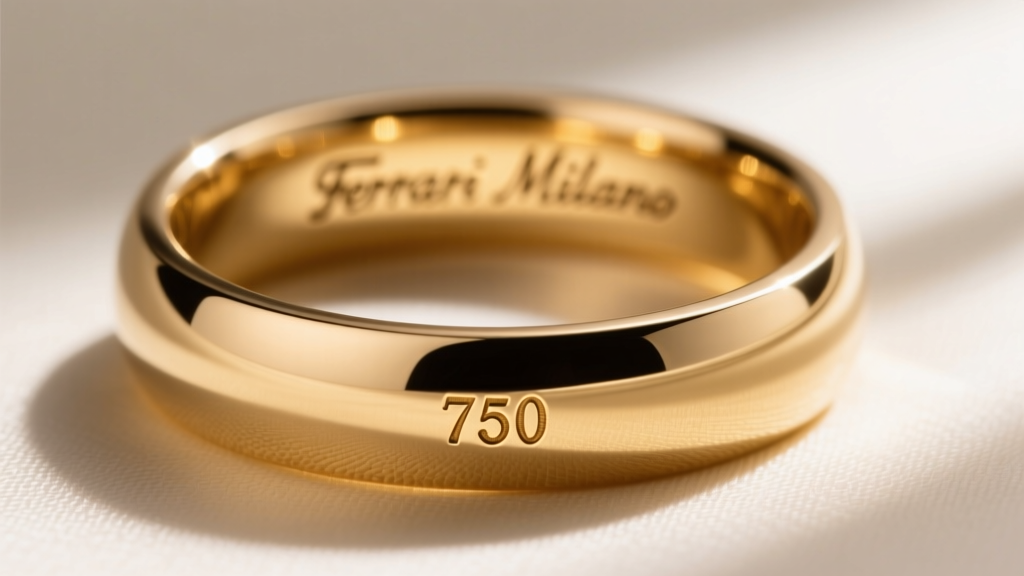
The first mark is the purity stamp, typically an oval containing the number 750 (or 585/333 for lower karats). The second, and more crucial for provenance, is the maker’s mark. This is a lozenge-shaped (diamond) cartouche containing a unique identification number and a two-letter provincial code. For example, a stamp reading 1234 AR indicates the piece was manufactured by the 1,234th registered goldsmith in the province of Arezzo. This dual-stamp system creates an unbreakable chain of custody, allowing authorities to trace any substandard alloy back to the exact factory floor where it was cast.
Signature Surface Properties: Florentine and Diamond-Cut Finishes
The physical properties of Italian gold are frequently manipulated at the surface level to alter light refraction and scratch resistance. Two techniques dominate the high-end Italian manufacturing space.
The Florentine Finish
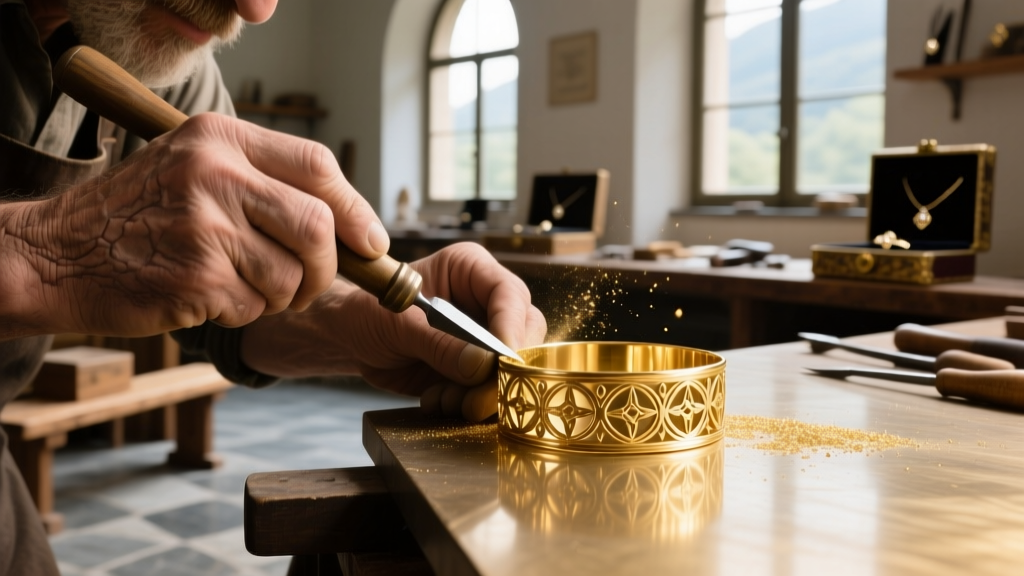
The Florentine finish is a hallmark of Renaissance-inspired Italian goldsmithing. Artisans use a specialized engraving tool called a burin to carve a series of parallel lines into the gold, followed by a second set of lines cut perpendicular to the first. This cross-hatching creates a matte, textured surface that diffuses light rather than reflecting it. From a material standpoint, the Florentine finish is highly practical: the microscopic valleys and peaks effectively hide micro-abrasions and daily wear scratches, making it an ideal finish for heavy gold cuff bracelets and signet rings that endure high impact.
CNC Diamond-Cutting
For chain manufacturing, particularly in the Arezzo region, Italian factories utilize CNC (Computer Numerical Control) lathes equipped with synthetic diamond-tipped blades. These blades shave microscopic, geometric facets into the surface of solid gold ropes and curb chains. Because 18k Italian gold possesses a higher pure-gold content, it yields a smoother cut under the lathe, resulting in a prismatic brilliance that mimics the fire of gemstones. The removal of material requires the underlying gold wire to be heavily work-hardened beforehand to prevent the chain links from warping under the pressure of the cutting blade.
Valenza, Vicenza, and Arezzo: Regional Alloy Variations
The material application of gold varies distinctly across Italy’s three primary jewelry hubs, each optimizing the 750 alloy for specific structural demands:
- Arezzo (The Chain Capital): Famous for automated, high-precision chain weaving. The gold alloys here are formulated for maximum ductility, allowing them to be drawn into ultra-fine wires (down to 0.15mm) for intricate weaves like the Figaro and Mariner chains without snapping.
- Valenza (The High Jewelry Nexus): Home to brands like Bulgari and Damiani. Valenza goldsmiths favor slightly harder 18k alloys with a higher copper content to ensure the prongs and micro-pavé settings maintain rigid tension around diamonds and colored gemstones.
- Vicenza (The Classical Forge): Known for heavy, volumetric casting and the famous Tubogas (gas pipe) technique. Tubogas relies on the interlocking tension of contoured gold bands wrapped around a steel core without the use of solder. The gold used here must possess exceptional elastic memory to snap back into place and grip the core tightly.
Authenticity Verification: Spotting Fake Italian Gold
Because of the premium commanded by gold jewelry from Italy, the market is saturated with counterfeits bearing fake '750' and 'Made in Italy' stamps. According to the Federal Trade Commission (FTC) guidelines and international trade laws, 'Made in Italy' requires substantial transformation within the country, not just final polishing of imported castings.
"True Italian gold verification requires looking past the surface stamp. A genuine piece will exhibit the lozenge maker's mark with a provincial code. If a piece only features a '750' and 'Italy' stamp without the numerical maker's mark, it is highly likely to be an imported casting merely polished in Italy, or an outright counterfeit."
To verify the material properties non-destructively, professional jewelers use X-ray Fluorescence (XRF) spectrometry. An authentic Italian 18k piece will show a gold peak at 75%, with the remainder split between silver and copper, and an absolute zero reading for nickel or cadmium (which are strictly banned in Italian foundries due to EU REACH regulations). If an XRF scan detects zinc levels above 5% or the presence of nickel, the piece is almost certainly not of Italian origin, regardless of the engraving on the clasp.
Final Verdict: Is the Italian Premium Justified?
When you purchase authentic gold jewelry from Italy, you are paying for superior metallurgical integrity. The strict adherence to the 750 standard ensures a metal that resists tarnish and oxidation far better than lower-karat alternatives. The absence of nickel makes it a safe choice for sensitive skin, while the regional specialization—from Arezzo’s diamond-cut chains to Valenza’s tension-set masterpieces—guarantees that the physical properties of the gold are perfectly matched to the structural demands of the design. For those who view jewelry as both an art form and a material science, Italian gold remains the undisputed global benchmark.
For further reading on precious metal standards and alloy compositions, consult the Gemological Institute of America (GIA) and the World Gold Council.