How to Know If Jewelry Is Real Gold: Expert Testing Guide
Learn how to know if jewelry is real gold with our expert deep dive. Discover acid tests, magnet checks, and hallmark decoding for authentic gold.

The Metallurgy of Authenticity: Why Fakes Fail
When figuring out how to know if jewelry is real gold, you must first understand the fundamental physics and chemistry of the metal itself. Pure 24-karat gold is exceptionally dense (19.32 g/cm³), highly malleable, and completely resistant to oxidation and tarnish. Because pure gold is too soft for daily wear, it is alloyed with metals like copper, silver, zinc, and nickel. These alloys alter the density, color, and hardness of the final piece, but they do not change gold's core diamagnetic properties or its noble metal status. Counterfeiters typically use brass, copper, or tungsten cores plated with microscopic layers of gold. By exploiting the differences in density, magnetic permeability, and chemical reactivity, we can definitively separate authentic gold alloys from sophisticated fakes.
Decoding Hallmarks: The First Line of Defense
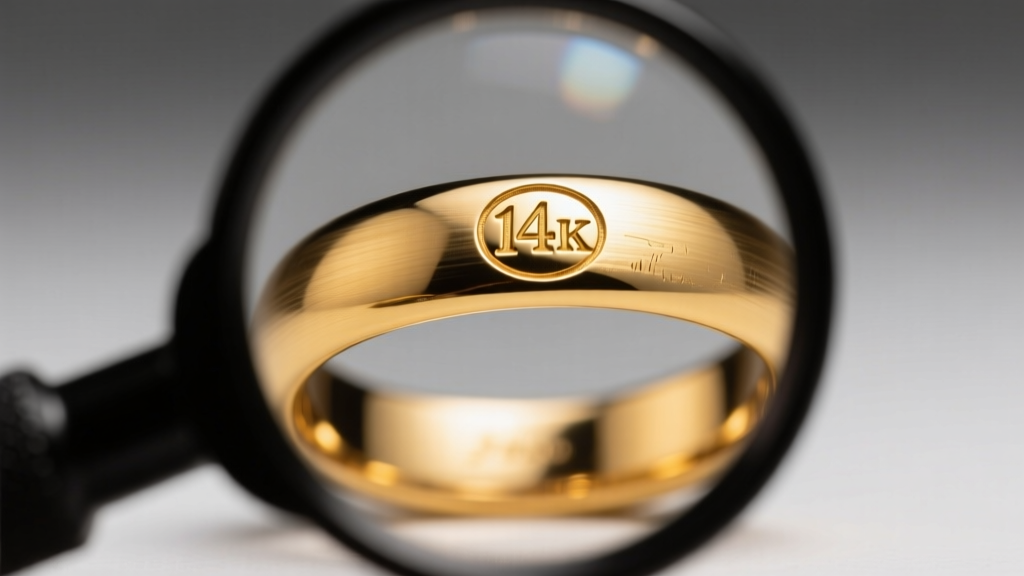
The hallmark is a stamped indication of the metal's purity. However, a stamp is the easiest thing for a counterfeiter to replicate. A genuine hallmark should be crisp, deeply struck, and perfectly centered. Blurry, shallow, or misaligned stamps are immediate red flags. Furthermore, you must understand international marking systems to spot inconsistencies.
| Karat | Millemesimal Fineness | Gold Percentage | Common Deceptive Stamps |
|---|---|---|---|
| 10K | 417 | 41.7% | 10K HGE, 10K GF |
| 14K | 585 | 58.5% | 14K EP, 14K Clad |
| 18K | 750 | 75.0% | 18K HGP, 18K Rolled |
| 22K | 916 | 91.6% | 22K Plated |
| 24K | 999 | 99.9% | 24K Gold Filled |
According to the Federal Trade Commission Jewelry Guides, terms like 'Gold Filled' (GF), 'Heavy Gold Electroplate' (HGE), and 'Gold Plated' must be clearly distinguished from solid gold. If you see '18K HGE', the piece is primarily base metal with a thick gold plating, not solid 18-karat gold.
The Magnet Test: Limitations and Real-World Application
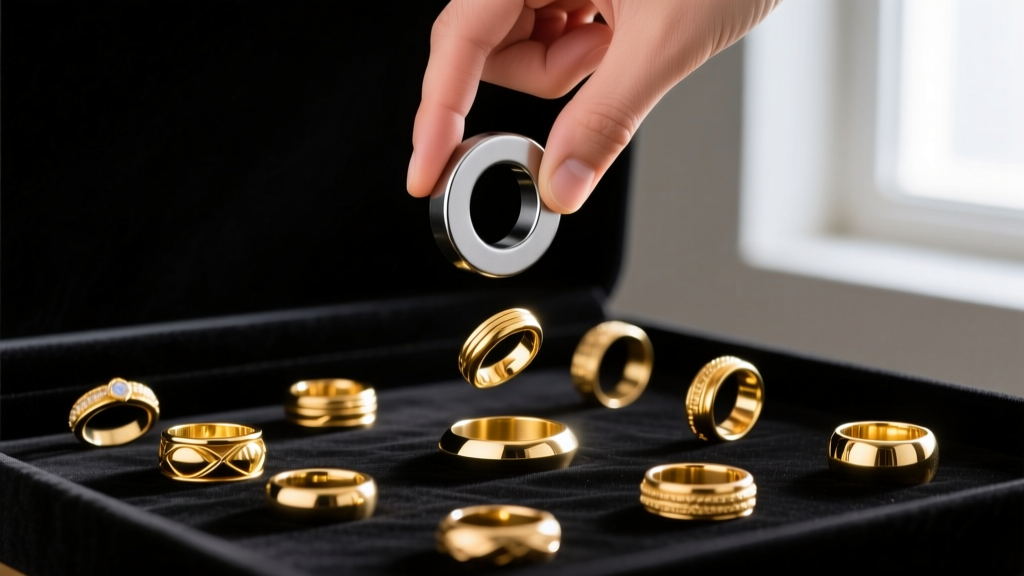
Gold is diamagnetic, meaning it is slightly repelled by a magnetic field rather than attracted to it. To perform this test, you need a high-grade N52 neodymium magnet. If the jewelry snaps to the magnet, it contains ferromagnetic metals like iron, steel, or nickel, proving it is not solid gold.
Expert Caveat: The magnet test is a test of exclusion, not confirmation. Brass, copper, aluminum, and even silver are non-magnetic. A counterfeit piece made of a brass core with gold plating will pass the magnet test flawlessly. Therefore, a lack of magnetic attraction only means the piece could be gold; it does not prove it is gold.
The Acoustic 'Ping' Test
Often paired with the magnet test is the acoustic resonance test. When struck lightly with a wooden or plastic tool, high-karat gold produces a dull, short-lived 'thud' due to its density and softness. In contrast, brass, steel, or tungsten alloys will emit a high-pitched, sustained ringing or 'ping'. While subjective, experienced jewelers use this acoustic feedback to quickly identify base metal cores in heavy chains and bangles.
Acid Testing: The Professional Standard
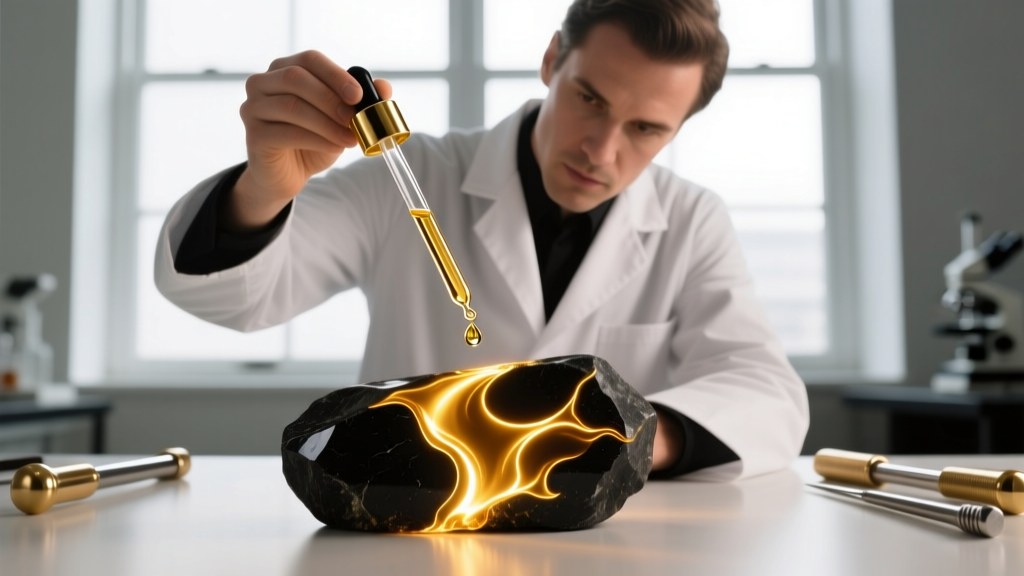
For definitive at-home verification, the nitric acid scratch test remains the industry standard. This method tests the chemical reactivity of the metal's core, bypassing surface plating. You will need a black testing stone, a set of gold testing acids (10K, 14K, 18K), and safety gear.
Step-by-Step Execution
- Prepare the Scratch: Rub the jewelry firmly against the black testing stone to leave a visible metallic streak. Ensure you scratch deeply enough to bypass any surface plating.
- Apply the Acid: Place a single drop of 14K acid across the streak.
- Observe the Reaction: Watch the streak for 10 to 15 seconds.
Interpreting the Chemical Reactions
- No Reaction (Streak Remains Bright): The metal is equal to or higher than the karat of the acid used. If 14K acid leaves the streak intact, the piece is at least 14K gold.
- Slow Dissolution (Streak Turns Brown/Milky): The metal is a lower karat than the acid. If 14K acid turns the streak brown, the piece is likely 10K gold.
- Immediate Dissolution (Green Reaction): The acid is reacting with copper or base metals, turning bright green and fizzing. The piece is gold-plated or entirely fake.
- White/Milky Reaction: This indicates the presence of silver in the alloy, common in white gold or certain vintage yellow gold pieces.
The Gemological Institute of America (GIA) notes that while acid testing is highly reliable, it is destructive on a microscopic level and requires careful handling of corrosive chemicals.
Specific Gravity Testing: The Archimedes Method
Specific gravity (SG) testing measures the density of the jewelry relative to water. This non-destructive test is highly effective for solid pieces without hollow cavities or gemstone inclusions.
The Formula:
SG = Weight in Air / (Weight in Air - Weight in Water)
To execute this, weigh the dry piece on a precision scale (0.01g accuracy). Then, suspend the piece in a beaker of distilled water using a fine nylon thread, ensuring it is fully submerged but not touching the bottom. Weigh it again. Divide the dry weight by the difference between the two weights.
Density Benchmarks for Gold Alloys
- 24K Gold: 19.32 g/cm³
- 18K Yellow Gold: ~15.2 to 15.9 g/cm³
- 14K Yellow Gold: ~12.9 to 14.6 g/cm³
- 10K Gold: ~11.0 to 11.6 g/cm³
The Tungsten Anomaly
Specific gravity testing has one major blind spot: Tungsten. Tungsten has a density of 19.25 g/cm³, nearly identical to 24K gold. Sophisticated counterfeiters create tungsten-core bars or thick chains plated in 24K gold. These will pass the SG test, the magnet test, and even basic electronic testers. To defeat tungsten fakes, professionals rely on ultrasonic thickness testing or XRF spectrometry to verify the core material.
Electronic Testers and XRF Spectrometry
Modern jewelry appraisal relies heavily on technology to avoid destructive testing. Electronic gold testers measure electrical conductivity. Since gold has a specific electrical resistance, these devices can differentiate between gold, brass, and platinum. However, they struggle with heavy gold-filled items and white gold (which is often rhodium-plated, altering surface conductivity).
For absolute certainty, X-Ray Fluorescence (XRF) spectrometry is the gold standard. An XRF machine bombards the piece with X-rays and measures the fluorescent X-rays emitted back, providing an exact elemental breakdown of the alloy (e.g., 75.1% Gold, 15% Copper, 9.9% Silver). While XRF is incredibly accurate, it only penetrates the surface layer (about 10 to 50 microns). It cannot detect a tungsten or lead core hidden beneath a thick layer of genuine gold plating.
Conclusion: Synthesizing the Evidence
Knowing how to know if jewelry is real gold requires a layered approach. Never rely on a single test. Start with a visual inspection of the hallmarks and a magnet check. Proceed to the acoustic ping test and specific gravity calculations for solid pieces. Finally, use the nitric acid scratch test to confirm the core metal's chemical authenticity. If you are dealing with high-value bullion, heavy chains, or suspect tungsten counterfeits, bypass at-home methods and take the piece to a certified gemologist or metallurgist equipped with XRF and ultrasonic testing technology. True expertise lies not just in performing the tests, but in understanding the metallurgical science behind the reactions.


