How To Shop Gold Fever Jewelry Store Baltimore MD In 2026
Learn how to evaluate karats, authenticate pieces, and negotiate custom gold jewelry at Gold Fever Jewelry Store in Baltimore, MD with our expert guide.

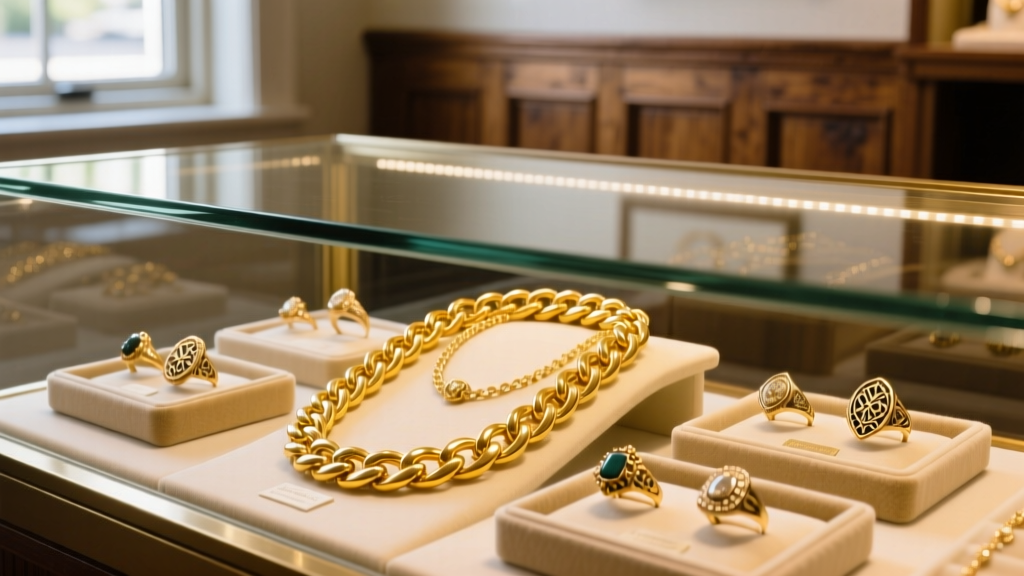
Introduction: Mastering the Brick-and-Mortar Gold Buy
When sourcing high-karat gold, heavy chains, or custom urban jewelry, visiting a dedicated local hub offers distinct advantages over online retailers. For Mid-Atlantic buyers, visiting the gold fever jewelry store baltimore md represents a prime case study in navigating a high-volume, specialized gold market. Local jewelers provide immediate access to physical weight verification, real-time alloy inspection, and on-the-spot custom commissions. This step-by-step guide will teach you how to evaluate authenticity, negotiate making charges, and inspect structural integrity like a seasoned gemologist, ensuring your 2026 gold investments are both authentic and structurally sound.
Step 1: Pre-Visit Preparation and Spot Price Analysis
Before stepping up to the counter, you must understand the baseline economics of solid gold. Gold jewelry pricing is universally calculated using a two-part formula: Melt Value + Making Charge (Labor). The melt value is dictated by the daily spot price of gold, adjusted for the purity of the alloy. The making charge covers the casting, polishing, and retail overhead.
To prepare, check the daily spot price per gram (not per troy ounce, as jewelry is weighed in grams). In 2026, with gold markets experiencing high volatility, knowing the exact spot price per gram allows you to reverse-engineer the retailer's markup. For example, if 14k gold (58.5% pure) is trading at $45 per gram in pure melt value, a 50-gram 14k Cuban link chain has a baseline melt value of $2,250. If the store quotes $3,000, you know the making charge and retail markup combined are $750 (or $15 per gram). According to the Federal Trade Commission (FTC) Jewelry Guides, retailers must accurately represent gold purity, but they are free to set their own labor premiums. Knowing your baseline gives you leverage to negotiate the labor fee, especially on heavier pieces where the markup scales unnecessarily.
Step 2: Authenticating Gold Purity In-Store
Once you have selected a piece, the next critical step is verifying its karatage. While hallmarks like '585' (14k) or '750' (18k) are legally required in many jurisdictions, stamps can be easily forged on counterfeit or heavily plated items. When shopping at a reputable local establishment, you should request non-destructive authenticity testing.
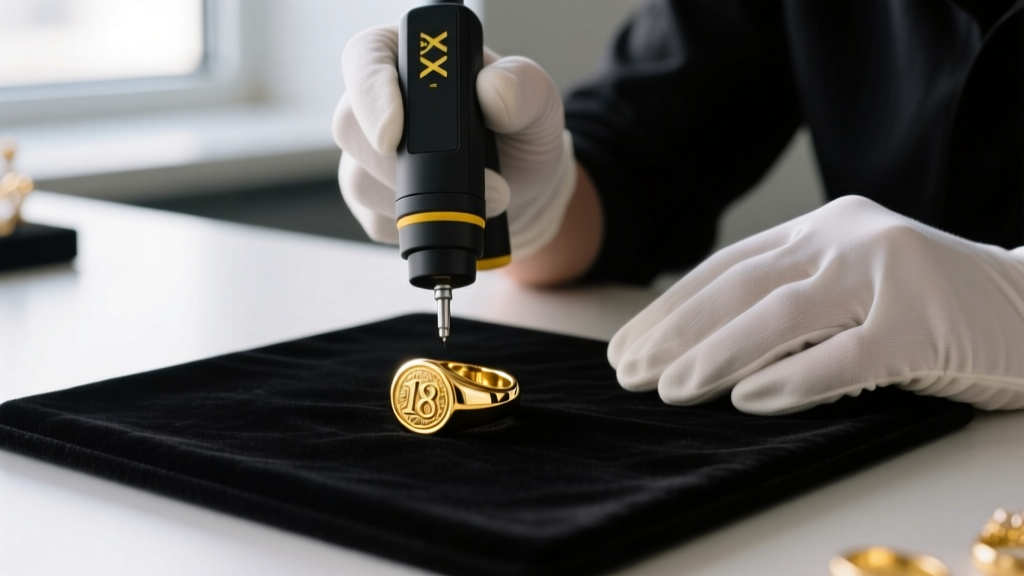
The industry standard for brick-and-mortar authentication is X-Ray Fluorescence (XRF) testing. An XRF gun fires X-rays into the metal, exciting the atoms and causing them to emit secondary fluorescent X-rays. The machine reads these emissions to provide an exact elemental breakdown of the alloy in seconds, revealing not just the gold content, but the exact percentages of copper, silver, zinc, or nickel used in the mix. This is vastly superior to the traditional nitric acid streak test, which only tests the surface layer and can damage the piece. If a store relies solely on acid testing for high-value items, proceed with caution. The Gemological Institute of America (GIA) emphasizes that modern alloy formulations can mimic higher karat colors, making elemental analysis the only foolproof verification method.
| Karat | Purity Stamp | Gold Content | Vickers Hardness (HV) | Best Application |
|---|---|---|---|---|
| 10k | 417 | 41.7% | ~130 HV | Everyday rings, highly durable chains |
| 14k | 585 | 58.5% | ~110 HV | Optimal balance of rich color and strength |
| 18k | 750 | 75.0% | ~85 HV | High-end pendants, luxury watches, rich hue |
| 22k | 916 | 91.6% | ~60 HV | Investment pieces, soft chains, traditional wear |
Step 3: Evaluating Chain Links and Clasp Integrity
Urban and streetwear gold markets heavily favor substantial chains like Cuban links, Figaros, and Franco chains. However, the structural failure points of these chains are rarely the links themselves; they are the solder points and the clasps. When inspecting a heavy gold chain (anything over 40 grams), you must evaluate the hardware.
First, inspect the clasp. A standard spring-ring clasp is entirely insufficient for chains weighing over 20 grams; the internal spring will inevitably fail, leading to a lost asset. You must look for a locking lobster clasp or a tongue-and-groove box clasp with a secondary figure-eight safety catch. Next, examine the jump ring connecting the clasp to the chain. It should be seamlessly soldered shut. If you can see a split or gap in the jump ring, it is a major structural vulnerability.

Additionally, beware of 'hollow' gold chains. Some manufacturers use electroforming to create massive, thick-looking chains that are actually hollow inside, drastically reducing the gold weight. To test for this, evaluate the weight-to-volume ratio. A solid 12mm 14k Cuban link chain should feel exceptionally dense and produce a dull, heavy 'clink' when dropped on a glass counter. Hollow chains will sound tinny and are prone to irreparable denting if compressed. Jewelers of America recommends always asking for the exact gram weight before assessing the visual thickness of a chain to avoid being misled by hollow-core manufacturing techniques.
Step 4: Navigating Custom Gold Commissions
One of the primary reasons buyers visit specialized local jewelers is for custom work, such as personalized pendants, signet rings, or dental grills. If you are commissioning a custom piece at a local Baltimore boutique, understanding the CAD (Computer-Aided Design) and lost-wax casting process is vital for quality control.
When reviewing the 3D CAD render of your design, pay close attention to the shrinkage rate. Gold alloys shrink by approximately 1.5% to 2% during the cooling phase of the casting process. An experienced jeweler will account for this in the digital model. Furthermore, inquire about their casting porosity protocols. Porosity occurs when gas bubbles become trapped in the molten gold, creating microscopic pits on the surface or internal weaknesses. High-end local casters use vacuum-assisted or centrifugal casting machines in oxygen-deprived environments to eliminate porosity. If your custom piece arrives with a 'bumpy' or pitted texture on the polished surfaces, it is a sign of poor casting technique and should be rejected or recast at the jeweler's expense.
Step 5: Negotiating the Making Charge and Finalizing
Once you have verified the purity, inspected the structural integrity, and confirmed the weight, the final step is negotiating the price. While the melt value of the gold is fixed to the commodities market, the 'making charge' (the labor cost to manufacture the chain or cast the pendant) is highly negotiable, particularly in high-volume local markets.
For standard, machine-made chains like rope or Franco links, the making charge should be relatively low, typically ranging from $15 to $30 per gram over the melt value, depending on the complexity of the link. For custom CAD-designed pendants or intricate hand-set diamond melee pieces, labor costs will naturally be higher, often exceeding $100 per gram. Approach the negotiation respectfully but firmly, using your pre-calculated melt value as an anchor. By combining rigorous physical inspection with a deep understanding of gold market economics, you can confidently navigate local jewelry hubs and secure high-quality, authentic gold pieces that will last a lifetime.


