Engineering Gold Chunky Jewelry: Karats, Weight, and Casting Tech
Discover the technical details behind gold chunky jewelry. Learn how karat alloys, casting methods, and gram weights affect durability and price.

The Physics of Proportion: Calculating Gram Weight and Density
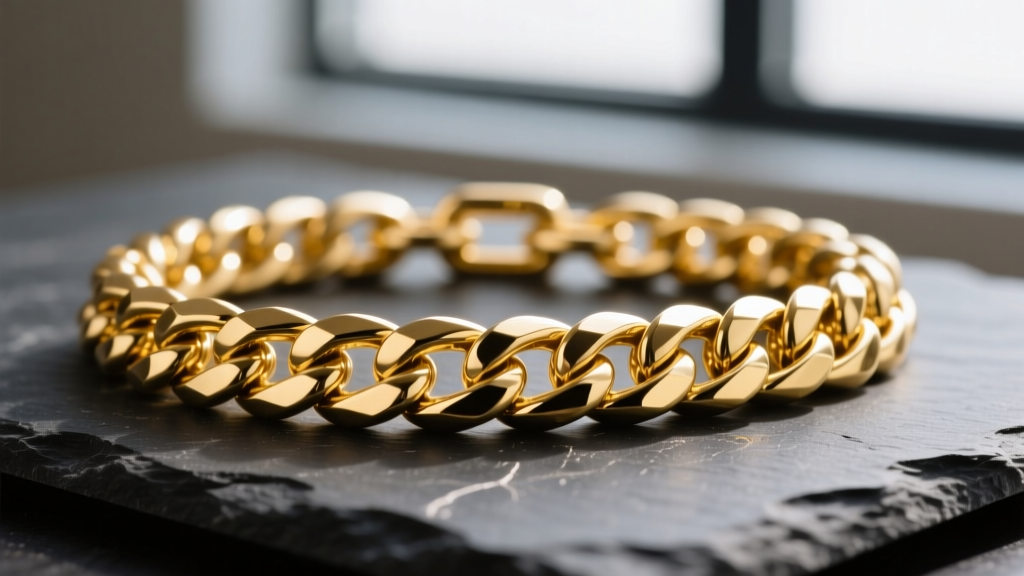
When evaluating gold chunky jewelry, collectors, bench jewelers, and metallurgists must look beyond mere aesthetics to understand the underlying physics of proportion. The term "chunky" in the jewelry trade generally refers to pieces that exceed standard volumetric thresholds: chains weighing over 35 grams, signet rings surpassing 15 grams, and bangles with a cross-sectional thickness greater than 5 millimeters. Because gold is exceptionally dense—with pure 24k gold boasting a specific gravity of 19.32 g/cm³—the mass of a piece scales exponentially as its dimensions increase.
To understand why a 12mm Cuban link chain weighs significantly more than double a 6mm chain of the same length, one must calculate volume. Volume dictates mass. A 12mm link has roughly four times the cross-sectional area of a 6mm link, meaning it requires four times the gold per linear inch. This exponential weight scaling is why gold chunky jewelry commands such high baseline premiums; you are paying for raw material density. According to the World Gold Council, the sheer mass of these pieces makes them highly sensitive to daily spot price fluctuations, often functioning as wearable bullion.
Alloy Metallurgy: Why 14k Outperforms 18k in Heavy Casts
A common misconception among luxury buyers is that higher karat gold is universally superior. However, in the realm of heavy, structural jewelry, 14k gold frequently outperforms 18k and 22k due to its metallurgical yield strength. Pure gold has a Vickers Hardness (HV) of roughly 25, making it entirely unsuitable for supporting the massive sheer stresses exerted by heavy pendants or the tension of thick spring-ring clasps.
By alloying gold with copper, silver, zinc, and occasionally nickel or palladium, manufacturers increase the Vickers Hardness significantly. Standard 18k yellow gold sits at approximately 125 HV, while 14k yellow gold achieves roughly 140 to 160 HV, depending on the exact alloy mix and whether it has been work-hardened. For gold chunky jewelry like heavy rope chains or thick tennis bracelets, this 15-20% increase in tensile strength is critical. It prevents the "stretching" phenomenon, where the cumulative weight of the piece gradually elongates the links over years of wear, eventually leading to structural failure.
Manufacturing Techniques: Lost-Wax Casting vs. CNC Milling
The production of substantial gold pieces requires specialized manufacturing techniques to ensure structural integrity. Bench jewelers and factories typically rely on two primary methods: lost-wax casting and CNC (Computer Numerical Control) milling.
Porosity Risks in Thick Cross-Sections
Lost-wax casting is the standard for complex, chunky signet rings and sculptural pendants. However, casting thick cross-sections of gold introduces a severe metallurgical risk: gas porosity. As molten gold (heated to roughly 1,064°C for 14k alloys) is forced into a flask, the exterior layers in contact with the investment plaster cool and solidify faster than the molten core. As the core eventually cools and shrinks, it can pull dissolved gases inward, creating microscopic voids or "piping" in the center of the shank.
Research presented at the Santa Fe Symposium on Jewelry Manufacturing Technology highlights that vacuum-assisted centrifugal casting and precise flask temperature control (typically between 550°C and 650°C) are mandatory to mitigate porosity in heavy rings. A porous chunky ring will eventually crack under the torque of daily wear, particularly at the bottom of the shank where bending stress is highest.
Structural Failure Points in Heavy Chains and Rings
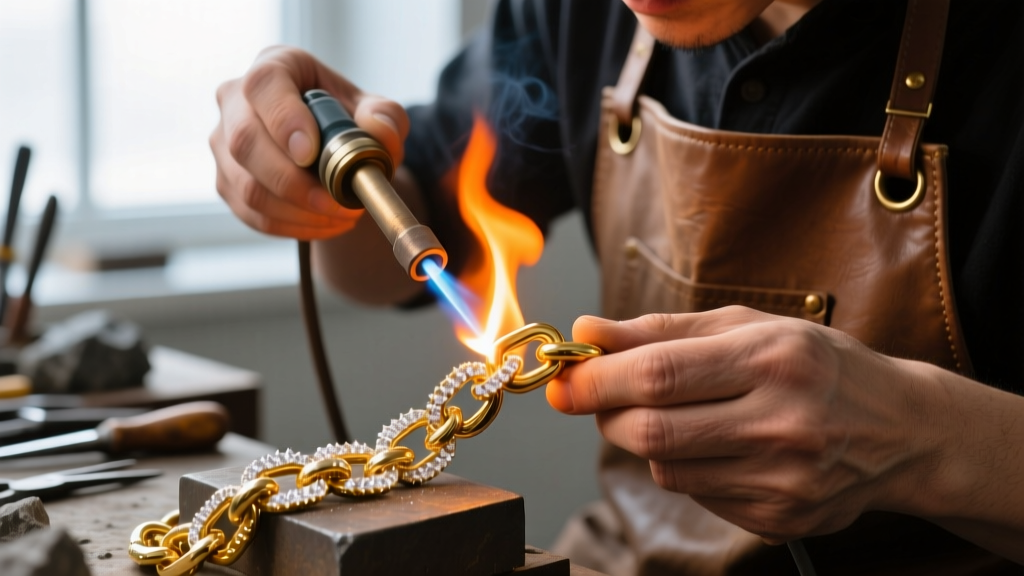
Engineering gold chunky jewelry requires anticipating failure points before they occur. The most common point of failure in heavy chains is the clasp assembly and the adjacent jump rings. A 100-gram solid gold curb chain exerts immense kinetic sheer force on its clasp when the wearer moves abruptly. Standard lobster clasps are entirely insufficient for chains over 50 grams; they will deform or the internal spring mechanism will fail.
Master jewelers mandate the use of heavy-duty box clasps with dual safety latches, or oversized barrel clasps, reinforced with laser welding. Laser welding is preferred over traditional torch soldering for heavy chains because it creates a localized, high-purity fusion zone without annealing (softening) the surrounding work-hardened links. Similarly, in chunky rings, the junction where the thick shank meets the gallery (the under-bezel) is a prime fracture zone. Proper engineering requires a continuous, thick gallery wall rather than hollowed-out galleries, which are often used to deceptively reduce gram weight.
Weight-to-Durability Matrix for Chains
| Chain Style | Width (mm) | Minimum Solid Weight (per 20") | Clasp Requirement | Primary Stress Vector |
|---|---|---|---|---|
| Cuban Link | 10mm | 45 - 55 grams | Box Clasp w/ Safeties | Lateral sheer at link joints |
| Figaro | 8mm | 30 - 40 grams | Heavy Lobster / Box | Tensile stretch on long links |
| Rope | 6mm | 35 - 45 grams | Barrel Clasp | Torsional twisting torque |
| Curb | 12mm | 60 - 80 grams | Custom Box Clasp | Vertical compression on links |
Pricing Frameworks: Spot Price vs. Craftsmanship Multipliers
Valuing gold chunky jewelry requires a bifurcated pricing framework: the intrinsic melt value and the craftsmanship multiplier (making charge). Because chunky pieces use a high volume of raw material, the making charge per gram is often lower than that of intricate, micro-pave, or lightweight filigree pieces. However, the absolute making charge remains substantial due to the finishing labor required.
Polishing a 60-gram solid gold chain to a mirror finish requires hours of manual labor on polishing wheels, followed by ultrasonic cleaning and steam drying. Furthermore, the diamond-cutting process used on Miami Cuban links—where a master cutter uses a lathe to shave precise geometric facets into the interlocking links—adds a significant premium. In the current 2026 market, buyers should expect to pay the daily spot price of gold multiplied by the karat purity (e.g., 0.585 for 14k), plus a making charge ranging from $15 to $45 per gram, depending on the complexity of the link geometry and the brand's retail markup.
Expert Verification: Spotting Hollow and Sand-Filled Fakes
The high intrinsic value of gold chunky jewelry makes it a primary target for sophisticated counterfeiting. Traditional acid testing is inadequate for thick pieces because it only verifies the surface layer. Unscrupulous manufacturers have been known to produce "sand-filled" or tungsten-core chains that mimic the specific gravity and heft of solid gold.
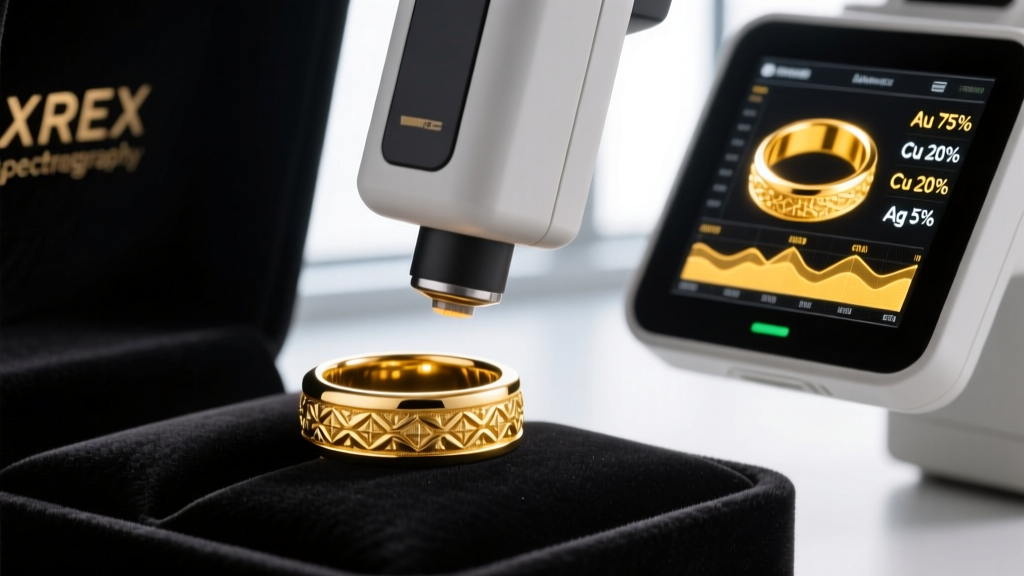
True authentication requires non-destructive, deep-penetration analysis. X-ray Fluorescence (XRF) spectrometry is the industry standard for surface and near-surface alloy verification, capable of detecting tungsten or lead cores if the outer gold layer is thin. However, for absolute certainty in massive pieces, bench jewelers employ the Archimedes specific gravity test using precision hydrostatic scales. By measuring the piece's weight in air versus its weight suspended in distilled water, jewelers can calculate the exact density. A 14k gold chain must yield a specific gravity between 12.9 and 13.6 g/cm³. Any deviation indicates internal voids, non-gold cores, or heavy metal adulteration, protecting the buyer from catastrophic financial loss.


