Understanding Symbols of Gold on Jewelry: Purity & Hallmarks
Learn to read symbols of gold on jewelry. We decode karat stamps, millesimal fineness, and maker's marks to verify purity and material properties.

The Anatomy of Gold Stamps: What Those Symbols Actually Mean
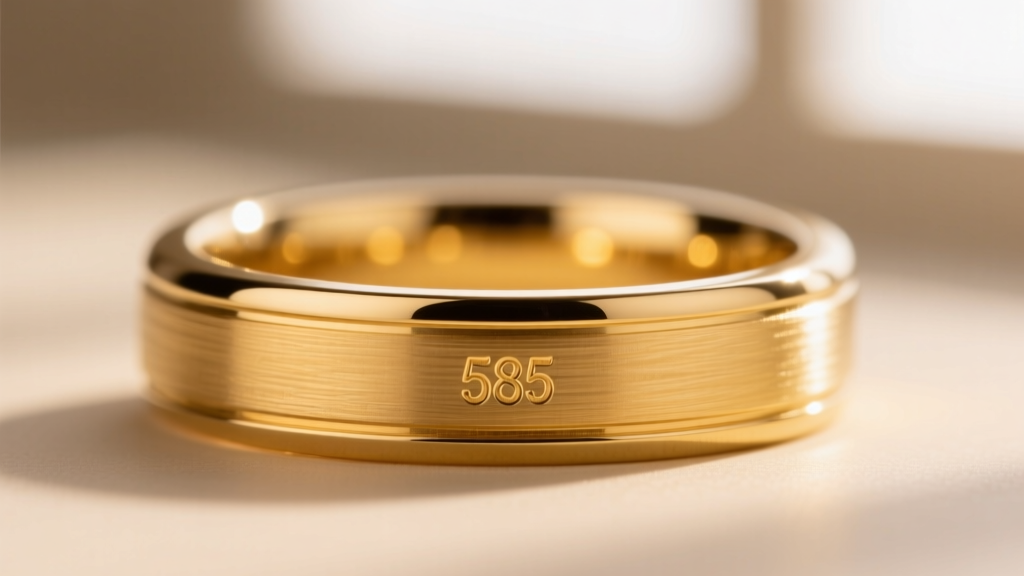
When evaluating fine jewelry, the untrained eye often focuses solely on design and gemstone quality. However, the true value, durability, and material integrity of a piece are dictated by the microscopic engravings hidden on its interior. Understanding the symbols of gold on jewelry is not just about verifying authenticity; it is about decoding the metallurgical blueprint of the item. These stamps reveal the exact ratio of pure gold to alloying metals, which in turn determines the piece's Vickers hardness, tensile strength, and resistance to oxidation.
In the United States, the Federal Trade Commission (FTC) Jewelry Guides mandate that any piece stamped with a karat mark must accurately reflect its gold content, allowing for a minute tolerance of 3/1000ths of a carat (excluding solder). However, in the UK and much of Europe, the hallmarking system is far more rigorous. According to The London Assay Office, a full traditional hallmark consists of three compulsory symbols: the sponsor's (maker's) mark, the millesimal fineness mark, and the assay office mark. Without these symbols, a piece cannot legally be described as gold in those jurisdictions.
Karat Marks vs. Millesimal Fineness: A Global Comparison
The most common symbols of gold on jewelry indicate purity, but the format changes depending on the region. North America primarily uses the karat system (e.g., 14k, 18k), which divides purity into 24 parts. Europe and Asia predominantly use millesimal fineness, which expresses purity in parts per thousand. A stamp reading '750' means the alloy is 75.0% pure gold, the exact equivalent of 18k.
Below is a comprehensive breakdown of standard purity marks and their corresponding material properties:
| Stamp Symbol | Karat Equivalent | Gold Content (%) | Vickers Hardness (HV) | Material Properties & Best Applications |
|---|---|---|---|---|
| 999 / 24k | 24k | 99.9% | 25 - 30 HV | Extremely malleable, highly tarnish-resistant, but too soft for prongs or daily wear. Best for investment bullion or ceremonial pieces. |
| 916 / 22k | 22k | 91.6% | 40 - 50 HV | Rich yellow hue, moderate scratch resistance. Widely used in traditional Indian and Middle Eastern jewelry, but requires bezel settings for stones. |
| 750 / 18k | 18k | 75.0% | 130 - 150 HV | The global standard for luxury fine jewelry. Excellent balance of rich color, hypoallergenic properties, and structural integrity for diamond prongs. |
| 585 / 14k | 14k | 58.3% | 150 - 170 HV | Highly durable and scratch-resistant. The premier choice for everyday wedding bands and active lifestyles due to its high alloy content. |
| 417 / 10k | 10k | 41.7% | 170 - 190 HV | The legal minimum to be called 'gold' in the US. Highly rigid but prone to tarnishing and a pale color due to the majority alloy composition. |
As the Gemological Institute of America (GIA) notes, the addition of metals like copper, silver, zinc, and palladium not only alters the color (creating rose or white gold) but fundamentally changes the crystal lattice structure of the alloy, directly impacting the hardness metrics listed above.
Decoding Layered and Plated Gold Symbols
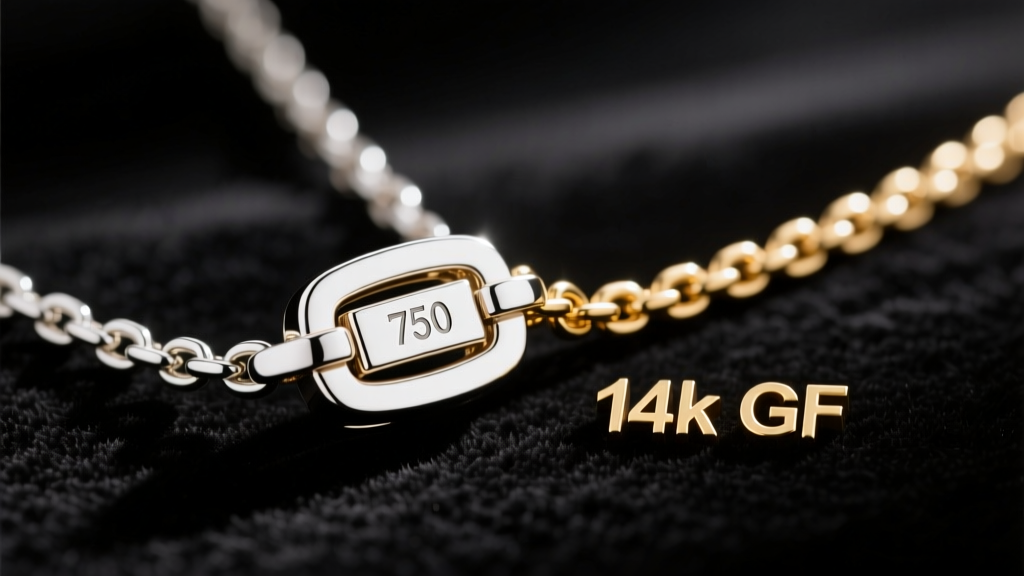
Not all symbols of gold on jewelry indicate a solid alloy. The secondary market and fashion jewelry sectors are saturated with layered materials. Misinterpreting these stamps is the most common mistake buyers make when assessing material value.
- GF (Gold Filled): A mechanical bonding process where a thick layer of solid gold is heat- and pressure-bonded to a brass or copper core. FTC regulations dictate that the gold layer must constitute at least 1/20th (5%) of the total weight of the item. A stamp reading '1/20 14k GF' guarantees this ratio.
- RGP (Rolled Gold Plate): Similar to gold-filled but with a significantly thinner gold layer, often less than 1/40th of the total weight. It will eventually wear through to the base metal with daily friction.
- HGE / HGP (Heavy Gold Electroplate): An electrical deposition process. While 'heavy' implies durability, HGE usually only guarantees a minimum of 2.5 microns of gold over a base metal. It lacks the mechanical bond of GF and is prone to flaking.
- Vermeil (No standard stamp, but requires specific composition): To be legally classified as vermeil, a piece must have a sterling silver (.925) base and be plated with at least 10k gold to a minimum thickness of 2.5 microns. If the base metal is brass, it is simply gold-plated, not vermeil.
Understanding these distinctions is critical for assessing longevity. A 14k GF chain will easily last decades with proper care, whereas an HGE chain will typically expose its base metal within one to two years of daily wear.
How Alloy Compositions Dictate Material Behavior
The symbols of gold on jewelry only tell half the story; they tell you the quantity of gold, but not the quality of the alloying metals. Two 14k (585) yellow gold rings can behave entirely differently based on their secondary metal recipes.
The Metallurgy of Color and Durability
Pure gold is inherently inert and will not oxidize. Therefore, any tarnish or corrosion you see on a gold piece is a direct result of the alloying metals reacting to sulfur, oxygen, or chlorine in the environment.
- Yellow Gold (18k): Typically alloyed with roughly 12.5% silver and 12.5% copper. The silver provides ductility, while the copper adds tensile strength. This specific ratio maintains the warm, buttery hue of pure gold while achieving the ~140 HV hardness required for secure stone setting.
- Rose Gold (14k): Achieves its pinkish-red hue through a massive copper content—often up to 36% copper, with trace amounts of silver. Copper is a highly durable metal, making 14k rose gold slightly harder and more scratch-resistant than 14k yellow gold. However, the high copper content makes it a poor choice for individuals with copper or nickel sensitivities.
- White Gold (18k): Pure gold cannot be made white without aggressive bleaching agents. 18k white gold is usually alloyed with palladium or nickel. Nickel-white gold is exceptionally hard and holds a bright polish, but it is a known contact allergen. Palladium-white gold is hypoallergenic and denser, but it has a slightly grayish undertone and requires rhodium plating to achieve a mirror finish.
Verifying Symbols: When Stamps Lie

While the FTC and international assay offices strictly regulate the application of gold stamps in primary manufacturing, the secondary and vintage markets are rife with counterfeit hallmarks. A stamped '750' on a clasp does not guarantee the entire chain is solid 18k gold. Bad actors frequently solder solid gold clasps onto gold-plated chains, or use counterfeit laser engravers to stamp 14k onto base-metal castings.
To truly verify the material properties dictated by the symbols of gold on jewelry, professional jewelers rely on non-destructive and destructive testing methodologies:
- X-Ray Fluorescence (XRF) Spectrometry: The industry standard for non-destructive testing. An XRF gun bombards the metal with X-rays and reads the fluorescent light emitted by the atoms, providing a precise elemental breakdown (e.g., 58.4% Au, 31.2% Ag, 10.4% Cu) in seconds. This instantly verifies if the millesimal stamp matches the actual atomic composition.
- Specific Gravity Testing: Utilizing Archimedes' principle, this method measures the density of the piece in water versus air. Since pure gold has a specific gravity of 19.32, and common alloys like copper (8.96) and silver (10.49) are much lighter, a 14k gold piece should yield a specific gravity reading of approximately 13.2 to 13.6. A reading of 8.5 immediately exposes a gold-plated tungsten or brass fake.
- Acid Scratch Testing: A destructive method where the item is rubbed on a touchstone, and varying strengths of nitric acid are applied to the streak. The chemical reaction (or lack thereof) confirms the karat threshold. This is highly effective for identifying gold-filled items where the surface layer tests as 14k, but filing through the surface reveals a base metal core that dissolves instantly in acid.
The Golden Rule of Verification: Never base a purchasing decision solely on the presence of a purity stamp. The symbols of gold on jewelry are your starting point for material analysis, not the final word. Always cross-reference stamps with physical weight, magnetic testing (real gold is entirely non-magnetic), and professional XRF verification for high-value acquisitions.
By mastering the language of hallmarks, millesimal fineness, and layered material stamps, you transition from a passive consumer to an informed metallurgical evaluator. Whether you are sourcing a 22k ceremonial bangle or a 14k white gold diamond setting, understanding these symbols ensures your investment aligns perfectly with your expectations for durability, hypoallergenic properties, and intrinsic value.


