Decoding the 925 Stamped on Jewelry: A 2026 Trend Guide
Discover what the 925 stamped on jewelry means in 2026. We analyze hallmark trends, counterfeit risks, and styling the raw stamp aesthetic.

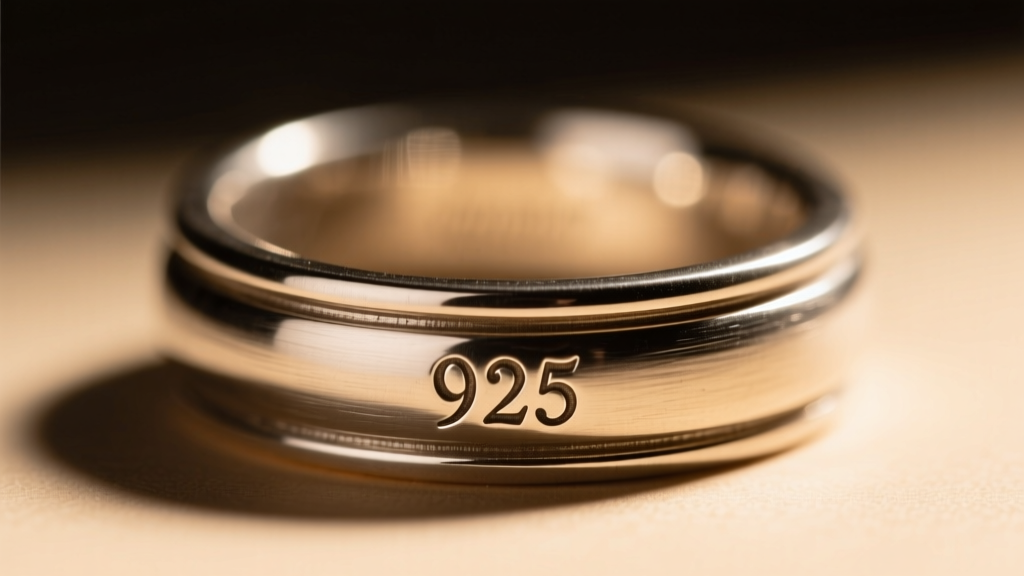
In the evolving landscape of fine and fashion accessories, the hallmark remains the ultimate arbiter of authenticity. For collectors, stylists, and everyday consumers, the 925 stamped on jewelry is universally recognized as the definitive marker of sterling silver. However, as we navigate the 2026 jewelry market, this tiny inscription has transcended its traditional role as a mere guarantee of metallurgical purity. Today, the 925 stamp is at the center of a fascinating intersection between material science, rampant counterfeit economics, and avant-garde design trends.
This comprehensive style and trend analysis explores the anatomy of the 925 hallmark, how contemporary designers are weaponizing it as an exterior aesthetic motif, and the rigorous verification frameworks required to navigate a marketplace flooded with sophisticated fakes.
The Anatomy of the Mark: Metallurgy and Manufacturing
To understand the cultural and stylistic weight of the 925 stamp, one must first understand the metallurgy it represents. Pure silver (999 fine) is too malleable for structural jewelry; it bends, scratches, and loses tension settings. The Gemological Institute of America (GIA) notes that sterling silver is an alloy composed of exactly 92.5% pure silver and 7.5% base metals—traditionally copper. This specific ratio provides the optimal balance of ductility, tensile strength, and brilliance.
The physical application of the 925 stamp varies drastically based on the manufacturing method and the structural integrity of the piece:
- Steel Punch Stamping: Traditional and common in cast or thick-gauge pieces (like 3mm+ signet rings). A hardened steel die physically displaces the metal. While deeply satisfying to the touch, aggressive punch stamping on thin bands (under 1.5mm) can create micro-fractures and structural weak points.
- Laser Engraving: The standard for 2026 lightweight and hollow-core jewelry. Lasers remove a microscopic layer of metal (usually 0.05mm to 0.1mm deep) to form the numbers. This preserves the structural integrity of delicate 18-gauge or 20-gauge chains and thin stacking rings.
- Cast-In Marks: Often found in mass-produced items, the stamp is part of the original CAD/CAM wax model. These tend to look softer, with slightly rounded edges, lacking the crisp, sharp shoulders of a post-cast punch or laser mark.
2026 Style Trend: 'Raw Hallmarks' as Exterior Motifs
Historically, the 925 stamp was hidden—tucked inside a ring shank, stamped on the back of a pendant, or placed near a lobster clasp. It was meant to be seen only by appraisers and jewelers. In 2026, however, the 'Neo-Brutalist' and 'Archival' jewelry movements have completely inverted this convention.
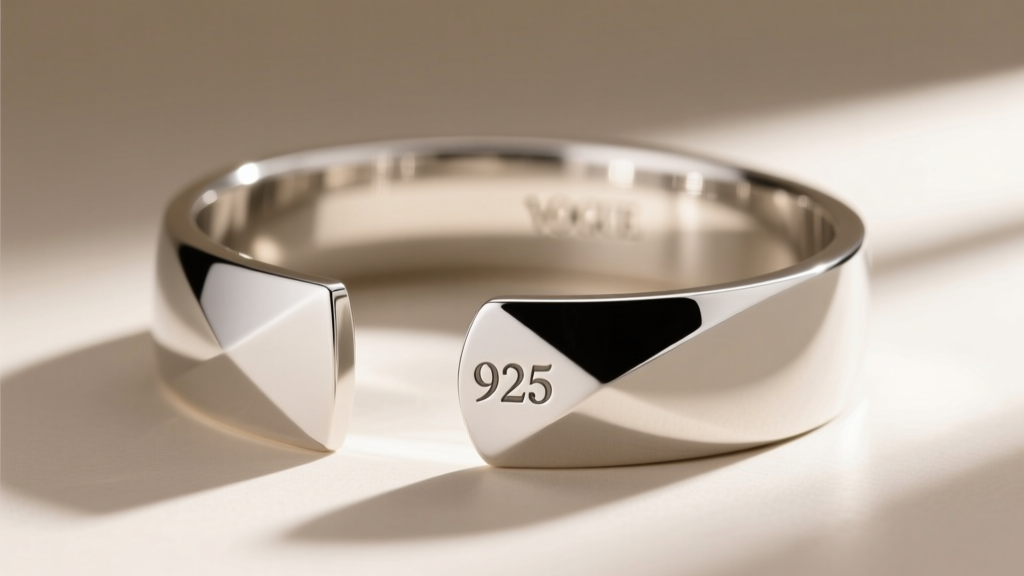
Contemporary indie designers and high-fashion houses are now treating the 925 stamped on jewelry as a deliberate exterior design element. Driven by a Gen-Z consumer base that values transparency, industrial aesthetics, and 'anti-luxury' signaling, the hallmark is being moved to the front and center.
Key Styling Trends in Hallmark Visibility
- Oversized Deep-Cast Stamps: Designers are scaling up the 925 mark, casting it in 12-point or 14-point font sizes across the flat face of heavy silver cuffs and wide-band rings.
- Oxidized Contrast: The stamp is deliberately oxidized (blackened with liver of sulfur) while the surrounding silver is polished to a mirror finish, turning the authenticity mark into a high-contrast typographic graphic.
- Assay Layering: Avant-garde pieces are featuring clusters of stamps—including the 925 mark, the maker's mark, and the assay office symbol—arranged in a grid pattern on the exterior of the jewelry, mimicking the serial plates found on aerospace components or luxury watch rehauts.
This trend transforms the stamp from a hidden legal requirement into a badge of industrial authenticity, aligning perfectly with the utilitarian fashion silhouettes dominating 2026 runways.
The Counterfeit Crisis: Faked Stamps in the Marketplace
As the price of spot silver continues to fluctuate and climb in the mid-2020s, the financial incentive for counterfeiters has reached unprecedented levels. The presence of a 925 stamp is no longer a guaranteed proxy for authenticity. Sophisticated black-market suppliers are now mass-stamping cupronickel, brass, and even 'Tibetan Silver' (a zinc-heavy alloy containing zero actual silver) with fraudulent 925 hallmarks.
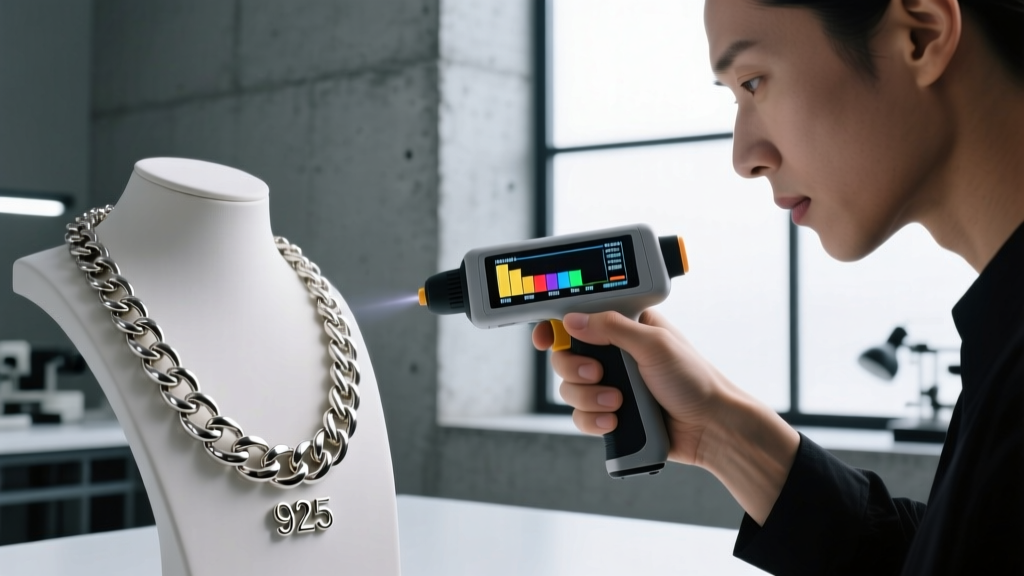
According to the Federal Trade Commission (FTC), it is illegal to misrepresent the metal content of jewelry, yet enforcement in cross-border e-commerce remains a massive challenge. Counterfeiters often use a technique called 'silver flashing'—electroplating a microscopically thin layer of pure silver (less than 1 micron) over a brass core. This defeats basic surface-level electronic testers and nitric acid swabs, as the acid only reacts to the pure silver surface layer.
| Feature | Authentic 925 Sterling | Counterfeit / Flash-Plated |
|---|---|---|
| Stamp Depth | Crisp, uniform depth; sharp inner corners on the '9' and '5' | Shallow, blurry edges; often slightly off-center or skewed |
| Wear Points | Tarnishes evenly; wear reveals identical silver color beneath | Friction points reveal yellow/brass or grey/nickel underlayers |
| Weight/Specific Gravity | SG of ~10.36; feels distinctly heavy for its volume | SG of ~8.4 (Brass); feels suspiciously light or 'hollow' |
| Magnetism | Strictly paramagnetic (zero attraction to rare-earth magnets) | May show slight pull if nickel or iron-core alloys are used |
Argentium vs. Standard 925: The Premium Shift
A major trend in the 2026 silver market is the migration toward Argentium Silver. While standard sterling uses copper as the 7.5% alloy, Argentium replaces a portion of that copper with the metalloid germanium. This results in an alloy that is highly resistant to firescale during manufacturing and drastically slows down environmental tarnishing.
From a hallmarking perspective, Argentium is still legally sterling silver and is frequently stamped with the traditional 925 mark. However, premium brands are increasingly adopting the proprietary 'A' or 'Argentium' stamp alongside the 925. For stylists and buyers, recognizing the subtle differences in the alloy's behavior—such as its ability to be fused without solder and its distinct, brighter white luster that closely mimics platinum—is crucial for accurate valuation and styling.
Actionable Verification Framework for Buyers
Given the proliferation of faked hallmarks, relying on the 925 stamped on jewelry is insufficient for high-value acquisitions. Professional buyers and serious collectors should employ a multi-tiered verification framework:
1. The Specific Gravity (Water Displacement) Test
This is the most reliable non-destructive test for solid pieces. By weighing the piece in air, then weighing it suspended in distilled water, you can calculate its specific gravity. Sterling silver will consistently yield a result between 10.3 and 10.4. If a heavy chain stamped '925' yields a 8.5, it is brass, regardless of the stamp.
2. The Deep-File Acid Test
To bypass the 'silver flashing' trap, use a jeweler's file to create a deep notch in an inconspicuous area, ensuring you penetrate past the top 20 microns of the metal. Apply a drop of 18k gold testing acid (which is stronger than standard silver acid) directly into the notch. A creamy white reaction confirms sterling; a bright green reaction instantly exposes a copper or brass core.
3. Acoustic Resonance (The Ping Test)
While subjective, the acoustic properties of silver are unique. When struck gently with a wooden mallet or another silver coin, genuine 925 sterling emits a high-pitched, sustained ringing tone that lasts for 1 to 2 seconds. Base metals like lead, zinc, or thick brass produce a dull, immediate 'thud' with no sustain.
The Future of Silver Authentication
As we look toward the late 2020s, the physical 925 stamp is beginning to share its duties with digital authentication. Forward-thinking brands are now embedding microscopic NFC (Near Field Communication) chips into the resin cores of heavy signet rings or the end-caps of luxury chain bracelets. Scanning the piece with a smartphone reveals an immutable blockchain ledger detailing the silver's mine of origin, the refinery, and the exact date of casting. Yet, despite these technological leaps, the visceral, physical impression of the 925 stamped on jewelry remains an irreplaceable symbol of heritage, craft, and enduring style.


