How Can I Tell If Jewelry Is Real Silver? A Value & Budget Guide
Learn how to tell if jewelry is real silver with expert testing methods. Protect your budget and assess true value before buying sterling pieces.

The True Cost of Fake Silver: Why Authentication Matters for Your Budget
Navigating the secondary jewelry market, estate sales, or even unverified online marketplaces requires a sharp eye and a firm grasp of metallurgy. When you are asking yourself, how can i tell if jewelry is real silver, you are not just looking for authenticity; you are protecting your budget. Counterfeit silver—often composed of nickel, brass, or copper with a microscopic silver flash—can cost you hundreds of dollars while holding zero intrinsic melt value. As a buyer in 2026, understanding the intersection of material science and precious metal economics is your best defense against overpaying for base metals disguised as sterling.
According to the Federal Trade Commission (FTC) Jewelry Guides, it is illegal to stamp an item as 'silver' or 'sterling' unless it contains at least 92.5% pure silver. Yet, enforcement in unregulated online marketplaces is notoriously lax. To assess true value, we must move beyond simple visual checks and employ a tiered testing methodology that ranges from at-home physics experiments to professional chemical analysis.
Visual & Hallmark Inspections: The First Line of Defense
The hallmark is the manufacturer's declaration of purity. However, because stamps can be easily forged, a hallmark should be treated as a starting point rather than definitive proof. Use a 10x or 30x jeweler's loupe to inspect the stamp. Authentic vintage pieces often show slight wear around the hallmark that matches the wear on the rest of the piece, whereas a freshly stamped fake will feature a crisp mark on otherwise heavily scratched metal.
Decoding Silver Stamps and Value Implications
| Hallmark | Classification | Silver Content | Budget & Value Assessment |
|---|---|---|---|
| 999 / Fine | Fine Silver | 99.9% | Highest melt value; too soft for most daily-wear jewelry. Excellent for investment pieces. |
| 925 / Sterling | Sterling Silver | 92.5% | The global standard for jewelry. Holds strong resale value and durability. The baseline for your budget. |
| 900 / Coin | Coin Silver | 90.0% | Common in vintage US pieces. Slightly lower melt value but high historical/numismatic premium. |
| 800 | Continental Silver | 80.0% | Frequent in European antiques. Lower intrinsic value but valued for craftsmanship. |
| EPNS / A1 | Electroplated | <1% | Base metal with a silver wash. Zero melt value. Only purchase for aesthetic or antique decor reasons. |
For a comprehensive breakdown of international assay marks, the London Assay Office provides an extensive database of historic and modern hallmarks that can help you trace a piece's origin and verify its stated purity.
At-Home Physical Tests: Exploiting Silver's Unique Properties
If a piece lacks a hallmark, or if you suspect a forgery, you can exploit silver's unique physical properties. Silver possesses specific thermal and magnetic characteristics that are incredibly difficult and expensive for counterfeiters to replicate.
The Ice Test (Thermal Conductivity)
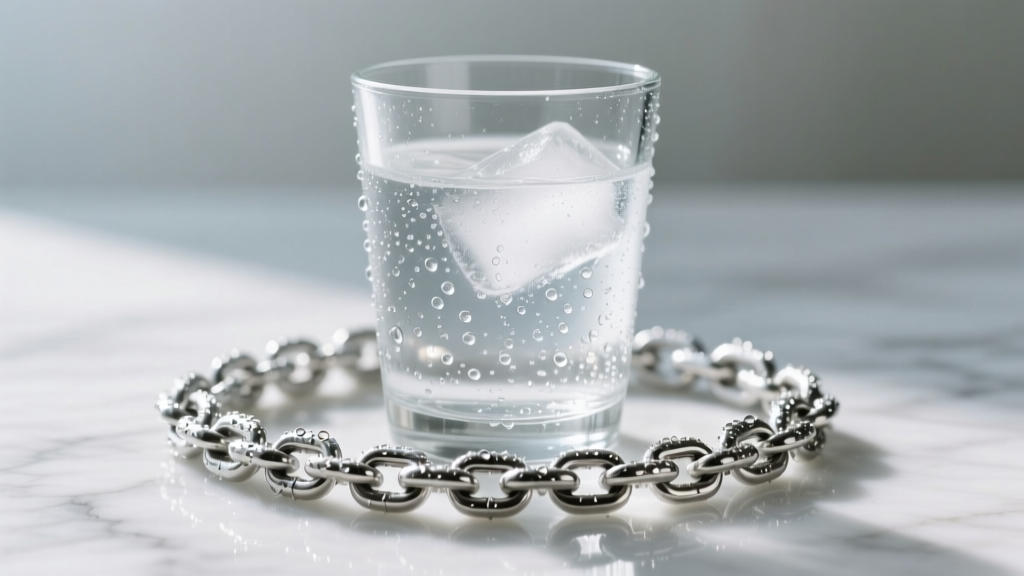
Silver has the highest thermal conductivity of any common metal, measuring an impressive 429 W/(m·K) at room temperature. To perform this test, place an ice cube on a flat surface and press the silver item directly against it. Real silver will transfer the ambient heat from the room into the ice so rapidly that the ice will begin to melt almost instantly, and the metal itself will become freezing cold to the touch within seconds. If the metal remains room temperature and the ice melts at a standard rate, you are holding stainless steel, aluminum, or a silver-plated alloy.
The Magnet Test (Paramagnetism)
Silver is paramagnetic, meaning it exhibits only a very weak, almost unnoticeable attraction to magnetic fields. Take a strong neodymium magnet (N52 grade is ideal) and hold it near the jewelry. If the jewelry snaps to the magnet or exhibits a strong pull, it contains a ferromagnetic core like iron or steel. Note: Some counterfeiters use copper or brass cores, which are also non-magnetic. Therefore, passing the magnet test does not guarantee the piece is silver, but failing it guarantees the piece is fake.
The Ping Test (Acoustic Resonance)
Gently strike the jewelry (like a heavy bangle or a coin) with another piece of metal or a wooden stick. Real silver produces a distinct, high-pitched, and long-lasting chime or 'ping' that resonates for a second or two. Base metals like lead, pewter, or brass produce a dull, short 'thud' due to their different crystalline structures and density.
Chemical & Advanced Testing for High-Value Purchases
When assessing high-value estate lots or heavy silver chains where the budget on the line is significant, at-home physics tests may not be enough. You must look at the chemical composition.
Acid Testing Kits: Reading the Color Reactions
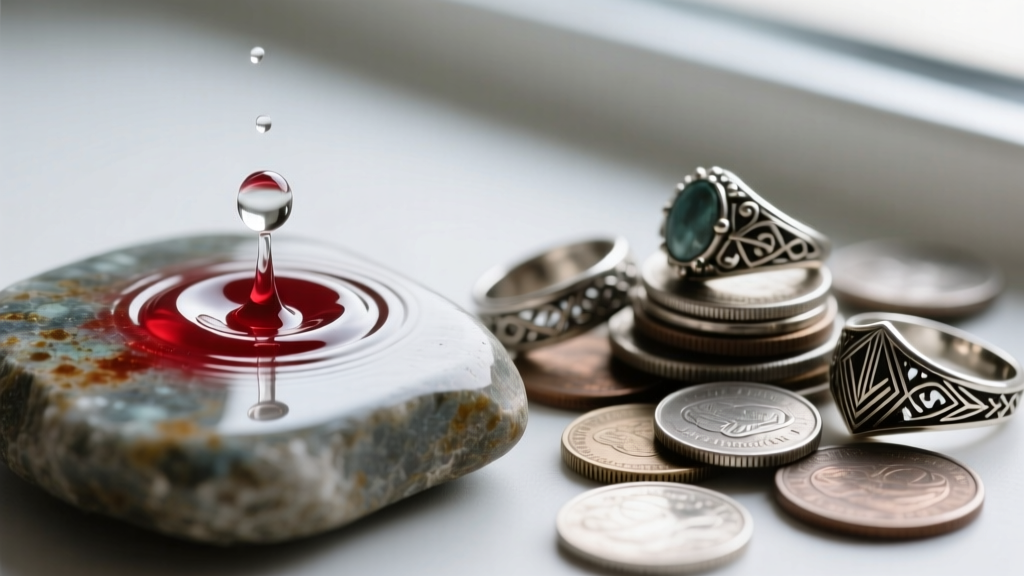
An inexpensive silver testing acid kit (usually containing nitric acid and dichromate) is a staple for pawnbrokers and estate buyers. You must file a tiny, inconspicuous notch into the metal to bypass any surface plating, then apply a drop of acid to a testing stone.
- Dark Red / Blood Red: Indicates .999 Fine Silver.
- Creamy / Cloudy White: Indicates .925 Sterling Silver.
- Green: Indicates a copper or brass base metal (fake).
- Blue: Indicates nickel or stainless steel.
Safety Warning: Nitric acid is highly corrosive. Always wear nitrile gloves and safety goggles, and perform this test in a well-ventilated area.
XRF Analyzers: The Professional Standard
For buyers who regularly source silver for investment or resale, handheld X-Ray Fluorescence (XRF) analyzers are the gold standard. These devices shoot X-rays into the metal and measure the fluorescent emission to determine the exact elemental breakdown down to the decimal. While an XRF gun costs several thousand dollars, many local jewelers or precious metal buyers will perform an XRF scan for a small fee or for free if you are a regular client.
Budget Assessment: The Melt Value Math
The most effective way to answer 'how can i tell if jewelry is real silver' when shopping online is to use simple mathematics based on the spot price of silver. Precious metals have a hard price floor dictated by global commodities markets.
The Golden Rule of Silver Budgeting: No legitimate seller will sell solid silver jewelry below its intrinsic melt value. If the math doesn't make sense, the metal isn't real.
Let us break down a real-world scenario. Suppose you are looking at a heavy, 60-gram Cuban link chain listed online for $35.
- One Troy Ounce equals 31.1 grams.
- A 60-gram chain contains approximately 1.93 Troy Ounces of metal.
- If the spot price of silver is $30.00 per ounce, the pure silver content is worth roughly $57.90.
- Because sterling is 92.5% pure, the melt value of a 60-gram sterling chain is roughly $53.50.
If a seller is offering that chain for $35, they are taking a massive financial loss. In the precious metals market, this does not happen. The item is mathematically guaranteed to be silver-plated brass or stainless steel, regardless of the '925' stamp in the listing photo. According to the Gemological Institute of America (GIA), understanding the weight-to-value ratio is critical for consumers navigating the modern influx of sophisticated counterfeit jewelry.
Final Verdict: Maximizing Your Silver Investment
Determining if jewelry is real silver requires a multi-layered approach. Start with the hallmark and the mathematical melt-value floor. If the price is too good to be true, walk away. If the piece passes the budget logic test, proceed to the ice and magnet tests to verify its thermal and magnetic properties. Finally, for high-ticket items, rely on acid testing or professional XRF verification. By combining material science with strict budget discipline, you can confidently build a genuine, high-value sterling silver collection without falling prey to deceptive market practices.


