How Do You Know If Jewelry Is Real Silver? Expert Testing Guide
Learn how do you know if jewelry is real silver with expert testing methods. Discover magnet, acid, and hallmark tests for 925 sterling.

The Metallurgy of Silver: Understanding the Alloys
Before attempting to authenticate a piece, it is crucial to understand what constitutes "real" silver in jewelry manufacturing. Pure silver, also known as fine silver (99.9% purity), possesses a Mohs hardness of just 2.5 to 3. This extreme malleability makes it entirely unsuitable for everyday jewelry, as it would warp, scratch, and lose structural integrity almost immediately. To solve this, metallurgists alloy pure silver with other metals—most commonly copper—to create durable variants.
The global standard for fine jewelry is 925 sterling silver, which consists of 92.5% pure silver and 7.5% copper or other strengthening alloys. Other legitimate variations include Britannia silver (95.8% purity, often used in British antique pieces) and Coin silver (90% purity, historically minted in the US). When consumers ask, "how do you know if jewelry is real silver," they are typically trying to differentiate genuine 925 sterling from base-metal imitations like nickel silver, alpaca, or heavily silver-plated brass.
Decoding Hallmarks: The First Line of Defense
The most immediate indicator of authenticity is the hallmark. According to the Federal Trade Commission (FTC) Jewelry Guides, any piece sold as "silver," "sterling," or "925" in the United States must contain at least 925 parts per thousand of pure silver. Look for stamps reading 925, STER, STG, or Sterling. In the UK and Europe, hallmarks are strictly regulated by assay offices; a genuine British piece will feature a "Lion Passant" (a walking lion) alongside a town mark and date letter.
However, hallmarks can be easily forged. Counterfeiters frequently stamp "925" onto brass or copper-alloy jewelry. Furthermore, be highly skeptical of terms like "Tibetan Silver," "Alpaca," or "German Silver." Despite the nomenclature, these contain absolutely zero elemental silver and are typically alloys of copper, nickel, and zinc. A hallmark is a starting point, not a guarantee, necessitating further physical testing.
Non-Destructive At-Home Testing Methods
The Magnet Test (Paramagnetism and Eddy Currents)
Silver is paramagnetic, meaning it exhibits a very weak repulsion to magnetic fields and will not stick to a standard magnet. If your jewelry strongly attracts a magnet, it contains a ferromagnetic core (like iron, nickel, or cobalt) and is not solid silver. However, the magnet test can be elevated using Lenz’s Law. If you slide a strong neodymium magnet down a solid silver coin or thick silver bar angled at 45 degrees, the magnet will slide down unusually slowly. This occurs because the moving magnetic field induces eddy currents in the highly conductive silver, creating an opposing magnetic field that acts as a brake. Base metals like stainless steel or brass will not produce this braking effect.
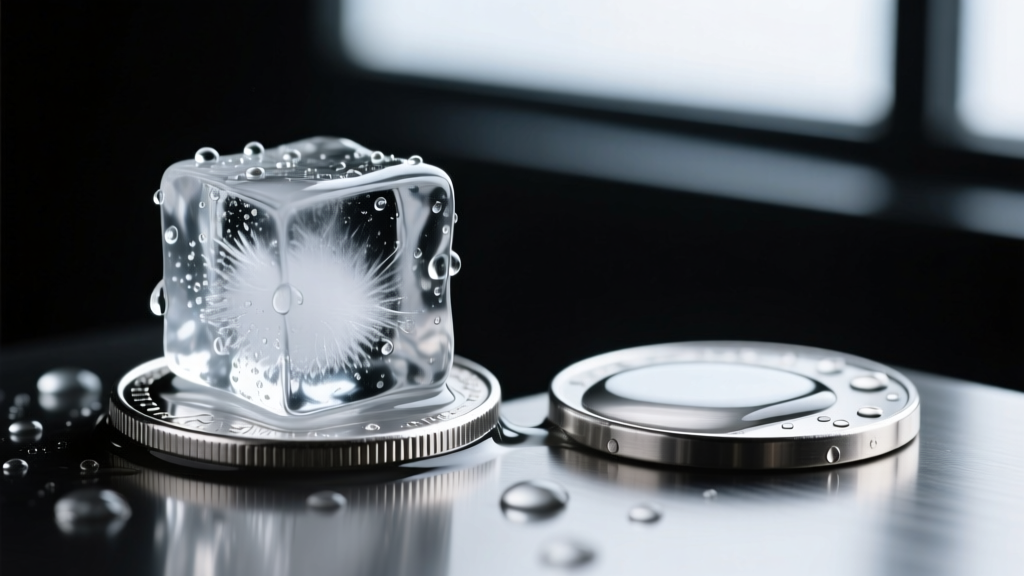
The Ice Test (Thermal Conductivity)
Silver possesses the highest thermal conductivity of any elemental metal, measuring approximately 429 W/(m·K) at room temperature. To perform this test, place an ice cube directly onto the jewelry and compare it to an ice cube on a known stainless steel or glass surface. Real silver will pull ambient heat from the air and the surface beneath it so rapidly that the ice will begin melting almost instantaneously, even if the silver piece was stored at room temperature. If the ice melts at a standard, gradual pace, the piece is likely a base metal or a very thin silver plating over an insulating core.
The Odor Test (Olfactory Detection)
Pure silver and sterling silver are virtually odorless. Conversely, the copper, brass, and zinc used in counterfeit alloys react with the natural oils and acids on your skin to produce a distinct, sharp metallic or sulfuric smell. Rub the jewelry vigorously between your palms for ten seconds to generate friction and heat, then smell it. If you detect a "penny-like" or metallic odor, the piece is predominantly copper or brass, even if it is heavily plated.
Advanced Diagnostics: Specific Gravity and Acid Testing
Specific Gravity (Water Displacement)
For a highly accurate, non-destructive test favored by gemologists and metallurgists, you can measure the piece's specific gravity (SG). Pure silver has an SG of 10.49 g/cm³, while 925 sterling silver typically measures between 10.30 and 10.40 g/cm³ due to the lighter copper alloy. You will need a precise digital scale and a cup of distilled water. First, weigh the dry piece in the air. Next, suspend the piece in water using a fine thread and weigh it again. Divide the dry weight by the difference between the dry weight and the wet weight. If the resulting number is near 10.36, you have genuine sterling silver. If it yields a number closer to 8.4 (brass) or 7.9 (steel), the piece is a fake.
Chemical Acid Testing
When absolute certainty is required, a silver testing acid kit provides definitive results. These kits utilize a solution of nitric acid and potassium dichromate. You must file a tiny, inconspicuous notch into the jewelry to bypass any surface plating, then apply a drop of the acid to the exposed metal or to a testing stone rubbed against the notch.
- Dark Red: Indicates 925 sterling silver.
- Brown/Brownish-Red: Indicates 800 silver (common in vintage European pieces).
- Green: Indicates a base metal like copper or brass.
As noted by the Silver Institute, chemical testing should only be performed on scrap or heavily tarnished areas, as the nitric acid will permanently etch and discolor the silver where applied.
Material Comparison Chart: Silver vs. Common Imitations
| Material | Thermal Conductivity | Magnetic Response | Specific Gravity (g/cm³) | Tarnish Profile |
|---|---|---|---|---|
| 925 Sterling Silver | Extremely High (Melts ice instantly) | Paramagnetic (Weakly repels / Eddy current brake) | ~10.36 | Turns black/yellow over time due to sulfur |
| Alpaca / Nickel Silver | Low to Moderate | Slightly magnetic (if high nickel content) | ~8.40 to 8.90 | Tarnishes dull grey, smells metallic |
| Stainless Steel | Low | Ferromagnetic (Strongly attracts magnet) | ~7.90 | Does not tarnish, remains dull grey |
| White Gold (14k) | Moderate | Paramagnetic (Non-magnetic) | ~13.00 to 14.00 | Does not tarnish, requires rhodium plating |
When to Consult a Professional Assayer
While at-home testing methods are highly effective for identifying blatant fakes, sophisticated counterfeits—such as thick silver-plated brass or cadmium-core chains—can sometimes pass superficial tests. If you are evaluating high-value antique silver, estate jewelry, or heavy bullion pieces, rely on the Gemological Institute of America (GIA) or a certified local metallurgist. Professionals utilize X-Ray Fluorescence (XRF) spectrometers, which bombard the metal with X-rays to read the exact elemental emission spectrum without damaging the piece. This provides a precise, down-to-the-decimal breakdown of the silver, copper, and trace element percentages, offering the ultimate peace of mind for serious collectors and investors.
Always remember that silver plating can be applied to any base metal. A piece that passes the magnet test and bears a 925 stamp can still be a counterfeit if the core is made of non-magnetic brass or lead. Combining multiple testing methods—specifically the ice test, odor test, and specific gravity calculation—is the most reliable way to verify authenticity without resorting to destructive acids.


