How to Verify the 925 Marking on Jewelry: A Step-by-Step Guide
Learn how to authenticate the 925 marking on jewelry with our step-by-step guide. Discover acid tests, magnet checks, and hallmark verification tips.

Understanding the 925 Marking on Jewelry
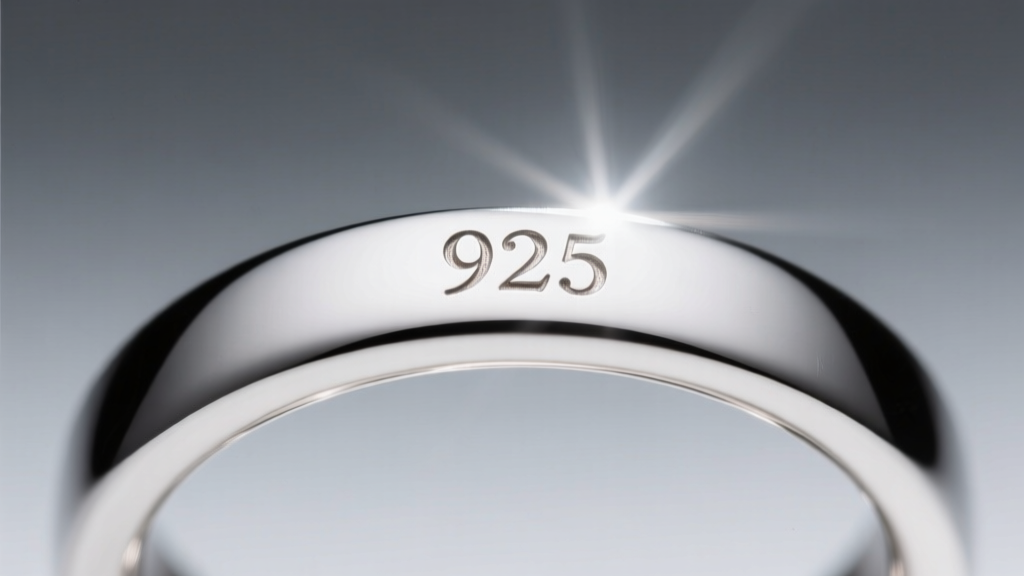
When shopping for fine jewelry, the 925 marking on jewelry is the universal indicator of sterling silver. But what does it actually mean, and more importantly, how can you trust it? The '925' stamp represents millesimal fineness, meaning the alloy consists of 92.5% pure silver and 7.5% other metals—typically copper, which adds the necessary tensile strength for wearable items. Pure silver (999) is too soft for rings or chains and would easily warp or scratch.
Unfortunately, the rise of global e-commerce has led to a surge in counterfeit hallmarks. Base metals plated with a microscopic layer of silver are frequently stamped with '925' to deceive buyers. According to the Federal Trade Commission (FTC) Jewelry Guides, it is illegal to misrepresent the metal content of jewelry, but enforcement across international borders remains challenging. This step-by-step guide will teach you how to scientifically and visually verify the authenticity of your silver pieces.
Step 1: Visual Inspection and Loupe Magnification
Before applying any chemicals or tests, start with a thorough visual inspection. You will need a jeweler's loupe with at least 30x magnification and a bright LED light source.
What to Look For:
- Font Consistency and Depth: Authentic factory stamps are usually applied with a hydraulic press or laser, resulting in crisp, evenly deep characters. Counterfeit stamps often look shallow, blurry, or slightly crooked.
- Wear Pattern Alignment: Examine the area around the stamp. If the jewelry shows heavy wear, scratches, or brass/copper showing through on the edges, but the '925' stamp looks brand new and pristine, the piece may have been re-stamped after plating.
- Contradictory Markings: Look for secondary stamps. If you see '925' alongside terms like 'Tibetan Silver', 'Alpaca', 'Nickel Free', or 'Silver Plated', you are holding a counterfeit. Authentic sterling silver is naturally nickel-free and would never be labeled as plated.
Expert Insight: Modern alternatives like Argentium Silver often carry a '935' or '960' stamp instead of 925, as they contain a higher silver content and germanium for tarnish resistance. Do not immediately dismiss these as fake; they are premium alloys recognized by The Silver Institute.
Step 2: The Magnet Test (Initial Screening)
The magnet test is a rapid, non-destructive screening method to catch the most blatant fakes. Silver is paramagnetic, meaning it exhibits only a microscopic, practically unnoticeable attraction to magnetic fields. It should never stick to a magnet.
How to Perform the Test:
- Acquire a strong neodymium magnet (grade N52 is ideal for jewelry testing).
- Hold the magnet near the main body of the chain, ring, or bangle.
- Observe the reaction. If the piece snaps to the magnet or exhibits a strong pull, it has a ferromagnetic core (like steel or iron) and is definitively not solid sterling silver.
Crucial Caveat: Do not test the clasps, hinges, or internal springs of lockets. These functional components require the structural memory of steel and will attract a magnet even on authentic 925 pieces. Always test the primary body of the jewelry.
Step 3: Chemical Acid Testing for Verification
If the piece passes the visual and magnet tests, the acid test is the industry standard for verifying the exact silver content. Silver testing acid is a diluted nitric acid solution that reacts differently depending on the copper content in the alloy.
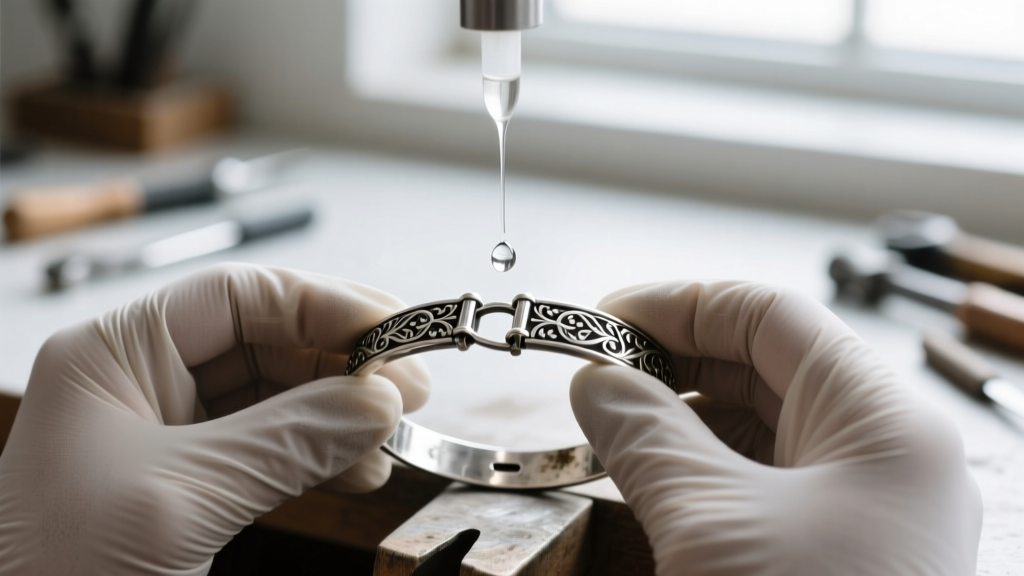
Step-by-Step Acid Testing:
- Safety First: Wear nitrile gloves and safety glasses. Work in a well-ventilated area.
- Create a Test Notch: Use a small jeweler's file to make a tiny, unobtrusive notch on the inside of the band or the back of a pendant. This is critical to bypass any silver plating and expose the core metal.
- Apply the Acid: Place one drop of silver testing acid directly into the filed notch.
- Read the Color Reaction: Watch the color change over 10 to 15 seconds.
| Acid Color Reaction | Indicated Metal Content | Silver Purity |
|---|---|---|
| Blood Red / Dark Red | Sterling Silver | 92.5% (Authentic 925) |
| Chocolate Brown | 800 Silver (Coin Silver) | 80.0% |
| Green | Low-Grade Silver / Plated | Below 80% |
| Blue | Brass / Copper / Nickel | 0% (Base Metal Core) |
If the acid turns a rich, dark blood red, the 925 marking on the jewelry is authentic. If it turns green or blue, the core metal is brass or copper, confirming the piece is merely silver-plated.
Step 4: Specific Gravity (Water Displacement) Test
For those who prefer a completely non-destructive, chemical-free method, the specific gravity (SG) test relies on Archimedes' principle. Pure silver has an SG of 10.49, while standard 925 sterling silver has an SG of approximately 10.36 due to the lighter copper alloy.
The Procedure:
- Place a digital scale on a flat surface and tare it to zero.
- Weigh the dry silver piece and record the mass (e.g., 20.0 grams).
- Place a beaker of distilled water on the scale and tare it to zero again.
- Suspend the jewelry in the water using a fine thread, ensuring it is fully submerged but not touching the bottom or sides of the beaker.
- Record the displaced water weight (e.g., 1.93 grams).
- Divide the dry weight by the displaced water weight (20.0 / 1.93 = 10.36).
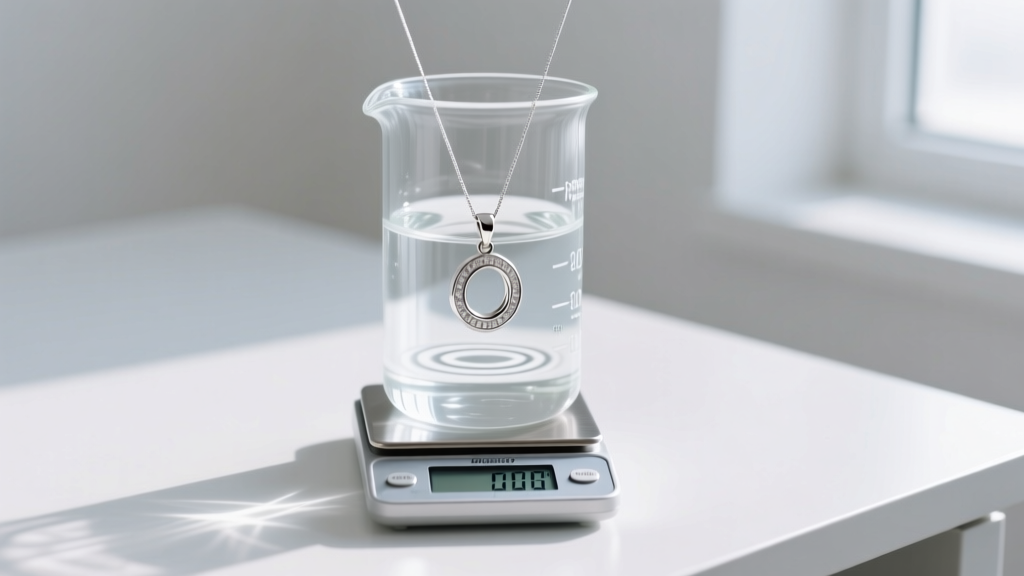
A result between 10.20 and 10.45 strongly indicates solid sterling silver. A result closer to 8.96 means the core is solid copper, while a result around 7.8 indicates a steel core. This method is highly accurate for solid items but will yield skewed results for hollow jewelry or pieces with large gemstones.
Common Fake 925 Markings and Red Flags
Scammers continually evolve their tactics. Be highly suspicious of the following scenarios when evaluating the 925 marking on jewelry:
- Gold-Colored 925: While silver vermeil (gold plated over sterling silver) exists, it is expensive. If a heavy, gold-colored chain is stamped 925 but priced under $30, it is likely brass with a gold wash and a fake stamp.
- The 'S925' Stamp: While 'S925' is legally used in some Asian markets to denote Sterling Silver, it is heavily co-opted by counterfeiters stamping cheap copper alloys. Always verify an 'S925' stamp with an acid test.
- Magnetic Clasps on 'Silver' Chains: If a chain is sold as solid 925 but features a magnetic clasp, the entire chain is likely stainless steel. Genuine silver chains use lobster clasps or spring rings with internal steel springs, but the clasp body itself should be silver.
Summary Checklist for Authentication
Verifying the 925 marking on jewelry requires a systematic approach. Never rely on the stamp alone. Follow this hierarchy of testing:
- Inspect: Use a 30x loupe to check stamp depth and wear patterns.
- Screen: Use an N52 neodymium magnet to rule out steel and iron cores.
- Verify: Use silver testing acid on a filed notch to confirm the 92.5% silver content.
- Measure: Use the specific gravity test for non-destructive confirmation on solid pieces.
By mastering these steps, you protect your investments and ensure that your sterling silver collection is built on genuine quality, not deceptive marketing.


