What Is 925 on Jewelry Mean? A Step-by-Step Verification Guide
Learn exactly what is 925 on jewelry mean and follow our step-by-step guide to test, verify, and authenticate your sterling silver pieces at home.

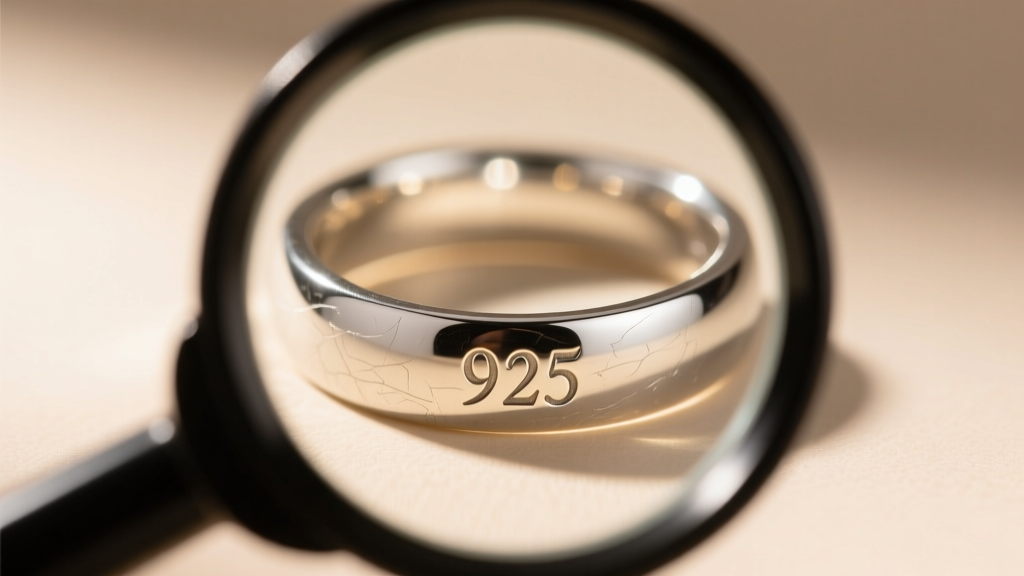
When shopping for precious metals, you will inevitably encounter the "925" stamp. But what is 925 on jewelry mean in practical terms, and how can you verify that the stamp is genuine rather than a deceptive factory marking? As counterfeit manufacturing techniques become increasingly sophisticated, relying solely on a visual stamp is no longer sufficient. This comprehensive, step-by-step guide breaks down the metallurgical science of sterling silver and provides actionable testing protocols to authenticate your jewelry.
The Metallurgy Behind the Stamp: Why Exactly 92.5%?
To understand what is 925 on jewelry mean, we must first look at the elemental composition of silver. Pure silver, often referred to as fine silver or 999 silver, is exceptionally soft. On the Mohs hardness scale, fine silver ranks between 2.5 and 3, making it entirely unsuitable for everyday jewelry; it would scratch, dent, and deform under minimal pressure.
To solve this structural vulnerability, metallurgists alloy pure silver with other metals. The global standard for "sterling silver" dictates a minimum of 92.5% pure silver and 7.5% secondary metals—most commonly copper. This specific ratio dramatically increases the tensile strength and durability of the metal while retaining the brilliant luster and hypoallergenic properties of pure silver. According to the Gemological Institute of America (GIA), this 92.5% threshold is the universally recognized benchmark for sterling quality. Modern variations, such as Argentium silver, replace some of the copper with germanium to drastically reduce tarnishing and fire scale, but the 92.5% pure silver requirement remains absolute.
Step 1: Visual Inspection and Hallmark Decoding
The first step in verification is a meticulous visual inspection. Counterfeiters often use shallow, poorly defined stamps. You will need a 10x triplet jeweler's loupe to examine the hallmark properly.
What to Look For Under Magnification
- The Purity Mark: Look for "925", "STERLING", "STER", or "STG". In the UK, look for the Lion Passant. These marks should be deeply and cleanly struck, with sharp, uniform edges.
- The Maker's Mark: Authentic pieces from reputable silversmiths will include a secondary trademark or maker's mark alongside the purity stamp. The Federal Trade Commission (FTC) mandates that any item stamped with a quality mark must also bear a registered trademark of the manufacturer.
- Plating Indicators: Inspect high-friction areas like clasp hinges, ring shanks, and chain links. If you see a yellowish or reddish hue bleeding through the silver surface, the piece is likely brass or copper that has been heavily silver-plated and deceptively stamped.
Step 2: Non-Destructive At-Home Testing Methods
If visual inspection raises red flags, proceed to non-destructive physical tests. These methods exploit the unique physical properties of silver without damaging the piece.
The Neodymium Magnet Test
Silver is paramagnetic, meaning it exhibits only a very weak, practically unnoticeable attraction to magnetic fields. To perform this test, use a strong N52-grade neodymium magnet. Hold the magnet near the jewelry. If the piece snaps to the magnet or exhibits a strong pull, it contains ferromagnetic metals like iron, steel, or nickel. Note: Some authentic silver clasps contain internal steel springs; a magnetic pull at the clasp is normal, but the chain or band itself must not react.
The Ice Cube Thermal Conductivity Test
Silver possesses the highest thermal conductivity of any metal on the periodic table, measuring approximately 429 W/(m·K). Place an ice cube directly on the silver item at room temperature. Genuine 925 sterling silver will transfer the ambient heat so rapidly that the ice cube will begin to melt almost instantaneously, and the metal itself will feel ice-cold to the touch within seconds. Base metals like stainless steel or brass will melt the ice at a noticeably slower rate.
Step 3: Semi-Destructive Chemical Acid Testing
For absolute certainty, chemical testing is the industry standard for pawnshops and jewelers. This requires a silver testing acid solution (typically a mixture of nitric acid and potassium dichromate) and an unglazed ceramic streak plate.
Warning: Always wear nitrile gloves and safety goggles. Nitric acid is highly corrosive. Perform this test in a well-ventilated area.
- Rub the jewelry firmly against the unglazed ceramic plate to leave a small metallic streak. This bypasses any surface plating.
- Apply a single drop of the silver testing acid directly onto the streak.
- Observe the immediate color reaction and compare it to the chart below.
| Acid Reaction Color | Indicated Metal Composition | Verification Status |
|---|---|---|
| Bright Blood Red | Fine Silver (99.9% Pure) | Authentic (High Purity) |
| Dark Brown / Chocolate | Sterling Silver (92.5%) | Authentic (Standard) |
| Dark Green | Base Metal (Copper/Brass) | Counterfeit / Plated |
| Blue | Nickel Silver (Cupro-Nickel) | Counterfeit (0% Silver) |
| Yellow / No Change | Gold or Platinum Group | Not Silver |
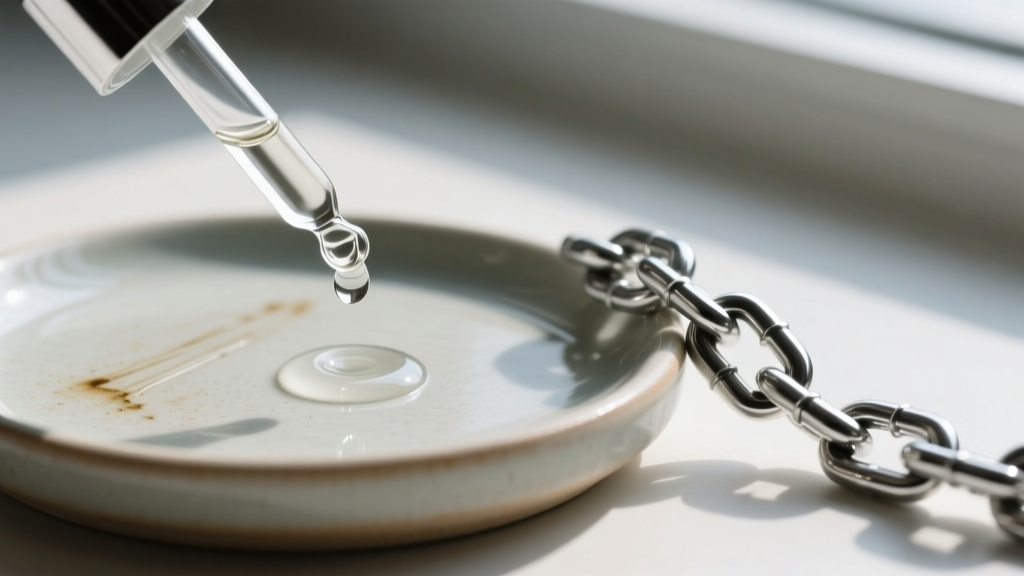
If the acid turns dark brown, your piece is verified as genuine 925 sterling silver. If it turns green, the streak is composed of copper or brass, proving the item is merely silver-plated or entirely fake, regardless of the "925" stamp.
Step 4: Professional Verification (XRF and Specific Gravity)
For high-value antique silver or investment-grade bullion jewelry where even a micro-streak test is unacceptable, professional laboratories utilize two advanced methodologies:
X-Ray Fluorescence (XRF) Spectrometry
XRF machines fire X-rays into the metal and measure the fluorescent radiation emitted. This provides an exact, non-destructive elemental breakdown down to the decimal point (e.g., 92.6% Ag, 7.1% Cu, 0.3% Zn). This is the gold standard for verifying modern alloys like Argentium or Palladium-bearing white gold/silver hybrids.
Specific Gravity (Archimedes) Testing
By weighing the jewelry in the air and then suspended in distilled water, gemologists calculate the specific gravity (SG) of the piece. Fine silver has an SG of 10.49 g/cm³. Because copper is much lighter (8.96 g/cm³), a true 925 sterling silver alloy will consistently yield an SG of approximately 10.36 g/cm³. Any significant deviation indicates the wrong core metals are being used.
Common Counterfeiting Tactics Exposed
Understanding what is 925 on jewelry mean also requires knowing the terminology scammers use to deceive buyers. Beware of the following misleading descriptors:
- Tibetan Silver: Despite the name, this contains absolutely zero silver. It is typically a cheap alloy of copper, zinc, nickel, and sometimes lead. It is highly toxic and should be avoided.
- Nickel Silver (German Silver): An alloy of copper, nickel, and zinc. It has a silvery appearance but contains no elemental silver and frequently causes severe contact dermatitis.
- 925 Plated: A deliberately confusing stamp. It implies the item is solid sterling, but usually means a microscopic layer of silver over a brass core. Under FTC guidelines, items must be explicitly marked as "Silver Plated" or "Silver Electroplate" if they are not solid.
Final Authenticity Checklist
Before finalizing a purchase, run the item through this quick diagnostic framework:
- Does the piece pass the N52 neodymium magnet test with zero magnetic pull on the main body?
- Is the "925" stamp crisp, deeply struck, and accompanied by a maker's mark when viewed under a 10x loupe?
- Does the ice cube melt rapidly upon contact with the metal surface?
- If testing with acid on a streak plate, does the reaction yield a dark chocolate brown?
By combining visual hallmark analysis with physical and chemical testing, you can definitively answer what is 925 on jewelry mean for any piece in your collection, ensuring you only invest in genuine, high-quality sterling silver.


