What Is Sterling Silver Jewelry? A Metallurgical Deep Dive
Discover what is sterling silver jewelry through a metallurgical lens. Explore alloy compositions, tarnish chemistry, and structural hardness data.

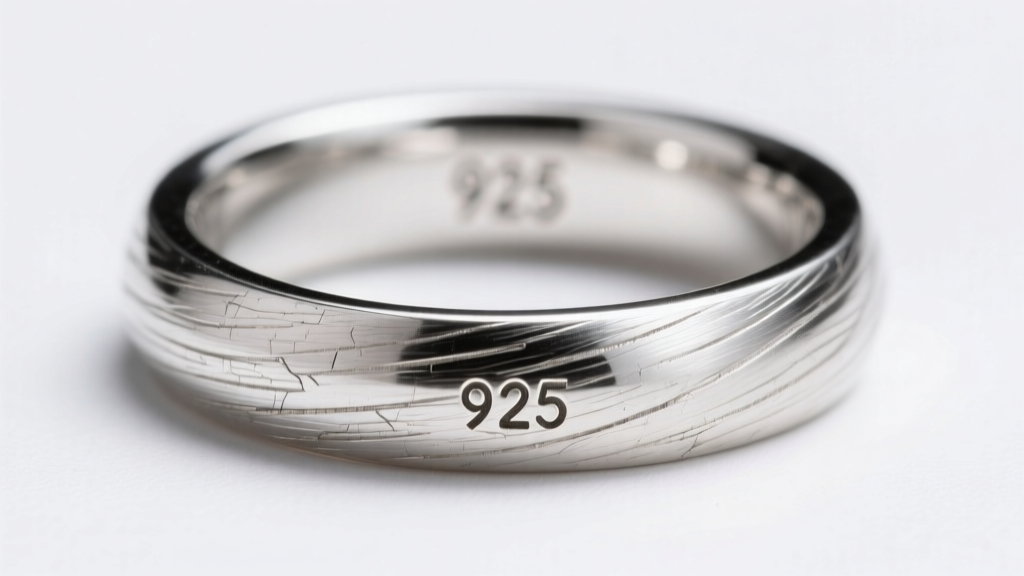
When consumers and collectors ask what is sterling silver jewelry, the standard retail answer is simply that it contains 92.5% pure silver and 7.5% alloy metals. However, from a materials science and gemological perspective, this definition barely scratches the surface. Sterling silver is a complex solid-solution alloy engineered to overcome the severe mechanical limitations of pure silver while maintaining its unmatched optical brilliance. In this expert deep dive, we bypass the basic marketing fluff to examine the metallurgical realities, chemical vulnerabilities, and structural data that define authentic 925 sterling silver.
The Metallurgy of 925: Why Pure Silver Fails in Jewelry
To understand the necessity of sterling silver, we must first look at fine silver (99.9% purity). According to The Silver Institute, pure silver is highly ductile and possesses exceptional thermal and electrical conductivity. However, its Vickers Hardness (HV) sits at a mere 25 HV. In practical jewelry terms, a ring crafted from fine silver will deform under the pressure of a firm handshake, and prongs holding gemstones will quickly wear away or bend, leading to stone loss.
By introducing 7.5% copper (or alternative metals) into the silver matrix, metallurgists create a substitutional solid solution. The copper atoms, being slightly smaller than silver atoms, distort the crystal lattice structure of the silver. This lattice distortion impedes the movement of dislocations within the metal, effectively increasing the Vickers Hardness to approximately 65-75 HV. This nearly threefold increase in tensile strength is what makes sterling silver viable for daily wear, secure stone setting, and intricate wirework.
Thermal Properties and Melting Ranges
Unlike pure elements that melt at a single specific temperature, alloys melt across a range. Fine silver melts precisely at 961.8°C (1763°F). Traditional 925 sterling silver, however, features a solidus temperature of roughly 893°C and a liquidus temperature of 954°C. This melting range is critical for jewelers during soldering; if a torch is applied unevenly, the copper-rich eutectic phases can melt prematurely, causing the piece to collapse while the bulk of the silver remains solid.
Beyond Copper: The Evolution of Sterling Alloys
While copper is the traditional alloying agent, it introduces a significant vulnerability: firescale and accelerated tarnishing. When traditional sterling is heated in the presence of oxygen, the copper migrates to the surface and oxidizes, forming a deep purple-black layer of cupric oxide (CuO) known as firescale. Furthermore, copper is highly reactive to atmospheric sulfur.
To combat this, modern metallurgy has introduced advanced alloys like Argentium Silver. By replacing a portion of the copper with germanium, the alloy's surface chemistry changes dramatically. When exposed to oxygen, the germanium forms a transparent, self-healing layer of germanium dioxide (GeO2) that acts as a barrier against sulfur compounds.
| Alloy Type | Composition | Hardness (HV) | Tarnish Resistance | Firescale Risk |
|---|---|---|---|---|
| Fine Silver | 99.9% Ag | 25 | High | None |
| Traditional Sterling | 92.5% Ag, 7.5% Cu | 65-75 | Low | High |
| Argentium 935 | 93.5% Ag, Cu, Ge | 70-80 | Very High | Minimal |
| Argentium 960 | 96.0% Ag, Cu, Ge | 85-95 | Exceptional | None |
The Chemistry of Tarnish: Silver Sulfide Formation
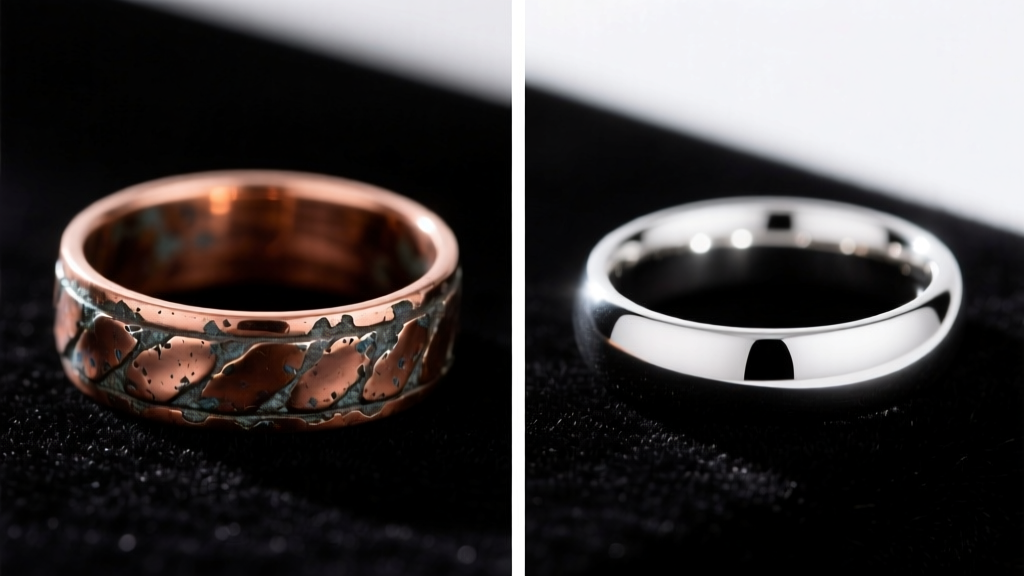
A common misconception is that sterling silver 'rusts' or oxidizes in the same way iron does. True tarnish on sterling silver is primarily silver sulfide (Ag2S), not silver oxide. The chemical reaction occurs when silver reacts with hydrogen sulfide (H2S) present in the atmosphere:
2Ag (s) + H2S (g) + 1/2 O2 (g) → Ag2S (s) + H2O (l)
The oxygen acts as a catalyst in the presence of moisture, accelerating the conversion of atmospheric hydrogen sulfide into a black silver sulfide layer on the jewelry's surface.
Environmental Accelerators
The rate of Ag2S formation is heavily dependent on environmental factors. High humidity acts as an electrolyte, speeding up the electrochemical reaction. Furthermore, everyday items contain hidden sulfur compounds that rapidly degrade sterling silver:
- Vulcanized Rubber: Elastic bands and rubber display mats emit sulfur gases that will blacken silver in hours.
- Protein-Rich Foods: Handling eggs, onions, or mayonnaise introduces sulfur compounds directly to the skin, which then transfer to rings and bracelets.
- Kraft Paper and Cardboard: The sulfite process used in paper manufacturing leaves residual sulfur, making standard cardboard boxes terrible for long-term silver storage.
Hallmarking, Assaying, and Authenticity Testing
Verifying the authenticity of 925 silver goes far beyond looking for a stamped '925' mark, which can be easily forged. Professional jewelers and assay offices rely on precise scientific testing to verify the elemental makeup of a piece.
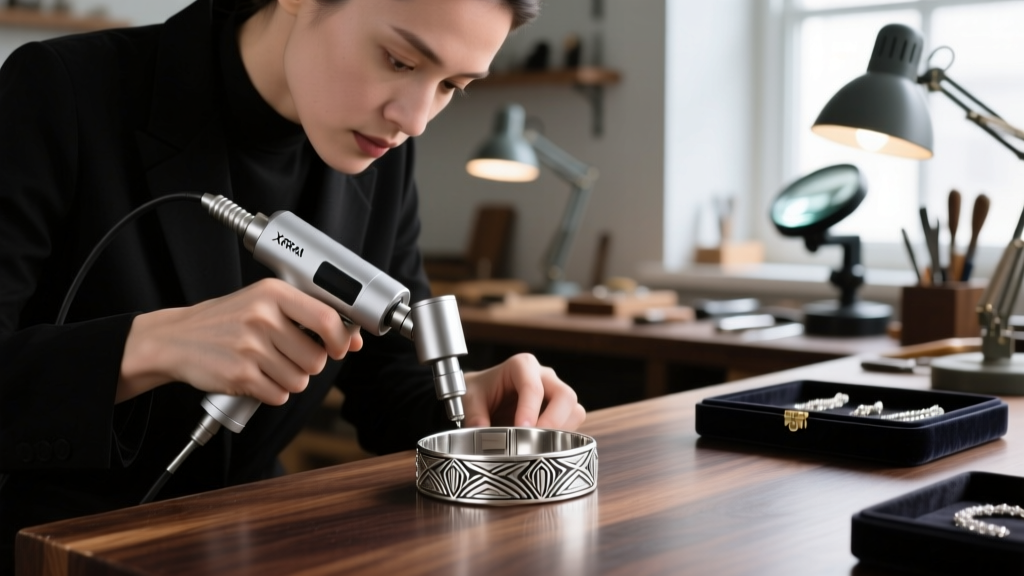
X-Ray Fluorescence (XRF) Spectrometry
For non-destructive testing, XRF technology is the industry standard. An XRF analyzer fires X-rays into the metal, causing the atoms to emit secondary fluorescent X-rays. By measuring the energy of these emissions, the device provides an exact parts-per-million (PPM) breakdown of the alloy. A genuine piece will read 92.5% Ag, with the remainder showing as copper, zinc, or germanium.
Specific Gravity (SG) Testing
For those without access to expensive XRF equipment, the specific gravity test offers a highly accurate, physics-based alternative. Pure silver has an SG of 10.49, while pure copper is 8.96. Using the rule of mixtures, traditional 925 sterling silver should yield an SG of approximately 10.36.
By weighing the piece in air, then weighing it suspended in distilled water, you can calculate the exact density. If a piece stamped '925' yields an SG of 8.50, it is likely a brass or nickel-silver (cupronickel) counterfeit containing zero actual silver.
Structural Considerations for Jewelry Design and Repair
Understanding what is sterling silver jewelry from a bench jeweler's perspective requires mastering its work-hardening characteristics. As sterling silver is bent, hammered, or drawn through a wire plate, the crystal grains elongate and lock together, increasing hardness but severely reducing ductility. If a jeweler attempts to bend a heavily work-hardened silver shank, it will snap rather than flex.
To restore ductility, the metal must be annealed. This involves heating the sterling silver to a dull cherry red (approximately 593°C to 650°C) and then quenching it in water. Unlike steel, which hardens when quenched, sterling silver softens when quenched because the rapid cooling traps the copper atoms in a randomized solid solution, preventing them from forming rigid precipitate structures. Mastery of these thermal cycles is what separates master jewelers from novice metalworkers, ensuring that sterling silver pieces remain structurally sound for generations.
Ultimately, sterling silver is not just a precious metal; it is a highly engineered material. By understanding its lattice structures, chemical vulnerabilities, and thermal behaviors, collectors and designers can better appreciate the true science behind the shine. For further reading on precious metal standards, consult the Gemological Institute of America (GIA) silver reference guides.


