Is Costume Jewelry Worth Money? Material Value Guide
Discover if your vintage pieces hold value. We analyze the material properties, base metals, and glass types that make costume jewelry worth money.

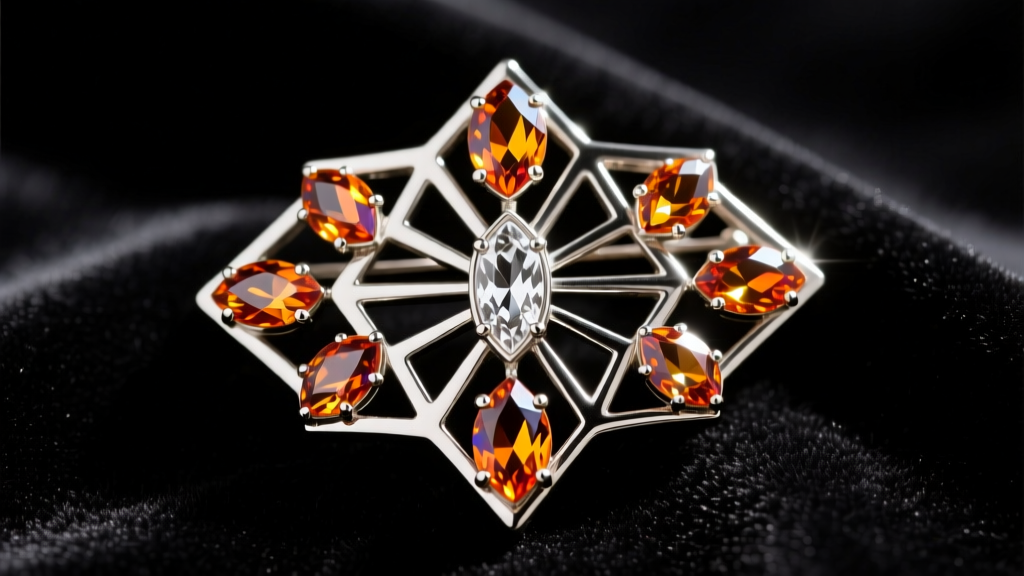
When collectors, estate liquidators, and appraisers evaluate vintage accessories, a common question arises: is costume jewelry worth money? The answer relies entirely on material science, historical manufacturing techniques, and the physical properties of the components used. Unlike fine jewelry, which derives its baseline value from the melt weight of precious metals and the carat weight of gemstones, high-value costume jewelry is priced on the scarcity of specific historical alloys, the optical properties of vintage glass, and the chemical stability of early synthetics.
In 2026, as the market for vintage and archival fashion continues to mature, understanding the exact material composition of your pieces is the only reliable way to separate valuable historical artifacts from worthless fast-fashion debris. This guide breaks down the specific material properties, failure modes, and grading metrics that dictate the financial value of costume jewelry.
Base Metal Alloys: The 'Zinc Pest' Failure Mode
The foundation of most vintage costume jewelry is "pot metal" or white metal. However, not all pot metal is created equal, and its exact chemical makeup heavily influences whether a piece survives a century or crumbles into dust. According to the Antique Jewelry University by Lang Antiques, the metallurgical composition of these alloys shifted dramatically due to wartime rationing.
Pre-War vs. Post-War Alloys
Pieces manufactured before 1940 typically utilized a higher percentage of tin, antimony, and copper. These alloys were heavier, took to electroplating beautifully, and possessed high structural integrity. Conversely, during and after World War II, manufacturers shifted to zinc-heavy die-cast alloys to conserve strategic metals. This introduced a catastrophic failure mode known as "zinc pest" or intergranular corrosion.
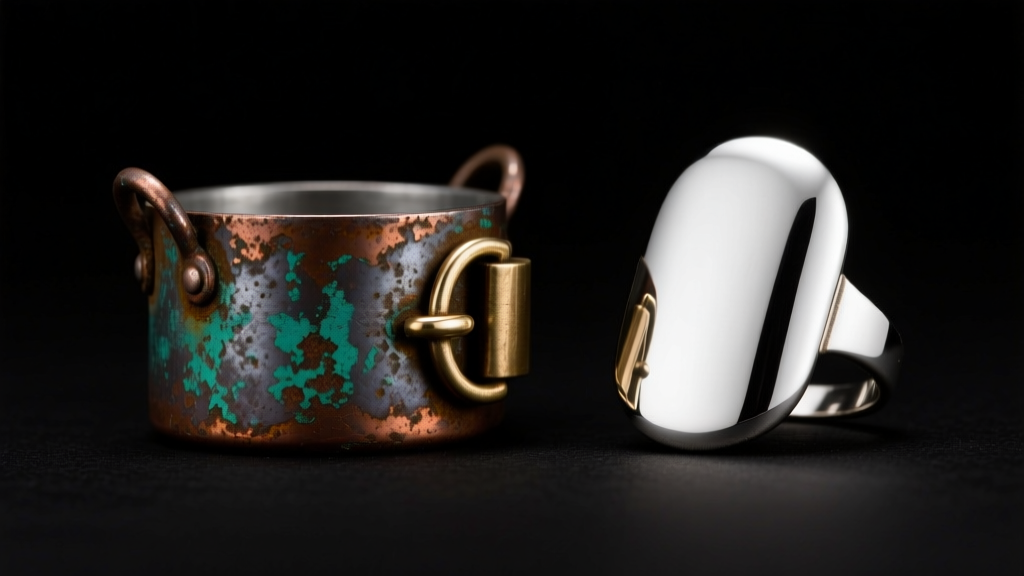
Zinc pest occurs when impurities (like lead or cadmium) in the zinc alloy cause the metal to oxidize from the inside out. The corrosion products occupy a larger volume than the original metal, causing the jewelry to swell, crack, and eventually shatter. If you are evaluating a vintage 1950s brooch and notice micro-fractures or a powdery white residue near the clasp, the piece is suffering from zinc pest. This structural failure immediately drops the item's market value to near zero, regardless of the designer stamp.
Optical Properties: Lead Glass vs. Modern Crystal
The "stones" in valuable vintage costume jewelry are rarely genuine gems; they are typically glass or early synthetics. However, the optical properties of vintage glass are vastly superior to modern alternatives, which is a primary driver of value.
Refractive Index and Foil Degradation
High-end vintage rhinestones (such as early Swarovski or Bohemian cuts) were made from flint glass containing up to 30% lead oxide. This high lead content increases the glass's refractive index (RI) to approximately 1.70, giving it a brilliant, diamond-like fire. In contrast, modern environmental regulations have forced manufacturers to use lead-free crystal, which typically maxes out at an RI of 1.52. The Gemological Institute of America (GIA) notes that while lead-free crystals are more environmentally sound, they require advanced faceting techniques to compensate for the lower light return.
| Material Type | Refractive Index (RI) | Mohs Hardness | Typical Value Multiplier |
|---|---|---|---|
| Lead Glass (Pre-1970s) | 1.65 - 1.75 | 5.0 - 6.0 | High (Foil intact) |
| Modern Lead-Free Crystal | 1.50 - 1.54 | 6.0 - 7.0 | Low (Mass produced) |
| Aurora Borealis (AB) Glass | 1.70 (with coating) | 5.5 | Medium-High (Post-1955) |
| Molded Lucite/Acrylic | 1.49 | 2.0 - 3.0 | Variable (Design dependent) |
Crucial Appraisal Tip: The value of lead glass rhinestones is entirely dependent on the integrity of the foil backing. If moisture breaches the setting, the silver or gold foil oxidizes, turning the stone opaque and black. A piece with "dead stones" (blackened foil) loses up to 80% of its collector value, as replacing custom-cut vintage stones is economically unviable.
Early Synthetics: The Chemistry of Bakelite and Celluloid
When assessing whether bangles or carved pendants from the 1920s and 30s represent costume jewelry worth money, you must distinguish between high-value thermoset plastics and worthless modern thermoplastics.
Bakelite (Polyoxybenzylmethylenglycolanhydride)
Bakelite, the first fully synthetic plastic, is highly sought after by collectors. It is a thermoset phenol-formaldehyde resin. Because it is thermoset, it will not melt or deform when exposed to heat, and it possesses a specific gravity of roughly 1.25 to 1.35, giving it a satisfying, heavy "clack" when two bangles are tapped together. Over time, Bakelite undergoes a chemical oxidation process that darkens its surface, creating a highly desirable patina. A cherry-red Bakelite bangle that has oxidized to a deep mahogany can command prices upwards of $1,500, provided it is authentic.
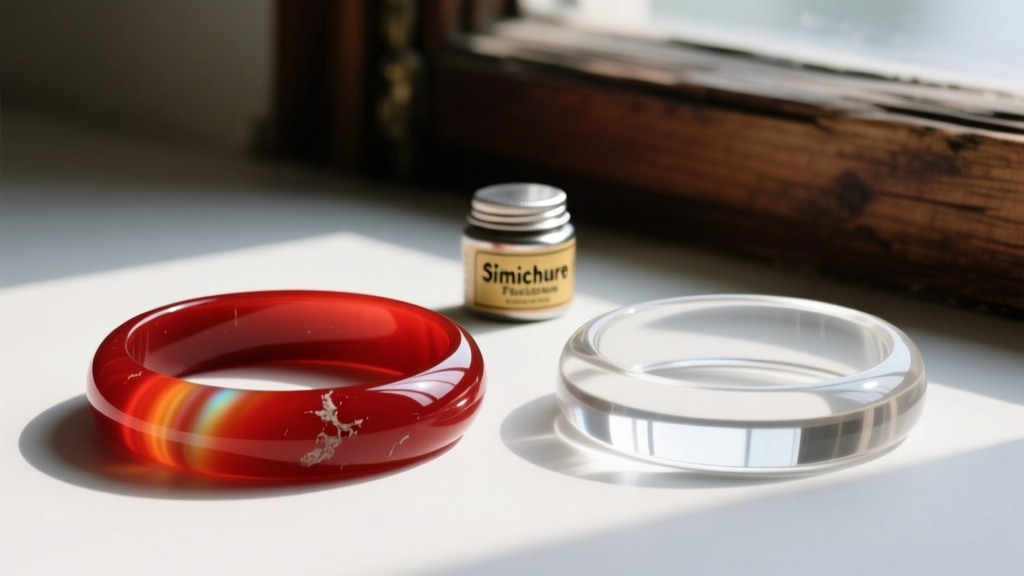
To authenticate Bakelite, appraisers use Simichrome metal polish. When rubbed on an inconspicuous area, the chemical reaction with the phenolic resin turns the polish a distinct, vibrant yellow. Modern acrylic copies will not trigger this reaction.
The Celluloid Hazard
Celluloid, an early thermoplastic made from nitrocellulose and camphor, was widely used for carved cameos and hair combs. While historically significant, celluloid is chemically unstable. As it degrades, it off-gases nitric acid. This acid actively corrodes the metal findings, pins, and clasps attached to the piece. Furthermore, celluloid is highly flammable. Collectors often avoid heavily degraded celluloid pieces due to the risk of spontaneous combustion in poorly ventilated storage environments, severely limiting its secondary market liquidity.
Plating Thickness and Micron Grading
The final material metric that separates valuable vintage costume jewelry from modern landfill is the thickness and method of the metal plating. The visual appearance of gold or rhodium plating is insufficient for valuation; you must understand the micron depth.
Electroplating vs. PVD and Flash Plating
Premium mid-century designers like Trifari, Coro, and Miriam Haskell utilized heavy electroplating processes. A high-quality vintage gold-plated piece may feature a gold layer between 5 and 20 microns thick, often layered over a copper or nickel strike to ensure adhesion. This thickness allows the piece to survive decades of wear without exposing the base metal beneath.
In stark contrast, modern fast-fashion jewelry relies on "flash plating," which deposits a microscopic layer of gold (typically 0.1 to 0.5 microns). By 2026, much of the industry has also adopted Physical Vapor Deposition (PVD) for base metals. While PVD is highly resistant to chemical tarnishing, it is incredibly thin. When PVD fails, it does so via micro-abrasion, flaking off in microscopic sheets that cannot be polished or repaired.
The Vermeil Distinction: Remember that for a piece to be legally classified as "Vermeil" in the United States, the Federal Trade Commission (FTC) mandates a base of solid sterling silver (.925) plated with a minimum of 2.5 microns of gold (minimum 10k fineness). Many high-end vintage pieces blur the line between demi-fine and costume, and identifying a sterling base beneath a gold exterior instantly elevates the piece's baseline material value.
Conclusion: Synthesizing Material Value
Determining if costume jewelry worth money is sitting in your estate requires a methodical inspection of its physical and chemical properties. Look for the heavy, high-tin base metals of the pre-war era. Inspect the foil-backing of high-refractive lead glass stones for moisture damage. Test carved plastics for phenolic reactions, and scrutinize the wear patterns on electroplated surfaces to estimate micron thickness. By shifting your focus from brand names to material science, you can accurately identify the historical accessories that possess genuine, enduring market value.


