Hello Kitty Industrial Earring: Expert Sizing & Fit Guide
Master the hello kitty industrial earring fit. Expert guide on 14g titanium sizing, charm weight distribution, and preventing migration.

The Biomechanics of a Scaffold Piercing
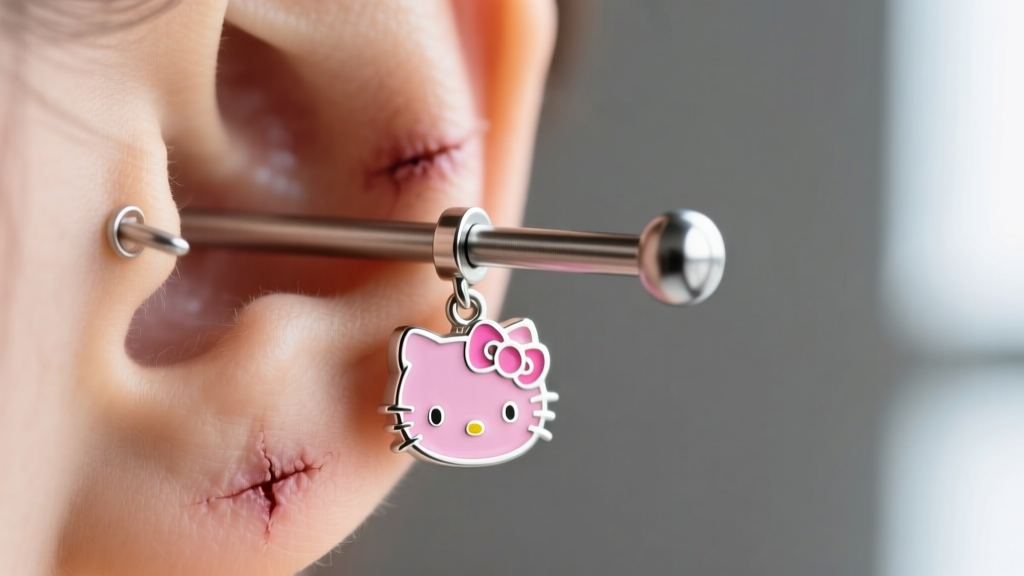
The industrial piercing, clinically referred to as a scaffold piercing, is one of the most complex cartilage modifications in modern body art. It requires two distinct puncture sites—typically the forward helix and the anti-helix—connected by a single, rigid barbell. When you introduce a novelty or character-themed component, such as a hello kitty industrial earring, you are not just making an aesthetic choice; you are altering the biomechanical equilibrium of the jewelry. As of 2026, advanced CNC-machining has allowed for highly detailed character charms, but these additions introduce unique variables regarding weight distribution, center of gravity, and snag hazards that must be carefully managed to prevent tissue damage and migration.
According to the Association of Professional Piercers (APP), the primary cause of industrial piercing failure is improper jewelry fit and excessive torque on the fistula. A rigid barbell demands absolute geometric precision. If the angle of the two piercings deviates by even a few degrees, the straight shaft will exert continuous lateral pressure on the cartilage, leading to pressure necrosis, hypertrophic scarring, or outright rejection. Adding a Hello Kitty charm to one or both ends of the barbell shifts the focal point of this pressure, making expert sizing and material selection non-negotiable.
Metallurgy and Material Grades: Why ASTM F136 is Mandatory
When selecting a hello kitty industrial earring, the base material of the barbell and the charm attachment mechanism must meet stringent biocompatibility standards. The cartilage of the ear is highly vascular and prone to prolonged inflammatory responses if exposed to reactive metals.
- Implant-Grade Titanium (ASTM F136): This is the gold standard for both initial and healed industrial piercings. It contains zero nickel, eliminating the risk of contact dermatitis. Furthermore, high-quality titanium can be polished to a mirror finish, which drastically reduces the microscopic surface area where biofilm and bacteria can adhere.
- 316L Surgical Steel: While historically common, surgical steel contains trace amounts of nickel. Over a 6-to-12-month healing period, the continuous friction of a heavy charm can cause microscopic abrasions in the fistula, allowing nickel ions to leach into the tissue and trigger localized allergic reactions.
- Enamel and Powder Coating: The iconic pink bow and facial features of a Hello Kitty charm are typically achieved through enamel filling or PVD (Physical Vapor Deposition) coating. Ensure the charm is sealed properly; chipped enamel inside the piercing channel can introduce foreign body debris into the wound.
The Weight Penalty: Charm Distribution and Migration Risks
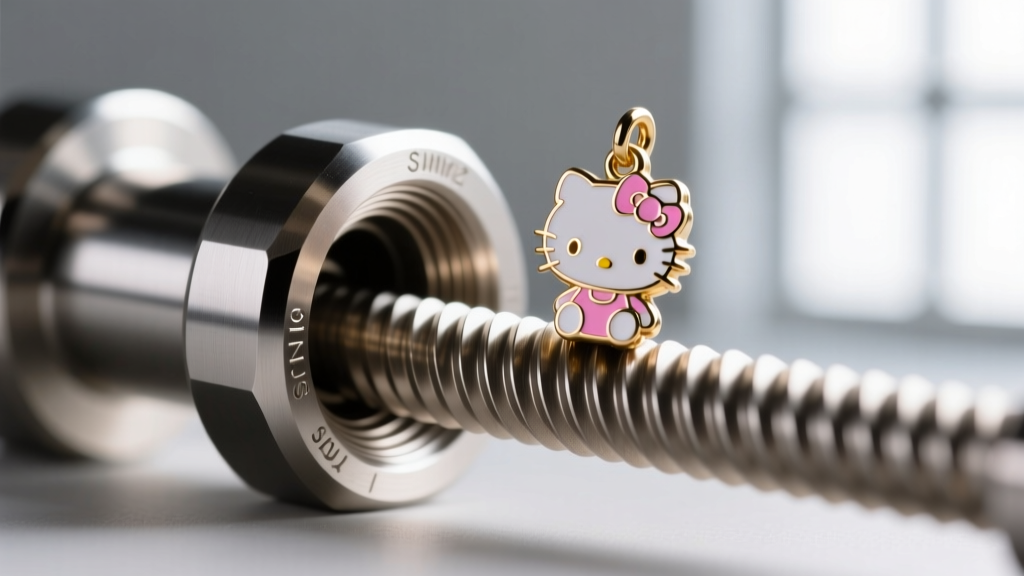
The most critical technical challenge of a hello kitty industrial earring is the weight of the charm itself. Standard ball ends on a 14g barbell weigh approximately 0.8 to 1.2 grams. A detailed, three-dimensional character charm with protruding elements (like ears and a bow) can easily exceed 3.5 grams. This additional mass creates a lever effect on the end of the barbell.
When the charm hangs from the forward helix, gravity pulls the end downward. Because the barbell is rigid, this downward force translates into an upward rotational torque on the opposite end (the anti-helix). Over time, this asymmetric pressure causes the jewelry to tilt, resulting in 'cheese-cutter' migration, where the jewelry slowly slices through the cartilage. To mitigate this, expert piercers recommend utilizing ultra-lightweight, hollow-backed charm designs or flat-profile enamel inlays rather than fully sculpted 3D charms, especially during the first year of healing.
Precise Sizing Matrix: Gauge, Length, and End Diameter
Sizing an industrial barbell is not a one-size-fits-all endeavor. The length must be customized to the exact topography of the wearer's ear to accommodate swelling while preventing excessive movement. Below is the standard sizing matrix utilized by professional piercers for scaffold jewelry.
| Measurement Parameter | Standard Specification | Custom/Anomaly Adjustment | Clinical Risk if Incorrect |
|---|---|---|---|
| Gauge (Thickness) | 14g (1.6mm) | 16g (1.2mm) for petite anatomy | Migration and cheese-cutter effect |
| Shaft Length | 1 inch to 1.5 inches | Custom measured to the millimeter | Pressure necrosis or severe snagging |
| Charm/End Diameter | 4mm to 5mm | Maximum 6mm for forward helix | Tragus interference and hair snagging |
| Threading Type | Internal (M1.2 or M1.6) | Push-pin (for tight anatomical folds) | Fistula tearing during jewelry changes |
If the shaft is too long, the hello kitty industrial earring will protrude too far from the ear, catching on headphones, hairbrushes, and pillowcases. If it is too short, the ends will compress the tissue, cutting off circulation and causing the cartilage to die (pressure necrosis).
Threading Mechanics and Charm Security
The method by which the Hello Kitty charm attaches to the barbell shaft is paramount for both safety and security. Internal threading is the only acceptable standard for high-end body jewelry. In this configuration, the screw is located on the charm end, and the threaded hole is inside the barbell shaft. This ensures that the smooth, unthreaded portion of the jewelry passes through the delicate fistula during insertion and removal.
Conversely, external threading (where the screw is on the barbell shaft) features sharp, jagged threads that act like a file, scraping and tearing the healing tissue every time the jewelry is moved. For a heavy charm like a Sanrio character, the torque applied when screwing the end on can also cause the shaft to bend slightly if the metal is low-grade. Always verify that your jeweler utilizes internally threaded or threadless (push-pin) systems, which rely on tension rather than screws to secure lightweight decorative ends.
Healing Timelines, Downsizing, and Snag Hazards
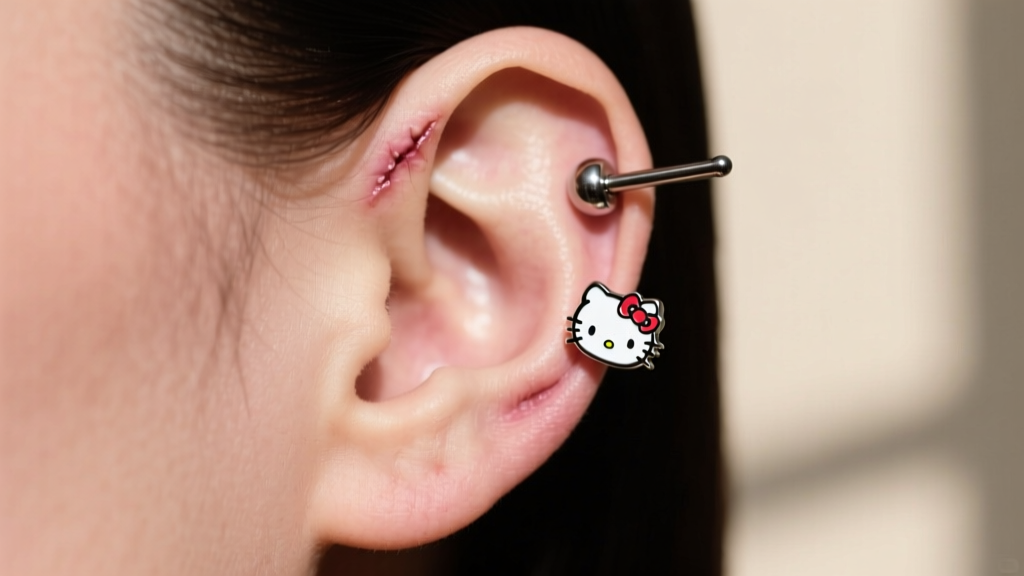
Industrial piercings are notorious for their prolonged and non-linear healing processes. While a standard lobe piercing heals in 6 to 8 weeks, a scaffold piercing involves two separate cartilage wounds connected by a rigid bridge. Full maturation of the fistula typically takes 9 to 12 months, and in some anatomical cases, up to 18 months.
'The introduction of novelty charms should be strictly delayed until the piercing is fully matured. A heavy or protruding charm on a healing industrial will almost certainly cause irritation bumps due to micro-trauma from snagging.' — APP Aftercare Guidelines
The specific design of a Hello Kitty charm introduces distinct snag hazards. The protruding 'ears' and the 'bow' act as hooks. During the healing phase, you must downsize the barbell shaft (usually from 1.25 inches down to 1 inch) around the 8-week mark to eliminate excess space where hair can wrap around the bar. Once healed, if you choose to wear a 3D charm, be hyper-vigilant when removing over-the-ear headphones, pulling sweaters over your head, or brushing your hair, as a sudden snag on the charm can instantly tear the cartilage channel.
Troubleshooting Common Fit Issues and Angle Mismatches
Even with perfect jewelry, anatomical anomalies can cause a hello kitty industrial earring to sit improperly. The most common issue is an angle mismatch. If the piercer did not align the forward helix and anti-helix punctures on the exact same vector, the straight barbell will force the ear to bend to accommodate the jewelry.
Symptoms of an angle mismatch include:
- Persistent redness and localized swelling at one or both ends of the barbell.
- The charm end sitting flush against the skin on one side, while gaping on the other.
- A visible 'dent' in the cartilage where the jewelry is pressing too deeply.
- Chronic irritation bumps (granulomas) that refuse to heal despite proper saline aftercare.
If you experience these symptoms, the solution is rarely to change the charm; the solution is to change the jewelry structure entirely. A professional piercer may need to replace the rigid straight barbell with two separate flat-back labret studs or a custom-bent barbell that matches the natural, imperfect geometry of your ear. Only once the tissue is completely healthy and relaxed should you reintroduce a specialized, lightweight character-themed end to your setup.


