Decoding Modern Jewelry Makers Marks: Metal Purity & Properties
Learn to read modern jewelry makers marks across gold, platinum, and alternative metals to understand material purity, properties, and quality tiers.

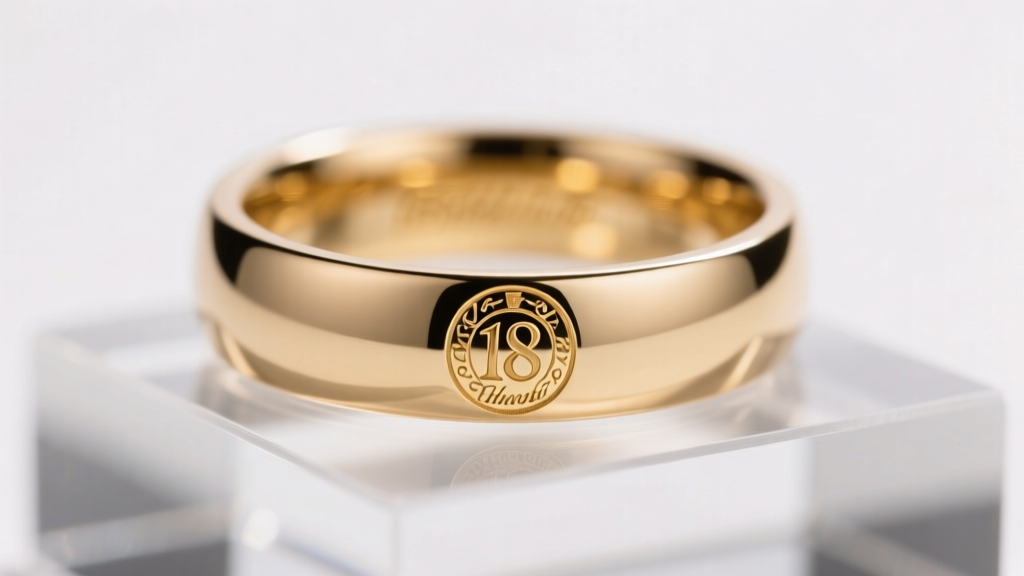
When evaluating fashion and fine jewelry, the untrained eye often focuses solely on the gemstones or the overall silhouette. However, the true DNA of any piece lies hidden on the inner shank or clasp: the hallmarks. Understanding modern jewelry makers marks is not just about identifying the brand; it is a masterclass in material science, metallurgy, and quality assurance. As we navigate the jewelry landscape in 2026, the way metals are marked has evolved dramatically, shifting from brute-force steel punches to precision photonics. This guide decodes these marks, linking them directly to the physical properties and quality tiers of the metals they represent.
Maker's Marks vs. Purity Stamps: Knowing the Difference
Before diving into specific alloys, it is crucial to distinguish between the two primary types of markings found on fine jewelry. A maker's mark (or trademark) is the registered symbol, initials, or logo of the manufacturing company or artisan. It guarantees the origin of the piece. A purity mark (or assay mark), on the other hand, indicates the exact metallurgical composition of the alloy. While a maker's mark tells you who made it, the purity mark tells you what it is made of. In many European countries, a third mark—the assay office mark—is also legally required, though the United States primarily relies on the maker's mark alongside the purity stamp to ensure accountability, as mandated by the Federal Trade Commission (FTC) Jewelry Guides.
The Evolution of Hallmarks: From Steel Stamps to Fiber Lasers
Historically, jewelry marks were applied using hardened steel punches and a mallet. This mechanical displacement of metal works beautifully for soft alloys like 24k gold or pure silver. However, as modern jewelry makers marks began appearing on harder, more durable alloys, traditional stamping became problematic. Striking a hardened steel stamp against a high-tensile platinum or cobalt chrome ring can shatter the metal, distort the ring's shape, or dull the stamp itself.
By 2026, the industry standard for applying modern jewelry makers marks has shifted overwhelmingly to fiber laser engraving. Fiber lasers operate at a 1064 nm wavelength, which is highly absorbed by metals. This allows for the annealing or micro-ablation of the metal surface, creating high-contrast, permanent marks without removing significant material or compromising the structural integrity of the band. This technological leap means that even ultra-hard alternative metals can now bear crisp, microscopic purity stamps and brand logos on their interior shanks.
Precious Metals: Deciphering Purity and Properties
The purity marks on precious metals are direct indicators of their alloy composition, which in turn dictates their Vickers hardness (HV), malleability, and tarnish resistance.
Gold Alloys: The Karat System
Gold purity is measured in karats (k), with 24k being 99.9% pure gold. Because pure gold is too soft for daily wear (Mohs hardness of 2.5), it is alloyed with metals like copper, silver, zinc, and palladium.
- 10k Gold (417 stamp): Contains 41.7% gold. Highly durable (approx. 170 HV) and resistant to scratching, but prone to tarnishing due to the high copper/zinc content. Often used in entry-level fashion jewelry.
- 14k Gold (585 stamp): Contains 58.5% gold. The sweet spot for durability and color (approx. 150 HV). It resists tarnish well and is the standard for fine jewelry in North America.
- 18k Gold (750 stamp): Contains 75% gold. Richer in color but softer (approx. 120-130 HV). According to the Gemological Institute of America (GIA), 18k gold is preferred for high-end gemstone settings because its slight malleability allows prongs to be securely burnished over stones without snapping.
Platinum: The Dense Standard
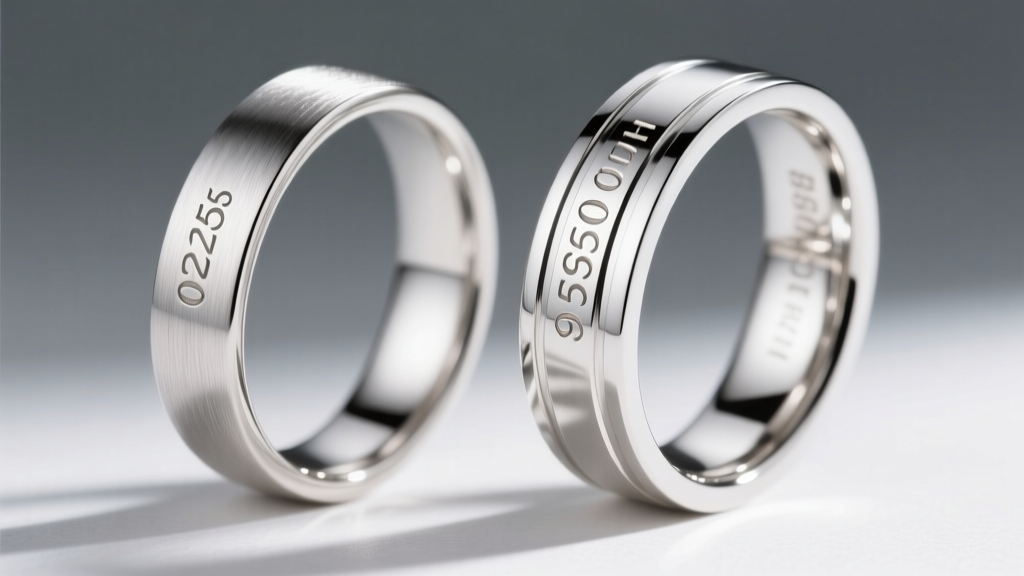
Platinum marks usually read 950 Pt or 900 Pt. Unlike gold, which loses metal when scratched, platinum merely displaces, developing a soft patina over time. 950 platinum is typically alloyed with 5% ruthenium or cobalt to increase its hardness from a baseline of 50 HV to around 130 HV. Because of its extreme density and high melting point (1,768°C), platinum requires specialized casting equipment, making it a definitive marker of a high-tier fine jewelry piece.
Silver: The Tarnish Factor
The 925 stamp denotes Sterling Silver (92.5% silver, 7.5% copper). The copper provides necessary structural integrity but introduces a vulnerability: oxidation. Modern jewelry makers marks on silver may also include a rhodium plating indicator, though this is rare. For buyers, a 925 mark means the piece will require periodic polishing or anti-tarnish storage to maintain its luster.
Alternative Metals: The Marking Challenge
The rise of alternative metals in the fashion and men's wedding band markets has complicated the hallmarking process. These metals do not use the karat system and often lack standardized, globally recognized purity stamps.
Titanium and Tungsten Carbide
Titanium used in jewelry is typically Grade 2 (commercially pure) or Grade 5 (6Al-4V alloy). Grade 5 is significantly harder and more scratch-resistant. Because titanium is highly reactive and work-hardens quickly, traditional stamps are impossible. Modern jewelry makers marks on titanium are exclusively laser-etched, often simply reading "Titanium" or featuring the brand's logo.
Tungsten Carbide is a composite material, not a pure metal. It ranks an 8.5 to 9 on the Mohs scale, making it virtually scratch-proof but highly brittle. A tungsten ring cannot be stamped; it will shatter under the impact of a steel punch. Furthermore, because it is a carbide matrix bound by a cobalt or nickel binder, it cannot be hallmarked for precious metal purity. Marks here are purely laser-etched brand identifiers.
Material Properties vs. Marking Techniques
The table below illustrates how the physical properties of different jewelry metals dictate the methods used to apply modern jewelry makers marks.
| Metal / Alloy | Mohs Hardness | Vickers Hardness (HV) | Primary Marking Method | Standard Purity Marks |
|---|---|---|---|---|
| 24k Gold | 2.5 | ~60 | Steel Punch / Stamp | 999, 24k |
| 14k Gold | 3.5 - 4.0 | ~150 | Steel Punch / Laser | 585, 14k |
| 950 Platinum | 4.0 - 4.5 | ~130 | Laser Engraving | 950, Pt950 |
| 925 Sterling Silver | 2.5 - 3.0 | ~75 | Steel Punch / Stamp | 925, Ster |
| Grade 5 Titanium | 6.0 | ~330 | Fiber Laser Only | None (Brand Only) |
| Tungsten Carbide | 8.5 - 9.0 | ~1500+ | Fiber Laser Only | None (Brand Only) |
Spotting Fakes: When Marks Lie About Material Properties
A hallmark is only as trustworthy as the integrity of the maker. In the secondary market and fast-fashion sectors, counterfeit marks are a persistent issue. A piece stamped "18k" might actually be a base metal electroplated with a microscopic layer of gold. Over time, the physical properties of the underlying metal will reveal the deception: the piece will be unusually light (due to the low specific gravity of brass or steel compared to gold), it will trigger skin allergies (due to nickel in the base metal), and it will eventually wear through to the base core.
Verification Beyond the Stamp
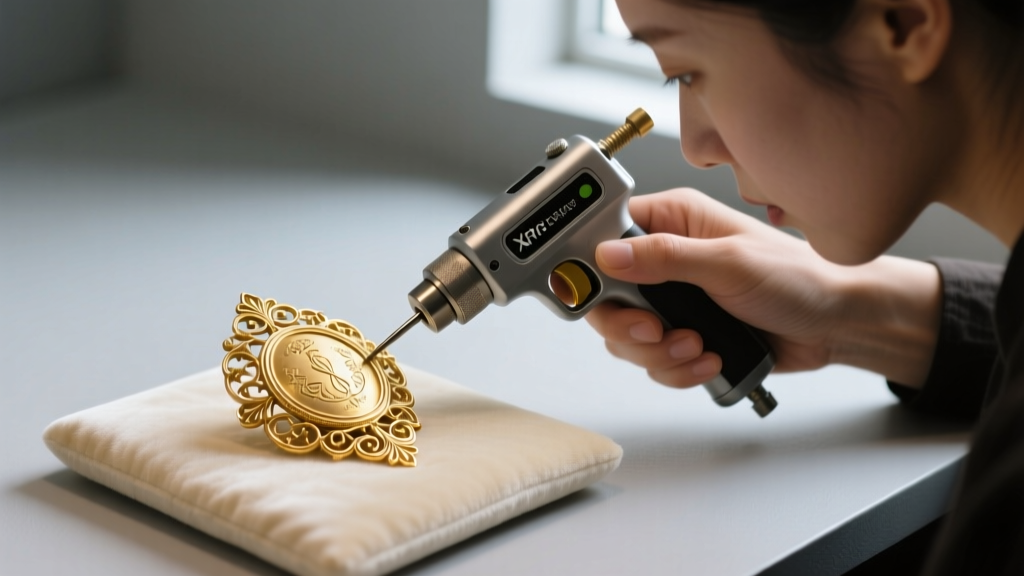
To truly verify the material properties implied by modern jewelry makers marks, professionals rely on non-destructive testing. X-Ray Fluorescence (XRF) analyzers are the gold standard in 2026. An XRF gun fires X-rays into the metal, causing the atoms to emit secondary fluorescent X-rays. By reading the energy spectrum, the device can determine the exact elemental breakdown of the alloy in seconds, verifying if a "750" stamp truly represents 75% gold or if it is a counterfeit.
For consumers without access to an XRF machine, the specific gravity test is a highly effective DIY method. By weighing the piece in air and then suspended in water, you can calculate its density. 14k gold has a specific gravity of roughly 12.9 to 14.6, while brass is around 8.4. If a heavy-looking chain stamped "14k" floats too high in the water, the purity mark is a lie, regardless of how authentic the maker's mark appears.
Conclusion
Modern jewelry makers marks are far more than mere decorative engravings or legal requirements; they are the metallurgical blueprints of your accessories. By understanding the relationship between a purity stamp and the physical properties of the alloy—whether it is the malleability of 18k gold, the dense patina of 950 platinum, or the brittle hardness of tungsten carbide—you can make highly informed purchasing decisions. Always look beyond the aesthetic, verify the marks, and respect the material science that makes fine jewelry endure.


