Ancient Egyptian Jewelry: 2026 Buyer's Guide & Authenticity Tips
Discover how to buy ancient Egyptian jewelry in 2026. Learn to authenticate antiquities, identify historical reproductions, and decode pharaonic materials.

The Allure and the Legal Landscape of Pharaonic Adornments
The market for ancient Egyptian jewelry is one of the most complex, heavily regulated, and frequently counterfeited sectors in the global antiquities trade. For serious collectors and historians, acquiring a genuine artifact from the Old, Middle, or New Kingdom is the pinnacle of jewelry acquisition. However, navigating this market in 2026 requires a forensic understanding of materials, a strict adherence to international provenance laws, and the ability to distinguish between genuine antiquities, 1920s revival pieces, and modern museum-grade reproductions.
Before making a purchase, buyers must understand that the term "ancient Egyptian jewelry" encompasses three entirely distinct markets. True antiquities (pre-30 BC) are governed by the 1970 UNESCO Convention on the Means of Prohibiting and Preventing the Illicit Import, Export and Transfer of Ownership of Cultural Property. Any authentic piece entering the market today must have documented provenance predating 1970. Without this paper trail, you are either buying a forgery, a reproduction, or participating in the illicit trafficking of cultural heritage. For a comprehensive overview of these legal frameworks, collectors should consult the UNESCO 1970 Convention guidelines.
The Three Tiers: Antiquities, Revival, and Reproduction
To buy intelligently, you must first define what you are actually shopping for. The untrained eye often confuses these three categories, leading to disastrous financial mistakes.
- Verified Antiquities: Artifacts excavated from Egyptian soil, dating roughly from 3100 BC to 30 BC. These are typically faience amulets, carnelian beads, or heavily degraded electrum bands. Gold pieces in pristine condition are exceptionally rare and usually reside in institutions like the British Museum's Egypt and Sudan department.
- Egyptian Revival (1920s-1930s): Following Howard Carter’s discovery of Tutankhamun’s tomb in 1922, jewelry houses like Cartier, Boucheron, and Van Cleef & Arpels created high-end Art Deco pieces utilizing Egyptian motifs. These are highly valuable, but they are 20th-century jewels, not antiquities.
- Museum-Grade Reproductions: Modern replicas cast using historical methods, often sold by institutions like the Metropolitan Museum of Art. These offer the aesthetic of the pharaohs without the legal hurdles or exorbitant costs of antiquities.
Material Forensics: What the Pharaohs Actually Wore
Authenticating ancient Egyptian jewelry begins with material analysis. The ancient Egyptians did not have access to modern alloys, synthetic dyes, or faceting techniques. If a piece features brilliant-cut gemstones, 14k gold, or dyed howlite masquerading as turquoise, it is an immediate red flag.
| Material | Ancient Sourcing & Characteristics | Modern Forgery Red Flags |
|---|---|---|
| Gold / Electrum | High karat (18k-22k) or electrum (natural gold/silver alloy). Hammered, not cast. | 14k or 10k alloys; presence of zinc or nickel; modern casting porosity. |
| Lapis Lazuli | Sourced from the Sar-e-Sang mines in Afghanistan. Features natural pyrite inclusions. | Dyed jasper or synthetic ultramarine resin lacking pyrite flecks. |
| Carnelian | Iron-rich chalcedony, often heat-treated in antiquity to deepen the red-orange hue. | Glass imitations or dyed agate with concentric color banding. |
| Faience | A sintered quartz-ceramic with a copper-alkaline glaze. Not a clay. | Modern polymer clays or slip-cast ceramics with uniform, glossy glazes. |
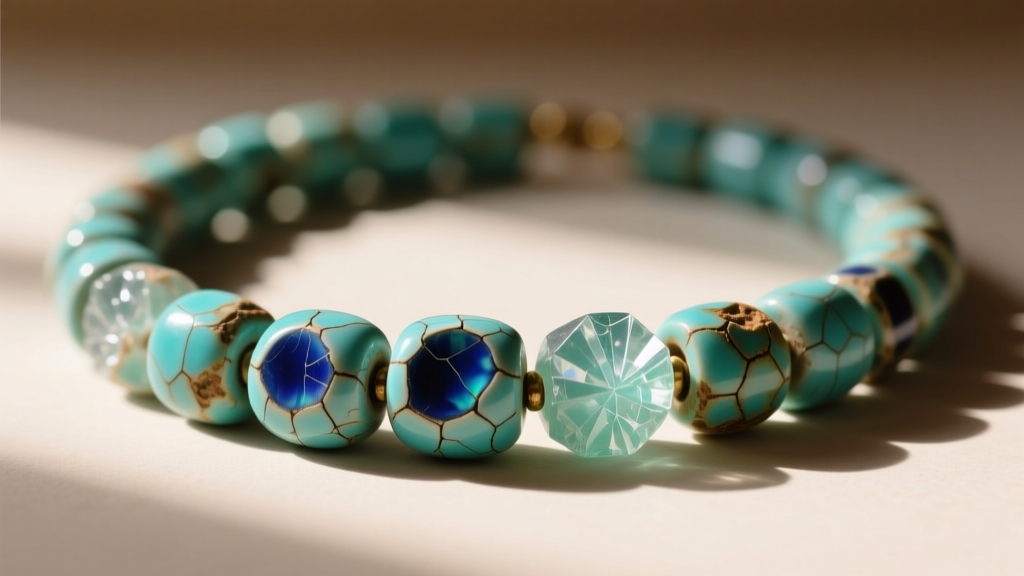
Understanding faience is critical, as it makes up the vast majority of surviving amulets and beadwork. As detailed in the Metropolitan Museum of Art's Heilbrunn Timeline, faience was created by mixing crushed quartz with copper salts and an alkaline binder. When fired, the copper migrated to the surface, creating a vitreous, turquoise-blue glaze. Genuine ancient faience will exhibit micro-crazing (a fine network of cracks in the glaze) and slight irregularities in color pooling, whereas modern resin fakes will appear perfectly uniform and feel unnaturally light.
Decoding Motifs: Iconography and Anatomical Accuracy
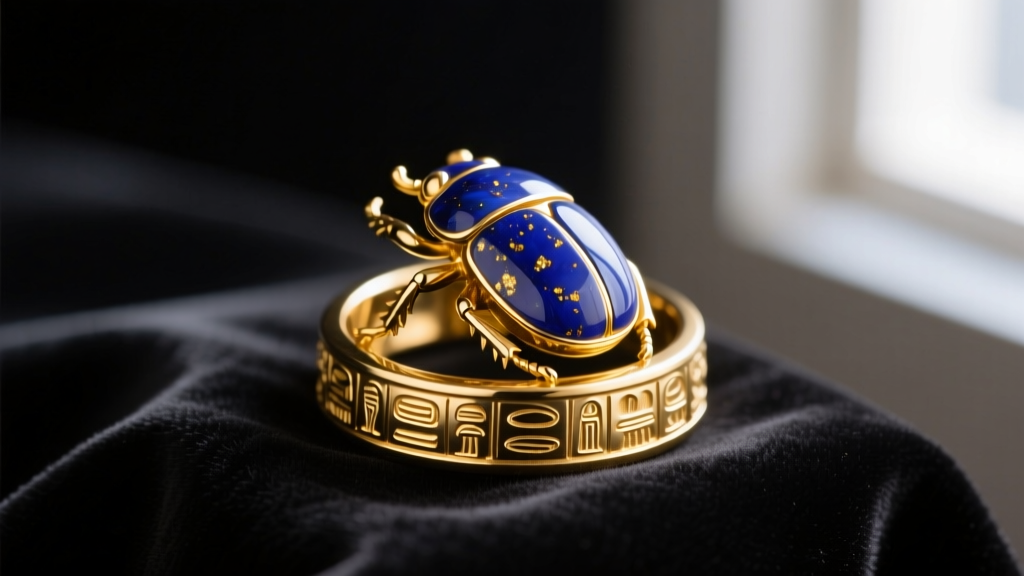
When evaluating scarabs, the most common form of ancient Egyptian jewelry, buyers must look beyond the general shape. Mass-produced forgeries often treat the scarab as a generic beetle, resulting in anatomical inaccuracies. A genuine New Kingdom scarab will feature a distinctly defined clypeus (the head shield) and precise, parallel striations on the wing cases (elytra). Furthermore, the underside of an authentic scarab is typically flat and carved with deeply incised, legible hieroglyphs or royal cartouches. Forgeries often feature shallow, mushy, or entirely fictitious "pseudo-hieroglyphs" that look more like random scratches than structured language.
Similarly, the Wedjat (Eye of Horus) amulet has strict proportional rules. The teardrop marking and the spiral flourish must follow specific artistic grids established during the Middle Kingdom. Modern tourist-trade replicas frequently mirror the image incorrectly or alter the proportions to fit modern jewelry settings, instantly revealing their inauthenticity.
2026 Pricing Matrix: What You Will Actually Pay
The pricing for ancient Egyptian jewelry varies wildly based on material, provenance, and condition. Below is a realistic market guide for legitimate acquisitions in 2026.
- Authentic Faience Amulets (Ushabti, Scarabs, Gods): $300 – $1,800. Price scales with the clarity of the glaze, the presence of original drill holes, and documented pre-1970 provenance.
- Authentic Carnelian & Lapis Bead Necklaces: $2,500 – $8,000. Restrung necklaces are common, but original knotting or ancient gold spacers exponentially increase the value.
- 1920s Art Deco Egyptian Revival (Cartier/Boucheron): $15,000 – $150,000+. These are priced as high jewelry, utilizing platinum, onyx, coral, and diamonds.
- Museum-Grade Replicas (Solid 18k Gold): $800 – $3,500. Excellent for daily wear without the risk of damaging a fragile, 3,000-year-old artifact.
- Verified Antiquity Gold Pectorals or Broad Collars: $50,000 – $500,000+. Exceptionally rare; usually sold at premier auction houses like Christie's or Bonhams with extensive thermoluminescence or XRF testing reports.
Red Flags: Spotting Modern Forgeries and Tool Marks
The most reliable way to authenticate hardstone and metal antiquities is through microscopic tool mark analysis. Ancient Egyptian lapidaries did not possess high-speed rotary tools. They shaped carnelian, lapis, and steatite using bow drills tipped with copper or flint, combined with abrasive quartz sand. Under a 10x loupe, genuine ancient drill holes will appear slightly conical, often drilled from both sides to meet in the middle, leaving a subtle ridge or misalignment inside the hole. The interior of the hole will show rough, irregular striations.
Conversely, modern fakes are drilled with high-speed steel or diamond-tipped bits. These leave perfectly cylindrical holes with smooth, continuous, spiral "Dremel marks" along the interior walls. If you are buying a $5,000 lapis lazuli scarab and the drill hole features perfect, modern spiral grooves, walk away immediately. Additionally, be highly suspicious of any gold piece that shows signs of modern soldering alloys, which contain zinc and cadmium—elements entirely absent from ancient Egyptian metallurgy.
The Ethics of Provenance and Final Buying Advice
In 2026, the ethical acquisition of antiquities is non-negotiable. The illicit looting of archaeological sites destroys historical context and funds criminal enterprises. Never purchase ancient Egyptian jewelry from unverified online marketplaces, social media sellers, or tourist shops in Cairo or Luxor. The Egyptian government strictly prohibits the export of antiquities, and any piece offered to you on the street is either a modern fake or illegally smuggled, carrying severe federal penalties upon import.
Always demand a documented chain of ownership. Acceptable provenance includes old auction catalogs, estate inventory lists dated prior to 1970, or export licenses issued by the Egyptian Ministry of Antiquities decades ago. If a dealer cannot provide this documentation, the piece is unsalable on the legitimate market and ethically compromised. By focusing on verified antiquities, high-end revival pieces, or master-crafted reproductions, you can build a collection that honors the master goldsmiths of the Nile without compromising legal or ethical standards.


