A Beginner’s Guide to Ancient Egyptian Scarab Beetle Jewelry
Discover the history, symbolism, and styling tips for ancient Egyptian scarab beetle jewelry. Learn how to choose authentic materials and wear them today.

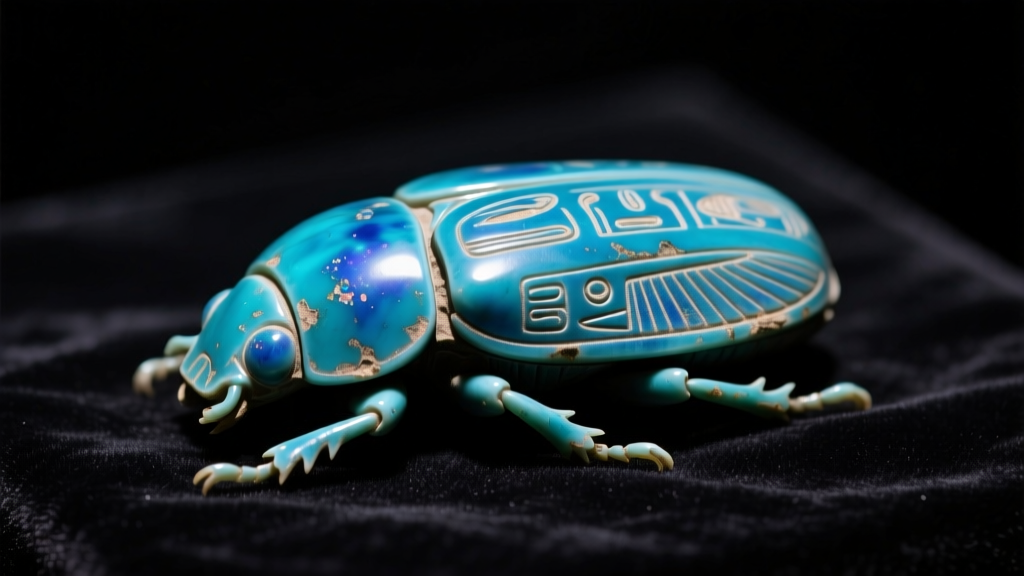
The allure of ancient Egyptian scarab beetle jewelry has captivated collectors, historians, and fashion enthusiasts for centuries. Far more than mere decoration, these intricate amulets served as powerful talismans of rebirth, protection, and divine connection. Whether you are an aspiring antiquities collector or a modern jewelry lover looking to incorporate historical motifs into your daily wardrobe, understanding the nuances of scarab jewelry is essential. This guide breaks down the theology, materials, authentication, and modern styling of these iconic artifacts.
The Theology of the Dung Beetle: Why the Scarab?
To appreciate ancient Egyptian scarab beetle jewelry, one must first understand its profound religious significance. The scarab amulet is modeled after the dung beetle (Scarabaeus sacer), an insect the ancient Egyptians observed rolling balls of dung across the desert floor. They drew a direct theological parallel between this behavior and the god Khepri, who was believed to roll the sun across the sky each day, only to bury it in the underworld at night and resurrect it at dawn.
Consequently, the scarab became the ultimate symbol of kheper—a word meaning 'to come into being' or 'to transform.' While small scarabs were worn in life as signet rings or protective pendants, the 'Heart Scarab' played a critical role in death. Placed over the heart of the mummy, these larger, flat-bottomed stones were inscribed with Chapter 30B of the Book of the Dead, imploring the heart not to testify against the deceased during the Weighing of the Heart ceremony in the afterlife.
Decoding the Materials: Faience, Gold, and Gemstones
When browsing the Metropolitan Museum of Art's online collection, you will notice that scarabs were crafted from a wide hierarchy of materials, largely dictated by the wealth of the owner and the intended purpose of the amulet. Understanding these materials is crucial for evaluating both antique and modern revival pieces.
| Material | Historical Context | Mohs Hardness | Modern Market Price Range |
|---|---|---|---|
| Faience (Glazed Steatite) | Most common; copper-glazed for blue/green hues representing rebirth. | 5.0 - 6.0 | $150 - $1,500 (Antique) |
| Lapis Lazuli | Imported from Afghanistan; reserved for royalty and high priests. | 5.0 - 5.5 | $300 - $3,000+ |
| Carnelian | Sourced locally; associated with the blood of Isis and vital energy. | 6.5 - 7.0 | $200 - $1,200 |
| Gold | Considered the 'flesh of the gods'; used for royal signet rings. | 2.5 - 3.0 | $2,500 - $20,000+ |
Faience deserves special attention. It is not a clay, but rather a composite material made from crushed quartz or sand, shaped, and coated in a copper-based alkaline glaze. When fired, it produces the brilliant turquoise and lapis-blue colors synonymous with Egyptian art. Because the core is essentially glass and sand, faience is highly susceptible to chipping and environmental degradation over millennia.
Authentic Antiquities vs. Revival Pieces
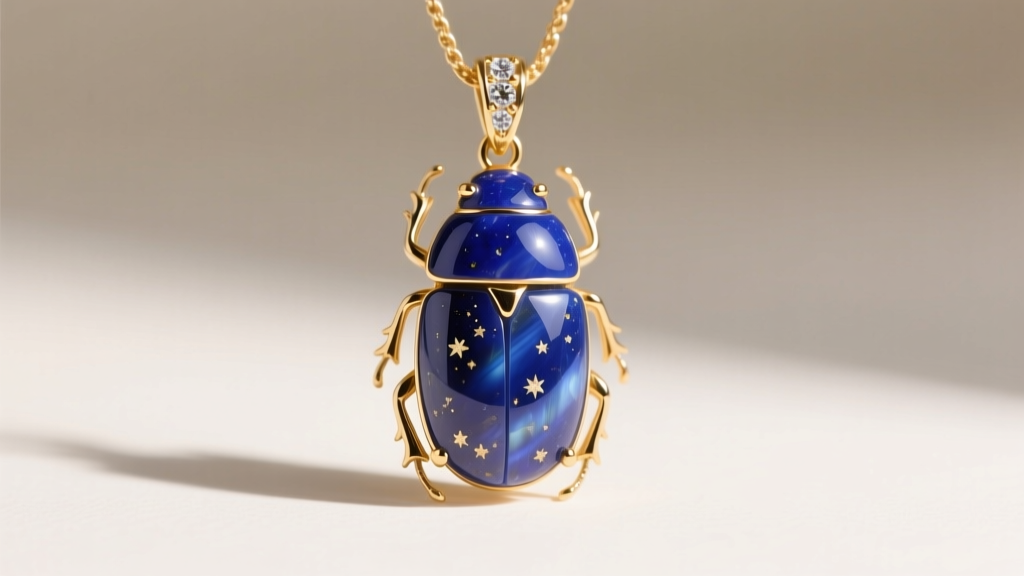
The market for ancient Egyptian scarab beetle jewelry is notoriously flooded with forgeries and later revival pieces. The discovery of Tutankhamun's tomb in 1922 sparked a massive 'Egyptomania' trend, leading jewelers in the 1920s and 1930s to mass-produce scarab jewelry. While these Victorian and Art Deco revival pieces hold their own historical and aesthetic value, they should not be sold as ancient antiquities.
How to Spot Genuine Antiquities
- Base Inscriptions: Authentic scarabs used as administrative seals feature deeply carved, asymmetrical hieroglyphs on the flat base. Forgeries often feature shallow, symmetrical, or 'pseudo-hieroglyphs' that mimic the look of writing but lack linguistic sense.
- Tool Marks: Ancient artisans used copper and bronze tubular drills, leaving specific, slightly irregular bore marks in the piercing holes. Modern fakes often show the uniform, high-speed striations of steel drill bits.
- Glaze Degradation: Genuine faience scarabs buried for 3,000 years will exhibit micro-crazing (a network of fine cracks in the glaze) and localized iridescence or mineral deposits that are nearly impossible to fake convincingly.
For reliable visual comparisons, the British Museum's collection database offers high-resolution imagery of verified, excavated scarabs spanning the Middle and New Kingdoms.
Modern Styling: Wearing Scarab Jewelry in 2026
Integrating ancient motifs into a contemporary wardrobe requires a balance of reverence and modern aesthetics. The swivel ring—a design invented by the Egyptians where the scarab is mounted on a wire axis allowing it to flip between the carved beetle back and the inscribed seal base—remains one of the most functional and interactive jewelry designs in history.
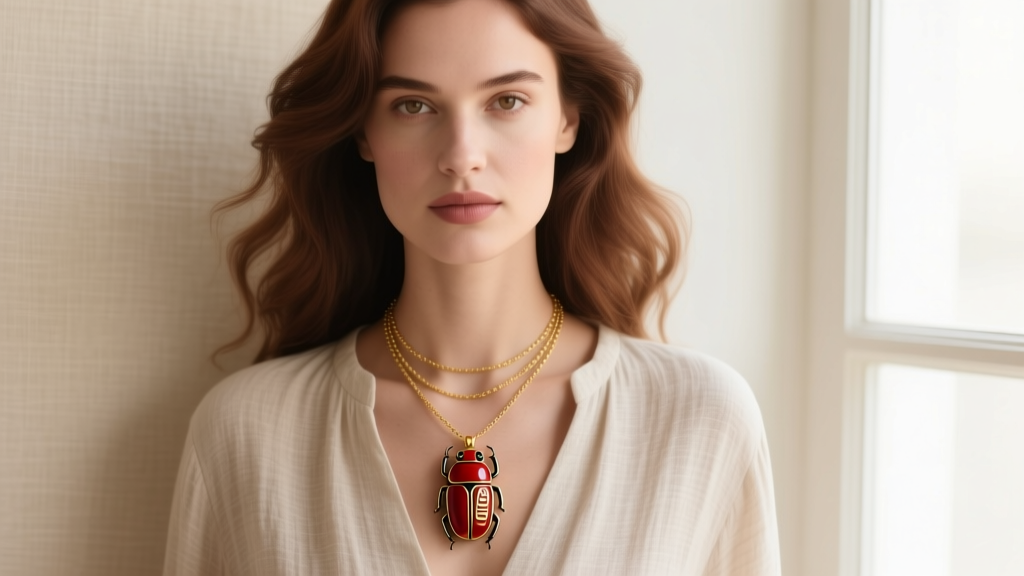
For everyday wear, consider a minimalist approach. A single, bezel-set carnelian or lapis lazuli scarab pendant on a 16-inch 14k gold chain offers a subtle nod to antiquity without looking like a costume. If you prefer the maximalist trend dominating 2026 fashion, layer a larger faience scarab necklace with textured gold herringbone chains and small lapis lazuli bead necklaces. The organic, asymmetric shapes of ancient stones pair beautifully with raw, hammered gold settings that mimic ancient metalworking techniques.
'The scarab is not merely a historical artifact; it is an interactive piece of ancient engineering. Wearing a swivel ring connects you to a 4,000-year-old tradition of tactile meditation, where the act of spinning the seal was a daily ritual of identity and protection.'
Conservation and Care for Delicate Pieces
Caring for ancient Egyptian scarab beetle jewelry requires strict adherence to conservation principles, especially when dealing with porous or fragile materials. Never use ultrasonic cleaners or commercial silver dips on any piece featuring faience, lapis lazuli, or turquoise. Ultrasonic vibrations will shatter the fragile glaze of ancient faience and can cause lapis lazuli—which is often stabilized with wax or resin—to fracture or discolor.
Instead, clean your scarabs using a soft, dry, natural-bristle brush to gently dislodge dust from the carved hieroglyphs on the base. If the metal setting requires polishing, use a microfiber cloth and carefully avoid the stone. Store your pieces individually in acid-free tissue paper within a climate-controlled environment, as high humidity can cause the copper compounds in faience glaze to develop destructive 'bronze disease' or weep salts.
Sourcing Reputable Scarab Jewelry
Whether you are hunting for a genuine New Kingdom artifact or a high-quality modern artisan recreation, provenance and transparency are paramount. When buying antiquities, always demand documentation or a verifiable collection history (provenance) predating the 1970 UNESCO convention on cultural property. Reputable auction houses and specialized antiquities dealers will provide this paperwork. For those seeking the aesthetic without the ethical complexities of the antiquities trade, look for modern jewelers who specialize in historical reproductions, using ethically sourced lapis and traditional lost-wax casting methods to honor the original Egyptian artisans.


