Ancient Greek Jewelry: A Buyer's Guide to Motifs & Metals
Discover how to buy ancient Greek jewelry with confidence. Learn to identify authentic motifs, evaluate gold purity, and spot quality reproductions.

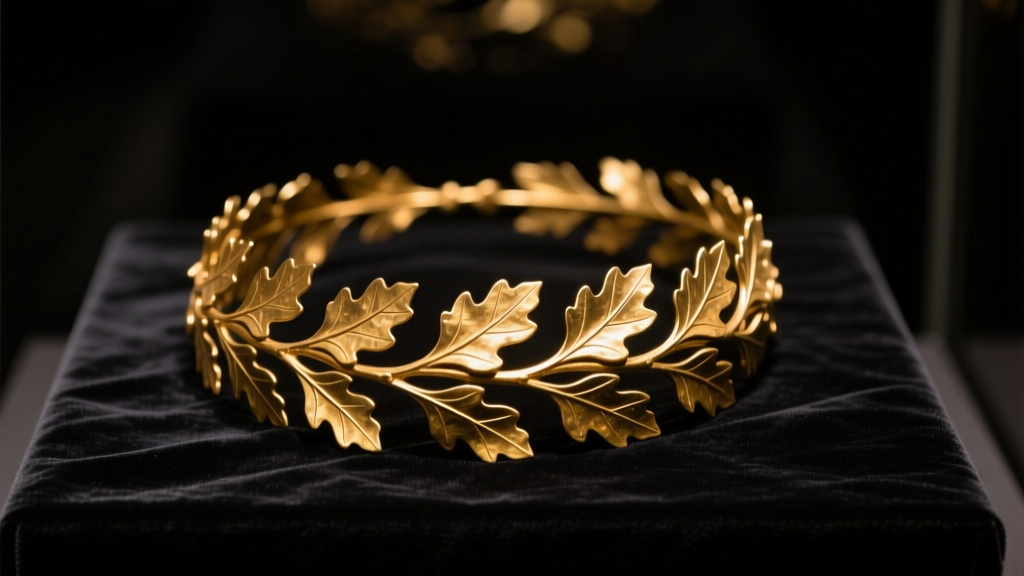
The market for ancient greek jewelry is as captivating as it is complex. From the geometric simplicity of the Archaic period to the opulent, gem-encrusted masterpieces of the Hellenistic era, these artifacts offer a tangible connection to classical antiquity. However, navigating this niche requires more than an appreciation for aesthetics; it demands a rigorous understanding of ancient metallurgy, authentication protocols, and international cultural heritage laws. Whether you are a seasoned collector seeking museum-grade antiquities or a historian looking for high-end reproductions, this comprehensive buying guide will equip you with the technical knowledge required to make informed, secure acquisitions.
The Metallurgical Reality: Karats, Alloys, and XRF Testing
A common misconception among novice collectors is that surviving ancient greek jewelry is made of pure, 24-karat gold. In reality, ancient metallurgists rarely achieved absolute purity. Most authenticated Hellenistic gold artifacts range between 18k and 22k (75% to 91.6% gold). The remaining composition typically consists of natural silver and copper inclusions, as the ancients relied on placer gold and early smelting techniques that could not fully separate these base metals.
When evaluating a potential purchase, the color and density of the metal are your first clues. Ancient gold often exhibits a slightly warmer, paler, or even faintly greenish hue due to silver content (electrum). Modern fakes, conversely, are frequently cast in bright, brassy 14k gold or heavily plated in blinding 24k gold to mimic 'pure' antiquity. Serious buyers should always request X-ray Fluorescence (XRF) spectrometry reports. XRF scanning provides a non-destructive, precise elemental breakdown of the alloy, confirming whether the trace elements (like lead or platinum group elements) align with known ancient Mediterranean ore signatures rather than modern industrial refining.
Decoding Hellenistic Motifs and Techniques
The artistry of ancient greek jewelry is defined by specific manufacturing techniques that are exceedingly difficult for modern forgers to replicate authentically. Understanding these methods is critical for verifying provenance and craftsmanship.
Repoussé and Chasing
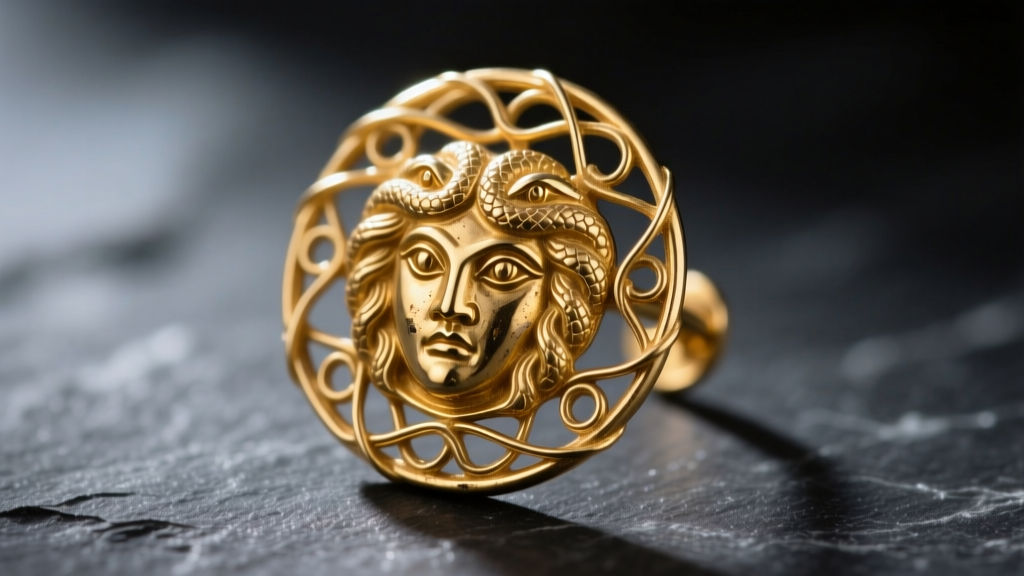
Hellenistic goldsmiths were masters of repoussé, a technique involving hammering malleable gold from the reverse side to create a raised, three-dimensional relief on the front. This was often followed by 'chasing' on the front to refine the details. When examining a piece, look for variations in metal thickness. Authentic repoussé will show thinning at the highest points of the relief and compression marks on the interior. Modern cast fakes will have a uniform thickness and lack the microscopic tool marks characteristic of hand-hammering.
The Secret of Colloidal Granulation
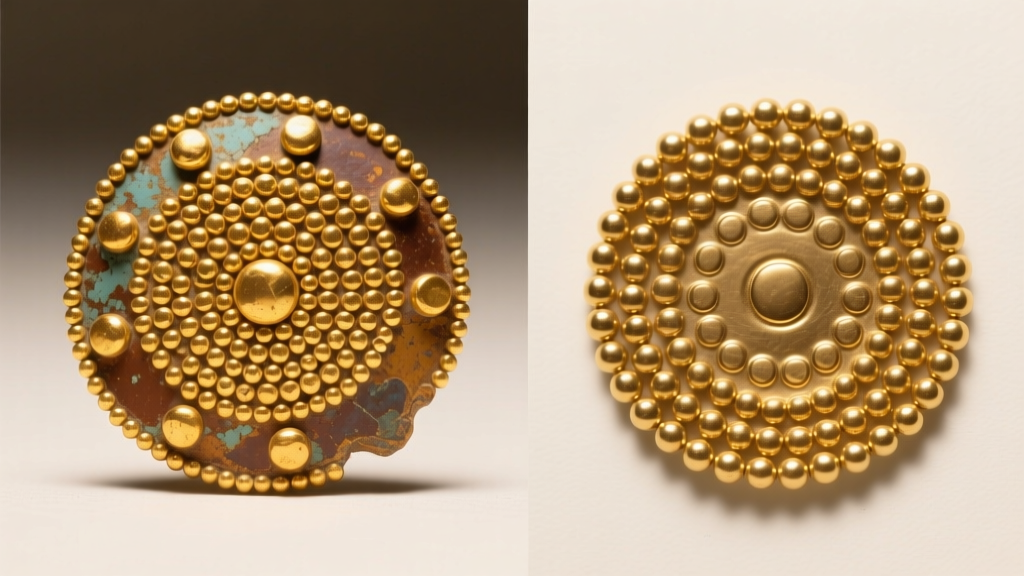
Granulation—the application of microscopic gold spheres to a gold surface without visible solder—is a hallmark of classical antiquity. The Greeks and Etruscans achieved this using a colloidal hard-soldering technique. They mixed copper salts (like malachite or verdigris) with an organic binder, such as fish glue. When heated in a reducing kiln, the organic binder carbonized, and the copper salts reduced to pure copper, creating a eutectic alloy that melted at a lower temperature than the gold base, fusing the granules seamlessly. Under 30x magnification, authentic granulation will show a smooth, flowing meniscus where the sphere meets the base. Modern fakes often use laser welding or bright, visible silver-solder, which leaves distinct, anachronistic pooling.
Iconic Motifs to Look For
- The Herakles Knot: Also known as the reef knot, this motif was widely used in marriage girdles and diadems, symbolizing protection and the unbreakable bond of matrimony.
- Gorgoneion: The head of Medusa was a prevalent apotropaic (evil-averting) symbol, often featured on signet rings and pendant earrings.
- Maenads and Eros: Hellenistic earrings frequently featured intricate, three-dimensional figures of maenads (followers of Dionysus) or Eros, often holding theatrical masks or amphorae.
Evaluating Bronze and Silver Artifacts
While gold commands the highest premiums, bronze and silver ancient greek jewelry offer accessible entry points for collectors. However, these metals are highly susceptible to environmental degradation, requiring careful inspection.
Silver and Horn Silver: Ancient silver artifacts rarely emerge from the ground looking like polished sterling. They are often heavily mineralized, encased in a hard, purplish-grey crust known as 'horn silver' (silver chloride). Over-cleaning by amateur sellers can strip this historical patina, exposing pitted, crystalline metal underneath and significantly reducing the artifact's archaeological value.
Bronze Disease: This is the most critical failure mode for ancient bronze jewelry. Bronze disease is a destructive chemical reaction caused by cuprous chloride interacting with atmospheric moisture, producing hydrochloric acid and cuprite. It manifests as powdery, pale green, or white spots that actively flake away. A stable, ancient patina (malachite or cuprite) should be hard, dark green, or reddish-brown, and tightly adhered to the metal. Never purchase a bronze artifact exhibiting powdery, light-green spots, as the piece will continue to disintegrate even in a controlled environment without expensive chemical stabilization.
Market Pricing and Provenance Tiers
The valuation of ancient greek jewelry is inextricably linked to its provenance and legal status. The market is strictly segmented based on documentation.
| Category | Price Range (USD) | Material & Quality | Provenance Requirement |
|---|---|---|---|
| Museum-Quality Antiquity | $25,000 - $150,000+ | High-karat gold, intact repoussé, rare motifs | Pre-1970 export docs, published in academic catalogs |
| Standard Authenticated Antiquity | $3,000 - $15,000 | Gold/Silver, minor restorations, common motifs | Verifiable auction history, reputable dealer certification |
| Museum-Grade Reproduction | $800 - $4,000 | 18k-22k gold, hand-forged using ancient techniques | N/A (Sold as modern art by master goldsmiths) |
| Commercial Reproduction | $150 - $600 | 14k gold or vermeil, cast from molds, uniform finish | N/A (Mass-produced for tourist and fashion markets) |
Legalities and the 1970 UNESCO Convention
Perhaps the most vital aspect of buying ancient greek jewelry is understanding international cultural heritage law. The Getty Conservation Institute and global antiquities markets operate under the framework of the 1970 UNESCO Convention. This treaty mandates that any artifact excavated or exported from its country of origin after November 1970 without explicit government permission is considered illicit.
When purchasing from prestigious auction houses like Christie's or Sotheby's, or from vetted antiquities dealers, you must demand a continuous chain of ownership dating prior to 1970. Acceptable provenance includes old European collection inventories, pre-1970 auction catalogs, or export licenses from the Greek Ministry of Culture. Buying unprovenanced 'fresh to market' artifacts not only funds illicit looting but also exposes the buyer to severe legal penalties and the permanent confiscation of the piece by international authorities. For comprehensive guidelines on Hellenistic artifacts, refer to the Metropolitan Museum of Art's Heilbrunn Timeline of Art History.
Caring for and Preserving Antiquities
Once acquired, ancient greek jewelry requires specialized conservation strategies to ensure its survival for future generations. Never use commercial jewelry dips, ultrasonic cleaners, or abrasive polishes on antiquities. These methods will instantly strip millennia-old stable patinas and can dissolve the fragile eutectic bonds of ancient granulation.
Store gold and silver pieces in acid-free, archival-quality tissue paper within a climate-controlled environment. For bronze artifacts, humidity control is non-negotiable; maintain a relative humidity (RH) level strictly below 40% to prevent the activation of dormant cuprous chlorides. As noted by conservators at The British Museum, the safest cleaning method for delicate gold diadems or earrings is the gentle application of distilled water and a soft sable brush, followed by careful drying with a low-heat air blower. By respecting both the historical integrity and the physical fragility of these pieces, collectors serve as custodians of classical history.


