Ancient Egyptian Scarab Jewelry: Troubleshooting Fakes & Damage
Learn how to authenticate, clean, and repair ancient Egyptian scarab jewelry. Expert troubleshooting for faience, steatite, and vintage reproductions.

The Authentication Dilemma: Original vs. Tourist Trade
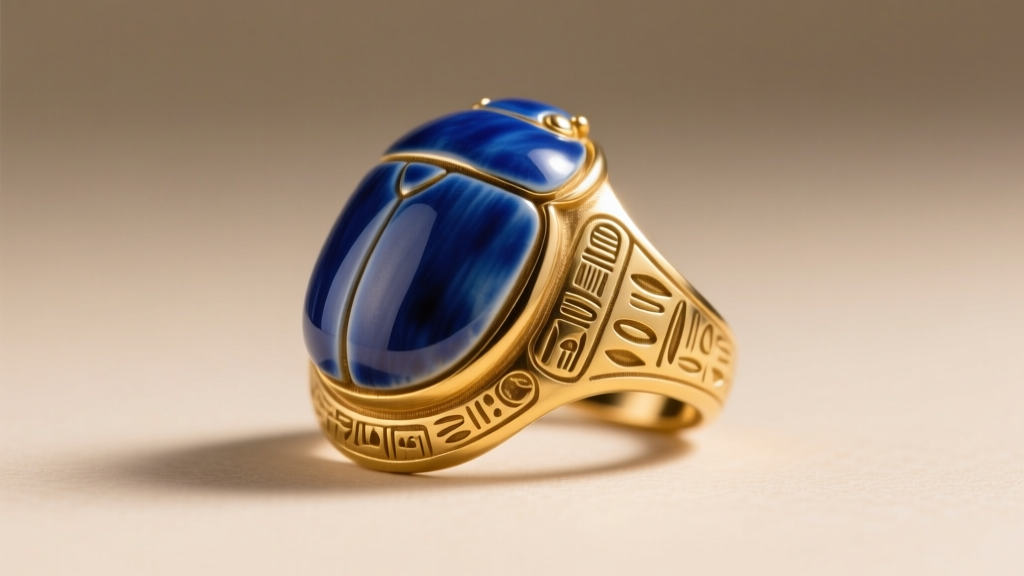
Collecting and wearing ancient Egyptian scarab jewelry is a pursuit fraught with pitfalls. The market is heavily saturated with Victorian-era 'tourist trade' reproductions and modern synthetic casts masquerading as New Kingdom (1550–1070 BCE) artifacts. For collectors and jewelers, troubleshooting the authenticity of a scarab requires moving beyond superficial visual checks and examining the microscopic and material realities of the piece. According to the Metropolitan Museum of Art's Heilbrunn Timeline, the scarab beetle (Khepri) was a potent symbol of rebirth, meaning these items were mass-produced in antiquity, but modern fakes vastly outnumber genuine survivals.
Material Diagnostics: Faience vs. Steatite vs. Resin
The most common authentic materials are faience and steatite. Faience is not a clay-based ceramic; it is a sintered-quartz material that relies on copper oxides to produce its iconic blue-green hues. Over three millennia, the alkaline fluxes in ancient faience can devitrify, leading to a matte, chalky surface. Modern fakes often use dyed resin or polymer clays. A definitive troubleshooting test involves thermal conductivity: genuine steatite and faience will feel noticeably cold to the touch and take longer to warm up against the skin compared to room-temperature resin. Furthermore, under 30x magnification, genuine ancient faience will reveal a granular, sandy internal structure if chipped, whereas resin will show a homogenous, bubble-filled matrix.
The Drill Hole Tell
The most reliable diagnostic feature for authenticating ancient Egyptian scarab jewelry is the longitudinal drill hole. Ancient artisans used bow drills equipped with copper tubes and quartz sand abrasives. This slow, imprecise process invariably resulted in biconical (hourglass-shaped) holes, where the drill was worked from both ends and met in the middle, often leaving a slight ridge or misalignment at the center. Modern fakes are drilled with high-speed steel twist bits, leaving perfectly cylindrical holes with parallel, uniform striations. If you can look through the piercing of a scarab ring and see a perfectly straight, machine-smooth tunnel, you are likely holding a 19th-century Grand Tour souvenir or a modern replica.
Troubleshooting Structural Damage in Scarab Rings
Setting an ancient artifact into modern wearable jewelry introduces severe mechanical risks. Ancient scarabs were carved from relatively soft stones, and subjecting them to the daily impacts of ring wear requires specialized troubleshooting and conservation techniques.
Rebuilding Crumbled Steatite
Steatite (soapstone) ranks a mere 1 to 2.5 on the Mohs hardness scale. It is incredibly friable. A common failure mode in vintage scarab rings is the crumbling of the scarab's base or the edges of the pronotum (the shield-like section behind the head) due to friction against the metal mount. 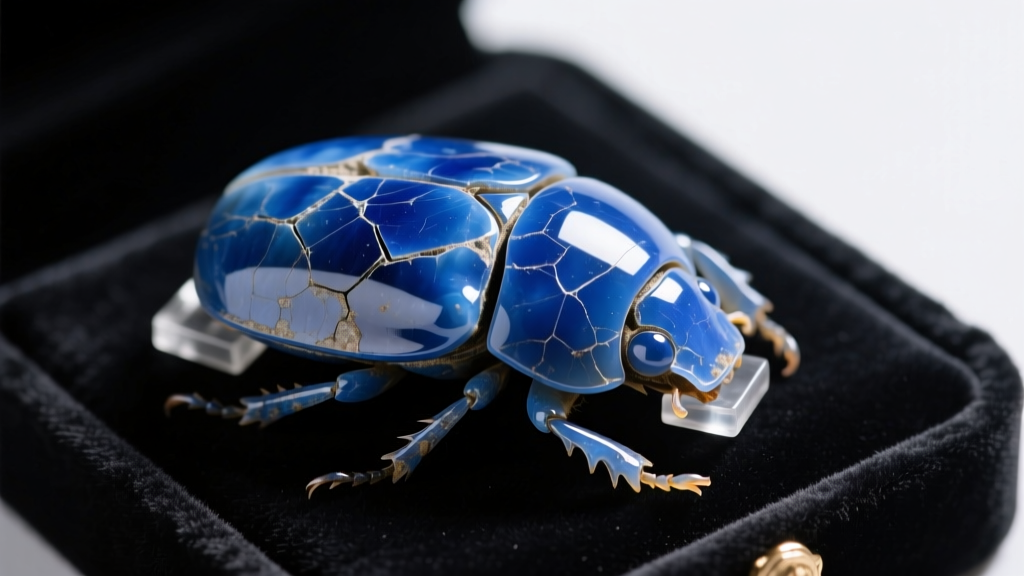 To stabilize flaking or crumbling steatite, conservationists use Paraloid B-72, an ethyl methacrylate copolymer dissolved in acetone. This solution wicks into the micro-fissures via capillary action and cures into a stable, reversible, and optically clear consolidant. Never use cyanoacrylate (Super Glue) or epoxy, as these are irreversible, will yellow over time, and can permanently stain the porous stone.
Bezel Tension and Prong Failures
Prong settings are an absolute contraindication for ancient scarabs. The localized pressure of a prong being pushed over the edge of a steatite or faience stone will almost certainly cause a shear fracture. Even bezel settings pose risks if the gold alloy is too hard. Standard 14k or 18k white gold is highly springy and requires significant force to burnish down. This outward pressure can crack the scarab. The professional solution is to fabricate the bezel cup from dead-soft 22k or 24k yellow gold. The pure gold yields easily under a burnisher, securing the stone with minimal lateral stress. If the scarab has an asymmetrical or uneven base, the bezel must be custom-fitted with an internal sleeve or inert museum wax to prevent the stone from rocking, which causes abrasive wear.
| Issue | Root Cause | Professional Troubleshooting Fix |
|---|---|---|
| Scarab wobbles in bezel | Asymmetrical ancient carving | Carve a custom silicone insert or use micro-crystalline museum wax for a tension-free fit. |
| Glaze flaking / crazing | Moisture expansion and salt crystallization | Consolidate with 3-5% Paraloid B-72 in acetone; avoid all liquid cleaners. |
| Shank snapping near mount | Hard gold alloy gripping soft stone | Rebuild shank; anneal the bezel or use a 22k gold inner sleeve to reduce compressive stress. |
| Drill hole widening | Metal wire friction in necklaces | Restrung using synthetic cord with protective Teflon or silk tubing inside the drill hole. |
Cleaning Protocols: What Destroys Ancient Glazes
One of the most frequent troubleshooting scenarios arises when well-meaning owners attempt to clean their ancient Egyptian scarab jewelry using commercial jewelry dips or ultrasonic cleaners. This is catastrophic for ancient materials.
"Ultrasonic cavitation will literally shatter the devitrified glaze of ancient faience and strip the painted details from carved steatite in seconds. Never subject antiquities to high-frequency vibrations."
The alkaline glazes of ancient faience are highly susceptible to chemical degradation. Ammonia-based cleaners will strip the copper-oxide patina, leaving the stone a pale, lifeless white. Similarly, acidic solutions (like vinegar or lemon juice, often wrongly recommended for 'natural' cleaning) will etch the calcium carbonate binders in steatite.
- Safe Cleaning Method: Use a soft, natural-bristle brush (like a makeup brush) to gently dislodge dry particulate matter from the carved hieroglyphs on the flat base.
- For Stubborn Grime: Lightly dampen a cotton swab with distilled water (never tap water, as dissolved salts will migrate into the stone and crystallize upon drying, causing spalling). Roll the swab gently over the surface without applying downward pressure.
- Drying: Allow the piece to air-dry in a low-humidity environment. Do not use heat or compressed air.
Sourcing and Setting: Modern Solutions for Ancient Stones
When commissioning a new setting for an unmounted ancient scarab, the jeweler must approach the piece as a conservator first and a designer second. 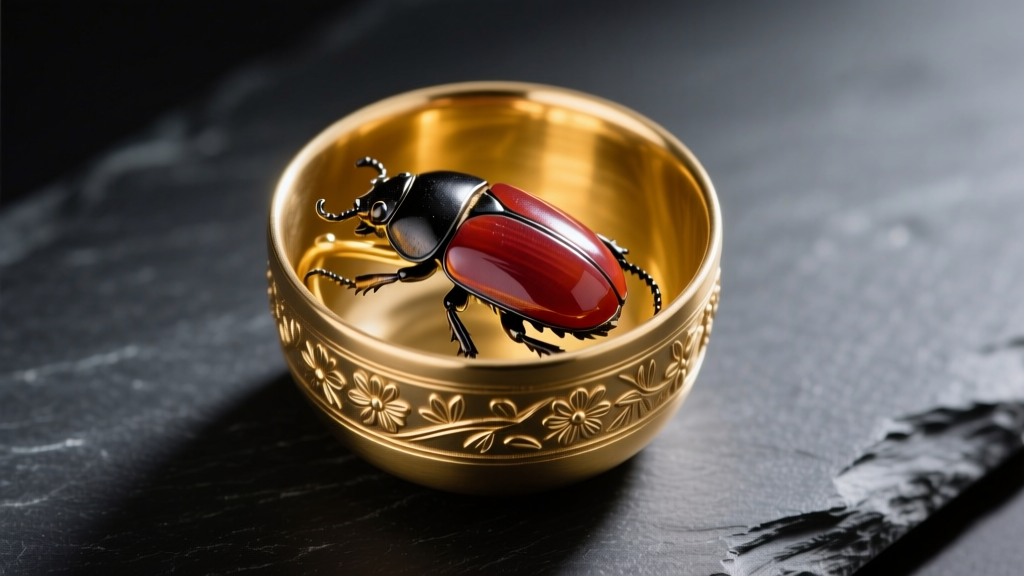 According to guidelines from institutions like the British Museum, any modern intervention should be reversible. This means avoiding soldering directly adjacent to the stone, as the thermal shock can cause carnelian or lapis lazuli scarabs to fracture. Laser welding is the preferred method for closing bezels near heat-sensitive antiquities.
Furthermore, if you are troubleshooting the restringing of an ancient scarab bead necklace, never use metal wire. Over decades, the micro-movements of a gold or silver wire will act like a saw, slowly drilling through the soft steatite and enlarging the ancient hole. Always use high-tensile synthetic cords (like WildFire or PowerPro) and line the interior of the scarab's drill hole with a microscopic sleeve of PTFE (Teflon) tubing to prevent cord abrasion against sharp internal quartz grains.
Conclusion
Maintaining and authenticating ancient Egyptian scarab jewelry requires a departure from standard gemological practices. By understanding the specific material vulnerabilities of faience and steatite, recognizing the telltale signs of biconical drilling, and employing conservation-grade mounting techniques, collectors can preserve these ancient artifacts for future generations. For further reading on material identification, the Gemological Institute of America (GIA) offers extensive resources on the optical and physical properties of ancient ornamental stones, bridging the gap between historical artifact and wearable art.


