Styling High End Men's Jewelry: A Technical Deep Dive
Discover how to style high end men's jewelry with our technical deep dive into metallurgy, carat weights, gauge sizing, and proportional fit.

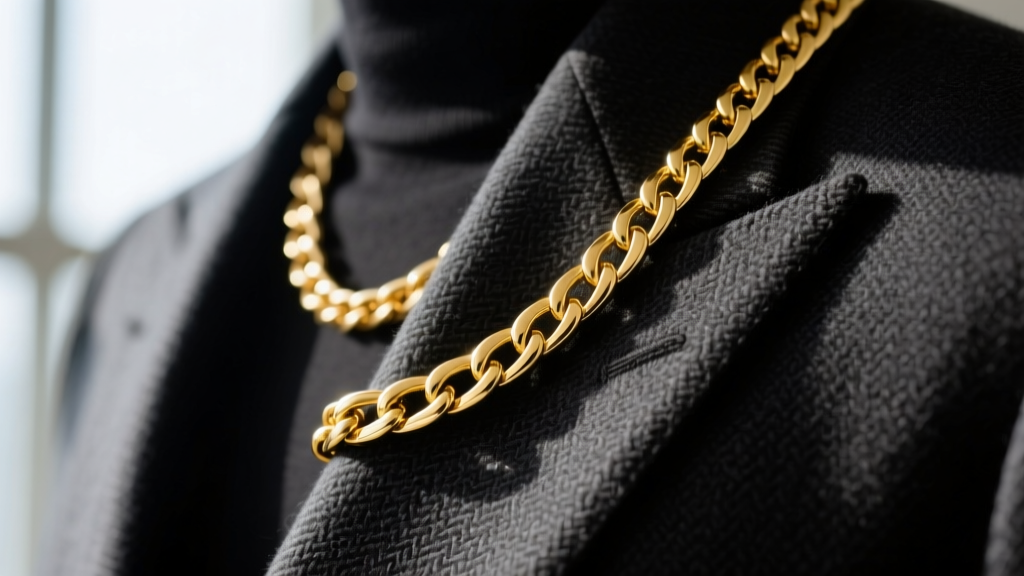
When curating a collection of high end men's jewelry, moving beyond basic aesthetics into the realm of metallurgy, structural engineering, and proportional styling is what separates a mere accessory buyer from a true connoisseur. Luxury men's pieces are not just about brand prestige; they are feats of material science and micro-mechanics. Understanding the Vickers hardness of precious alloys, the shear strength of clasp mechanisms, and the exact drop lengths required for specific sartorial contexts will fundamentally elevate how you select and wear your pieces.
This technical guide dissects the engineering and styling mechanics behind luxury men's adornments, providing actionable frameworks for building a capsule collection that performs flawlessly in both boardroom and black-tie environments.
The Metallurgy of Luxury: Decoding Precious Metal Alloys
The foundation of any luxury piece lies in its alloy composition. Pure 24k gold registers at roughly 25 HV (Vickers Hardness), making it far too malleable for daily-wear rings or heavy chains. Consequently, the Gemological Institute of America (GIA) notes that high end men's jewelry predominantly utilizes 18k (75% purity) or 14k (58.3% purity) alloys to achieve the necessary structural integrity.
Gold Alloys and Hardness Profiles
- 18k Yellow Gold: Alloyed primarily with silver and copper. It sits at approximately 125 HV. It offers the ideal balance of rich color and durability for signet rings and chains, though it will develop a soft patina over time.
- 18k Palladium White Gold: Unlike nickel-based white gold (which can cause contact dermatitis), palladium alloys are hypoallergenic and naturally possess a darker, steel-like hue. They require less frequent rhodium plating, making them superior for heavy-wear items like wedding bands and cufflinks.
- 14k Rose Gold: With a higher copper content (up to 22%), 14k rose gold can reach 160 HV. The increased copper not only provides the distinct pinkish hue but significantly boosts tensile strength, making it excellent for intricate link bracelets.
Platinum: The Density Advantage
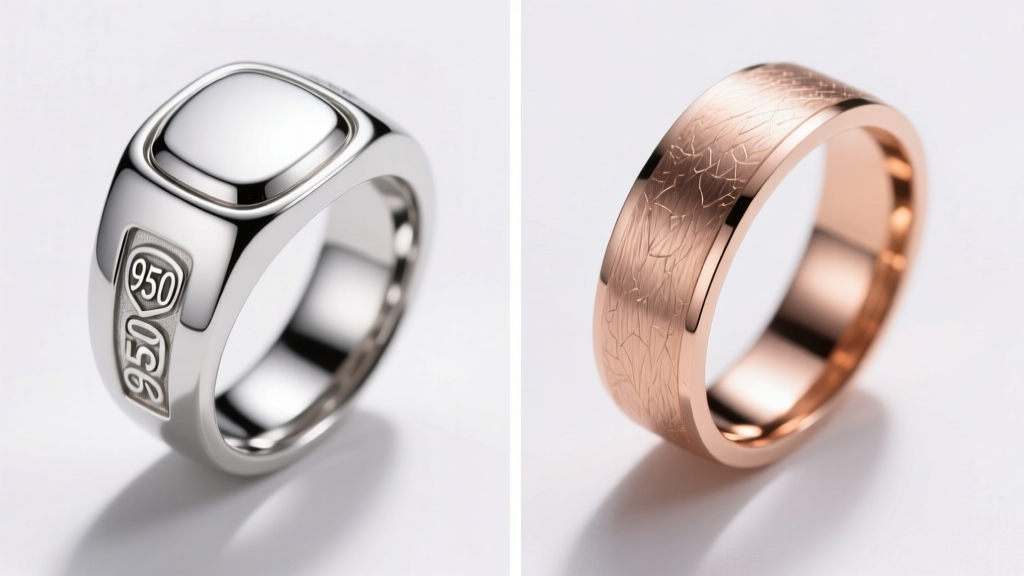
Platinum 950 (95% pure platinum) is the undisputed heavyweight of luxury metals. However, the remaining 5% alloy dictates its behavior. Platinum alloyed with Ruthenium (Pt950/Ru) yields a harder metal (~135 HV) with a slightly darker, gunmetal undertone, ideal for sharp, geometric designs. Conversely, Iridium alloys (Pt950/Ir) are softer (~90 HV) but brighter, often preferred for high-polish dome rings. Because platinum displaces rather than loses metal when scratched, it is the only precious metal that can be endlessly polished without compromising its structural gauge.
Proportional Styling: Matching Gauge and Scale to Physique
A common failure in men's styling is ignoring the relationship between body mass, wrist/neck circumference, and jewelry gauge. A 4mm chain on a man with a 20-inch neck and broad shoulders will look disproportionately fragile, while a 12mm chain on a slender frame can appear ostentatious and overwhelm the collarbone.
The Proportion Matrix
Use the following technical matrix to determine the optimal chain width and bracelet gauge based on your physical metrics. These recommendations assume a standard 18-inch chain drop and a 7.5-inch bracelet circumference.
| Body Type / Build | Neck Circumference | Optimal Chain Width | Optimal Bracelet Gauge | Approx. Chain Weight |
|---|---|---|---|---|
| Slender / Ectomorph | 14" - 15" | 2.5mm - 4.0mm | 4.0mm - 6.0mm | 15g - 35g |
| Athletic / Mesomorph | 15.5" - 17" | 4.5mm - 7.0mm | 7.0mm - 9.0mm | 40g - 85g |
| Heavy / Endomorph | 17.5" - 20"+ | 8.0mm - 12.0mm | 10.0mm - 14.0mm | 95g - 180g+ |
Hardware and Clasp Failure Modes
When dealing with high end men's jewelry, the clasp is the most frequent point of mechanical failure. According to manufacturing standards cited by Jewelers of America, standard spring-ring clasps are rated for a maximum static load of roughly 15 grams. If you are wearing an 80-gram 18k gold Cuban link, a spring-ring or small lobster clasp will inevitably deform under lateral stress.
- Lobster Claws: Suitable for chains up to 40g. Ensure the lever mechanism has a high-tension spring.
- Fold-Over Clasps: Ideal for medium-weight link bracelets (40g-70g). They rely on friction and a mechanical latch, distributing stress across a wider surface area.
- Custom Box Clasps with Dual Safeties: Mandatory for any chain exceeding 75g. The tongue must be precision-milled to click into the box, supplemented by two figure-eight safety catches on the exterior to prevent catastrophic loss if the primary tongue bends.
Sartorial Integration: Clearances and Fabric Pairings
High end men's jewelry must integrate seamlessly with the geometry of menswear. This requires an understanding of shirt weaves, collar spreads, and fabric weights.
Necklines and Chain Drops
The "drop" is the total circumference of the chain. For a standard dress shirt worn with the top button undone (spread collar), an 18-inch drop will sit precisely at the clavicle notch, framing the neck without dipping into the visible chest area. If you prefer a relaxed, unbuttoned camp-collar shirt in a lightweight linen, a 20-inch to 22-inch drop is required so the pendant or chain links rest against the sternum rather than tangling in the shirt placket.

Cufflinks and Shirt Weaves
The weight and face diameter of your cufflinks must correspond to the fabric weight of your shirt. A heavy, 18k gold and mother-of-pearl cufflink (weighing 12+ grams per pair) will pull and distort the delicate drape of a 100s-count poplin or voile shirt. Reserve heavy, oversized cufflinks for twofold oxford or herringbone weaves, which possess the structural rigidity to support the hardware. For fine poplins and eveningwear, opt for low-profile silk knots or minimalist 8mm metal bullet-back cufflinks that slide easily through single or double French cuffs without creating tension puckers.
Maintenance and Patina Management
Owning luxury pieces requires a proactive approach to surface finishing. High-polish platinum and gold will inevitably accumulate micro-scratches (commonly referred to as a "patina"). Rather than constantly sending pieces to a jeweler for abrasive machine polishing—which removes microscopic layers of metal and softens sharp, milled edges over time—embrace alternative finishes.
"A brushed or satin finish is the ultimate pragmatic choice for daily-wear high end men's jewelry. The directional scratching inherent in a brushed surface naturally masks the micro-abrasions of daily life, maintaining the piece's architectural integrity for decades."
For high-polish rings, utilize a non-abrasive jewelry polishing cloth infused with micro-jeweler's rouge once a month to restore luster without removing metal mass. By mastering the metallurgy, respecting proportional scaling, and understanding the mechanical limits of luxury hardware, you transform your jewelry from mere decoration into a meticulously engineered extension of your personal style.


