The Antique Jewelry Casket: 2026 Collector & Styling Trends
Discover 2026 trends for the antique jewelry casket. Explore valuation, Boulle and guilloché identification, and curatorial styling tips.

The Renaissance of the Antique Jewelry Casket in Modern Collecting
As we navigate the 2026 collector market, a distinct shift has occurred in how enthusiasts approach historical adornment. The focus is no longer solely on the gems and metals worn on the body, but on the vessels that house them. The antique jewelry casket has transcended its utilitarian roots to become a highly sought-after category of objet de vertu. Today’s collectors and interior stylists view these pieces not merely as storage, but as standalone sculptural art that anchors a room's aesthetic.
Whether crafted from intricate Tunbridge ware micro-mosaics, adorned with French ormolu, or showcasing the technical marvel of Russian guilloché enamel, the antique jewelry casket represents a convergence of horology, marquetry, and metallurgy. According to the Victoria and Albert Museum's jewellery archives, the evolution of these caskets from simple Georgian mahogany boxes to extravagant Art Deco coffrets mirrors the broader socio-economic shifts of the 19th and 20th centuries. In 2026, sourcing, restoring, and styling these pieces requires a nuanced understanding of historical manufacturing techniques and modern conservation ethics.
Material & Era Identification: Deconstructing the Casket
Authenticating an antique jewelry casket requires a granular understanding of era-specific materials. The market is currently saturated with high-quality mid-century reproductions, making the ability to identify period-correct craftsmanship essential for serious collectors.
Victorian Boulle and Piqué Tortoiseshell
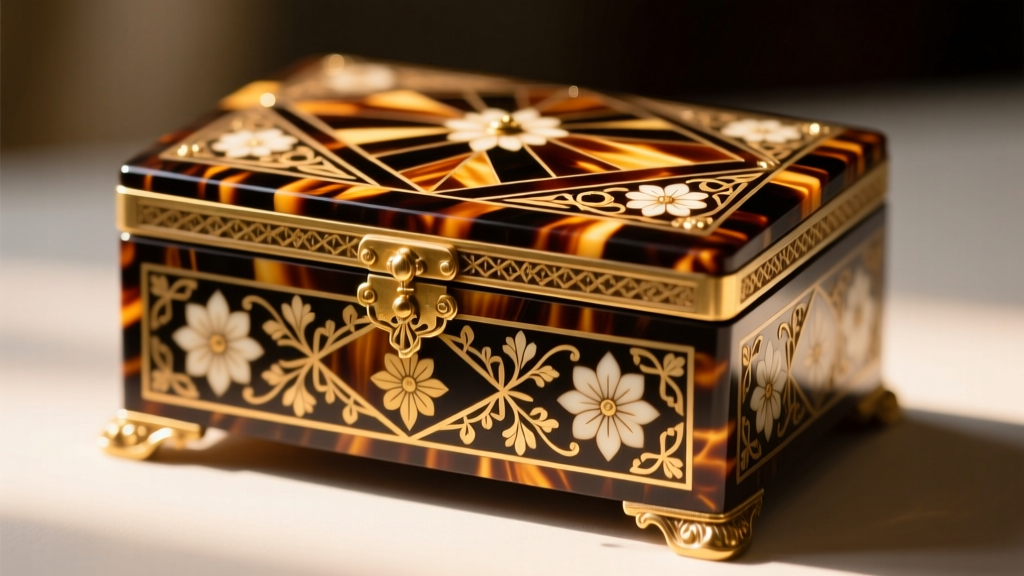
During the mid-to-late 19th century, the fascination with exotic materials led to the popularity of tortoiseshell (specifically from the hawksbill sea turtle). Master artisans utilized Boulle work—a painstaking marquetry technique inlaying engraved brass or silver into the shell. A related technique, piqué, involved heating the shell and pressing tiny gold or silver pins into it to create celestial or floral motifs. Because hawksbill turtle is now strictly protected under CITES, only pre-1947 antique caskets with verifiable provenance can be legally traded in many jurisdictions, driving premium pricing for authenticated pieces.
Art Deco Guilloché and Vermeil
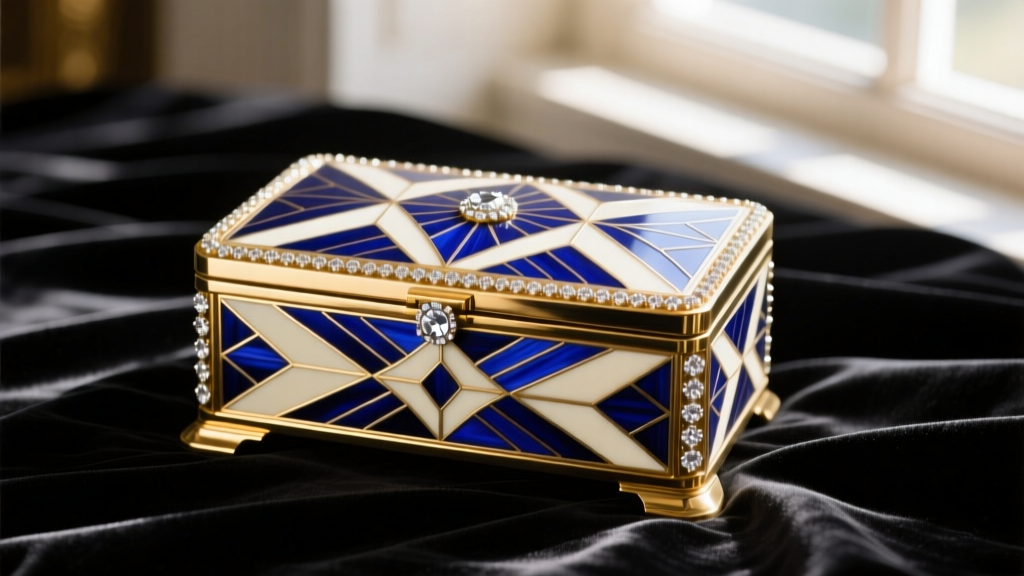
Moving into the 1920s and 30s, the antique jewelry casket embraced the machine age. The defining technique of this era is guilloché (engine-turned) enamel. Artisans used a rose engine lathe to carve precise, repetitive geometric wave patterns into a silver or gold base. This base was then coated in translucent vitreous enamel and fired in a kiln at approximately 800°C. The result is a mesmerizing, three-dimensional optical illusion. The Metropolitan Museum of Art's Art Deco overview notes that firms like Cartier and Fabergé elevated these caskets into luxury icons, often incorporating rock crystal, nephrite, and diamond-set thumbpieces.
2026 Valuation Matrix: Pricing the Antique Jewelry Casket
Valuation in the current market is heavily dictated by condition, maker's marks, and the integrity of organic materials. Below is a comprehensive pricing framework for the 2026 auction and private sale landscape.
| Era & Style | Primary Materials | Condition Factor | Estimated 2026 Market Value (USD) |
|---|---|---|---|
| Georgian (c. 1780-1830) | Flamed mahogany, brass inlay, velvet interior | Original hinges, minor veneer loss | $600 - $1,800 |
| Victorian Piqué (c. 1860-1880) | Tortoiseshell, 15k gold pins, silver inlay | Intact shell (no cracking), pristine pins | $2,500 - $6,500 |
| Edwardian (c. 1900-1910) | Sterling silver, leather, silk-lined | Clear hallmarks, minor leather desiccation | $800 - $2,200 |
| Art Deco Guilloché (c. 1920-1935) | Vermeil, vitreous enamel, jade/onyx accents | Flawless enamel, functioning mechanical clasp | $8,000 - $25,000+ |
| Mid-Century Retro (c. 1940-1950) | Bakelite, mirrored glass, chrome hardware | Original mirror silvering, intact Bakelite | $400 - $1,200 |
Curatorial Styling: Integrating Caskets into Modern Interiors
The styling of an antique jewelry casket in 2026 rejects the cluttered, dusty aesthetic of traditional antique shops. Modern interior design demands intentionality. Here are three curatorial frameworks for displaying these pieces:
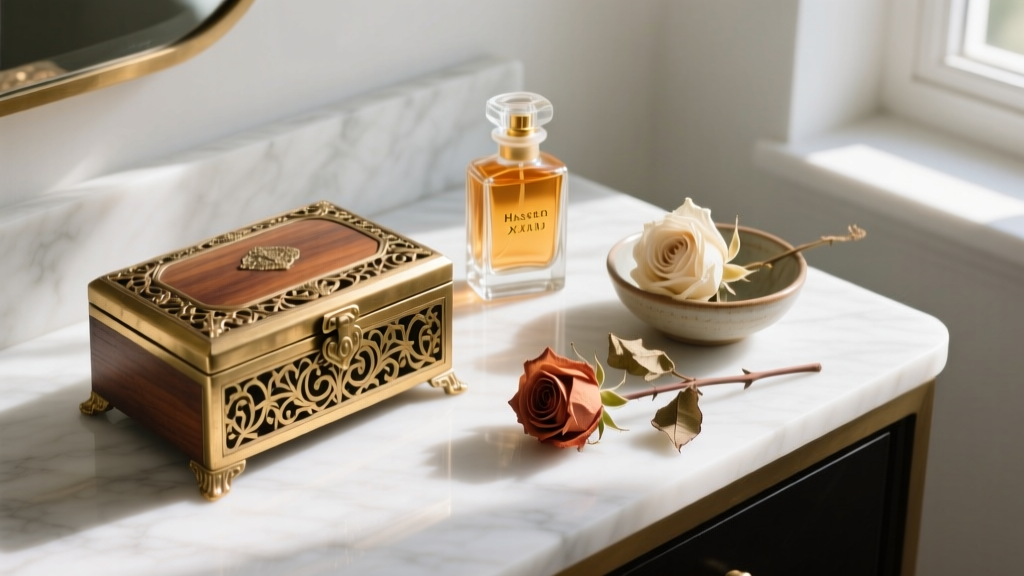
- The Glass Dome Isolation: Place a single, high-contrast piece (such as a dark tortoiseshell Boulle casket) on a minimalist acrylic plinth and cover it with a museum-grade UV-filtering glass cloche. This isolates the object, forcing the viewer to appreciate the marquetry as sculpture rather than a container.
- The Maximalist Vignette: For Art Deco enamel caskets, embrace the opulence of the era. Group the casket on a lacquered tray alongside a vintage Baccarat perfume flacon, a stack of cloth-bound design books, and a single architectural flower (like an anthurium or orchid). The juxtaposition of organic florals against geometric enamel is a hallmark of 2026 luxury styling.
- The Open-Archive Display: Leave a Georgian or Edwardian casket open on a vanity, but curate the interior. Instead of a jumble of modern chains, display a single strand of natural pearls or a pair of cameo earrings resting on the original, albeit faded, silk lining. This honors the object's original purpose while maintaining visual calm.
Preservation Protocols: Troubleshooting Hinge, Veneer, and Enamel Failures
Owning an antique jewelry casket comes with strict conservation responsibilities. The most common failure points are structural (hinges and veneers) and cosmetic (enamel chipping and metal tarnishing).
The Hide Glue Imperative
When dealing with lifting wood veneers or separating tortoiseshell, the modern instinct is to reach for PVA (wood glue) or cyanoacrylate (super glue). Never do this. Historically, these caskets were assembled using reversible animal hide glue (pearl glue). Using synthetic adhesives creates a rigid bond that will eventually tear the historic substrate when the wood or shell naturally expands and contracts with humidity changes. Always consult a conservator who will use traditional hot hide glue, allowing for future, non-destructive reversibility.
Enamel and Guilloché Stabilization
Vitreous enamel is essentially glass fused to metal. It is highly susceptible to thermal shock and impact. If an Art Deco guilloché casket suffers a micro-chip, do not attempt to fill it with modern resin, which will yellow and refract light differently than the original glass enamel. Furthermore, avoid ultrasonic cleaners for any casket featuring enamel, as the high-frequency vibrations will cause spider-webbing and catastrophic enamel loss.
Hardware and Patina Maintenance
For brass, ormolu, and silver hardware, avoid harsh chemical dips or ammonia-based polishes. These strip the historic patina and can cause irreversible chemical burns to adjacent organic materials like horn or ivory. The industry standard for maintaining the metalwork on an antique jewelry casket is a microcrystalline wax, such as Renaissance Wax. Applied with a soft brush and buffed gently, it provides a stable, non-yellowing barrier against atmospheric moisture and skin oils.
Sourcing Authentic Pieces and Avoiding Reproductions
The secondary market for the antique jewelry casket is rife with "marriage" pieces—where a modern box is fitted with antique hardware, or a damaged 19th-century shell is remounted into a 20th-century frame. When sourcing, always examine the interior lining. Original silk or velvet should show age-consistent wear patterns that align with the hinges. If the interior fabric is pristine but the exterior shell is heavily oxidized, walk away.
As highlighted in Sotheby's editorial on Fabergé and objet de vertu, provenance is the ultimate safeguard. Look for caskets that bear the stamp of renowned retailers like Asprey, Tiffany & Co., or Cartier, and cross-reference the hallmarks with the era's dating letters.
"The true value of an antique jewelry casket lies not just in the precious materials of its construction, but in its survival as a tactile time capsule. It is a vessel that has guarded secrets, heirlooms, and sentiments across generations."
By approaching the antique jewelry casket with a blend of historical reverence, strict conservation practices, and modern curatorial styling, collectors in 2026 can ensure these magnificent objects continue to captivate for centuries to come.


