Care Guide: Cleaning Vintage Butterfly Wing Jewelry Safely
Learn expert techniques to clean, store, and preserve vintage butterfly wing jewelry without damaging the fragile iridescent scales or silver settings.

The Fragile Anatomy of Vintage Butterfly Wing Pieces
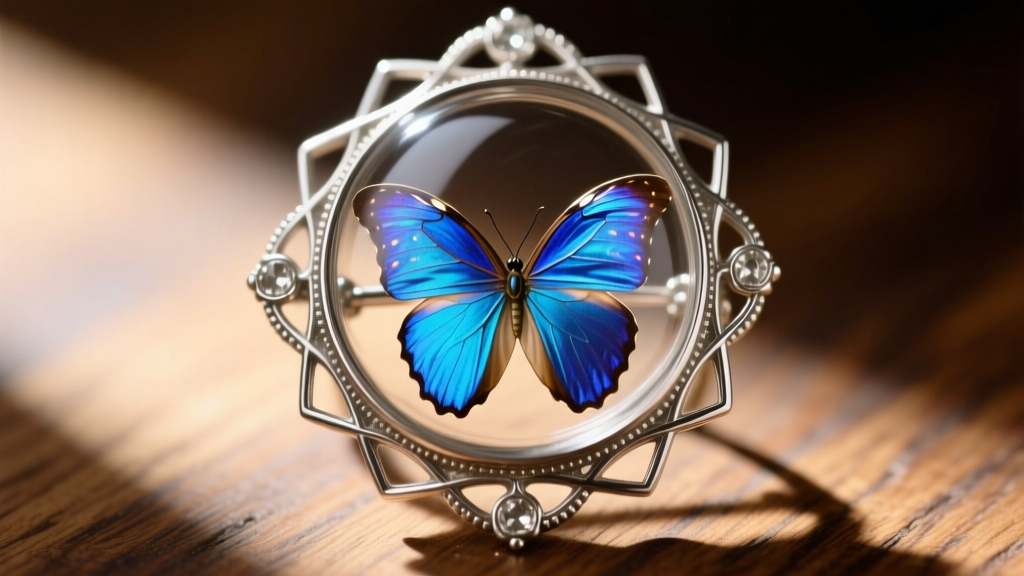
Collecting and maintaining vintage butterfly wing jewelry requires a profound understanding of both entomology and metallurgy. Most antique pieces on the market today originate from the 1920s through the 1950s, with the English firm Thomas L. Mott (TLM) being the most prolific manufacturer. These exquisite brooches, pendants, and earrings typically feature the iridescent wings of the South American Morpho menelaus or Morpho peleides butterflies, encased in sterling silver, gold-plated brass, or early plastics like Bakelite and celluloid.
To properly care for these artifacts, you must first understand that the brilliant blue hue of the wing is not caused by chemical pigments. Instead, it is the result of structural coloration. Microscopic chitin scales on the wing act as photonic crystals, refracting light to produce that signature metallic blue. Because these scales are essentially dry, microscopic biological structures, they are exceptionally vulnerable to moisture, chemical fumes, and physical abrasion. Once the structural integrity of these scales is compromised, the iridescence is lost forever, leaving behind a dull, lifeless grey or brown membrane.
As we navigate jewelry conservation standards in 2026, horologists and antique curators universally agree that traditional jewelry cleaning methods are highly destructive to organic inclusions. What works perfectly for a diamond and platinum ring will instantly ruin a morpho wing pendant. Below is a comprehensive, expert-level guide to preserving the delicate ecosystem trapped within your vintage butterfly wing jewelry.
The Chemical Danger Zone: What NEVER to Use
The most common cause of irreversible damage to vintage butterfly wing jewelry is improper cleaning of the surrounding metal settings. Because the wings are sealed behind glass or early synthetics, collectors often assume the seal is airtight. In reality, decades of thermal expansion and contraction create micro-fractures in the bezel seals.
Banned Cleaning Agents and Tools
- Silver Dip and Liquid Tarnish Removers: These products rely on thiourea and harsh acids to strip silver sulfide. Thiourea releases volatile fumes that easily penetrate micro-gaps in the bezel. When these fumes react with the chitin of the butterfly wing, they cause an immediate, irreversible chemical burn that turns the vibrant blue scales a mottled grey-black.
- Ultrasonic Cleaners: The high-frequency cavitation bubbles generated by ultrasonic machines will shatter the fragile glass or celluloid covers, while the vibrations will dislodge the microscopic wing scales from the membrane.
- Ammonia and Bleach: Ammonia-based glass cleaners (like Windex) will degrade the celluloid covers found on 1920s pieces and strip the natural oils from any organic backing materials.
- Steam Cleaners: Heat and moisture are the ultimate enemies of desiccated biological materials. Steam will instantly warp the wing membrane and promote rapid mold growth inside the sealed bezel.
Safe Cleaning Protocols for Silver and Glass Settings
When your vintage butterfly wing jewelry requires cleaning, the goal is to polish the metal and clarify the glass without introducing any liquids or fumes near the bezel edge. According to guidelines published by the Victoria and Albert Museum regarding organic-inorganic composite jewelry, dry and mechanical cleaning methods are always preferred.
Step-by-Step Polishing Method
- Assess the Cover Material: Determine if the wing is covered by glass or celluloid. Glass can be polished safely. Celluloid, however, is prone to "celluloid disease" (nitric acid off-gassing) and should only be wiped with a dry, lint-free microfiber cloth. Never apply liquid polish to celluloid.
- Select the Right Polish: Use a mild, non-abrasive calcium carbonate-based silver paste, such as Goddard’s Silver Polish. Avoid pastes containing harsh solvents or ammonia.
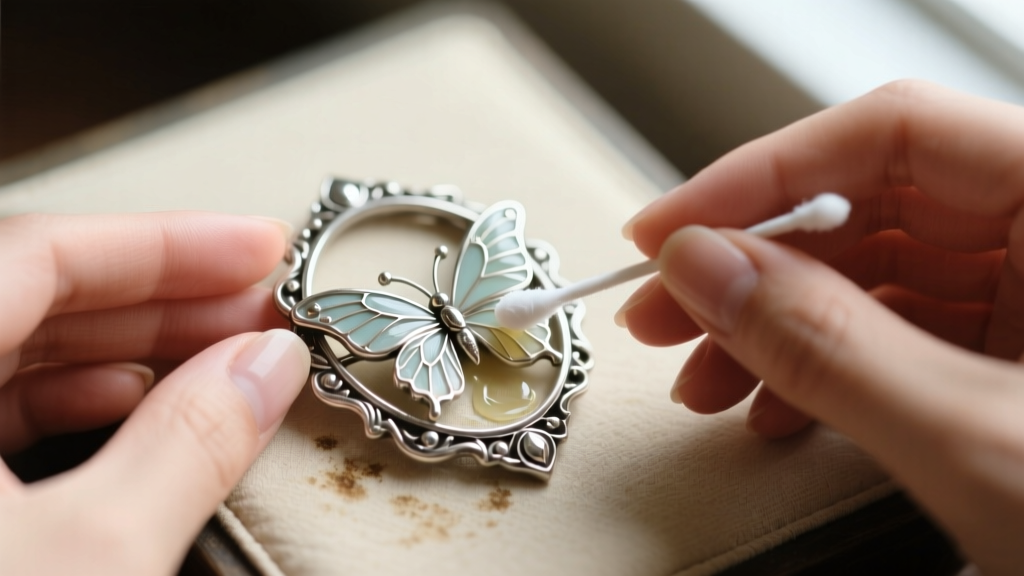
- Isolate the Bezel: Apply a tiny amount of polish to a cotton micro-swab (not a large cloth). Carefully polish the sterling silver frame, stopping exactly 2 millimeters short of the bezel lip where the metal meets the glass.
- Buff and Remove Residue: Use a clean, dry horsehair detailing brush to flick away any remaining polish residue from the crevices of the silver filigree. Ensure absolutely no white paste remains near the seal.
- Clean the Glass: Use a completely dry, high-density optical microfiber cloth to gently buff the glass cover. If there is stubborn grime on the glass, breathe lightly on it to create a minimal amount of condensation, then wipe immediately. Do not spray any liquid onto the piece.
Troubleshooting Common Failure Modes
Even with meticulous care, antique butterfly wing jewelry suffers from specific age-related degradation. Use the diagnostic table below to identify issues and implement the correct conservation response.
| Visual or Auditory Symptom | Root Cause Analysis | Expert Conservation Solution |
|---|---|---|
| Dull, grey, or black spotting on the blue wing | Moisture intrusion or historical exposure to thiourea silver dips. | Move to a desiccant-controlled environment immediately. The color loss is permanent, but further degradation can be halted. |
| A faint rattling sound when the brooch is moved | Desiccation of the wing membrane causing it to detach from the backing board. | Stop wearing the piece. Store it completely flat in an archival box to prevent the loose wing fragment from crumbling. |
| Yellowing, sticky, or cracking transparent cover | Celluloid degradation (off-gassing of nitric acid and camphor). | Isolate the piece from other jewelry. The acidic fumes will tarnish surrounding silver and burn the wing. Seek a conservator to replace the cover with UV-filtering acrylic. |
| Heavy, crusty black tarnish deeply pitted into the silver | Silver sulfide buildup exacerbated by high-sulfur storage environments (e.g., wool or rubber). | Apply Renaissance Wax to seal the metal after gentle mechanical polishing. Do not attempt to remove deep pits. |
Archival Storage: Controlling Humidity and UV Exposure
Proper storage is arguably more critical than cleaning when it comes to vintage butterfly wing jewelry. The Gemological Institute of America (GIA) emphasizes that organic gem materials require strict environmental controls to prevent structural collapse.
The 45% Relative Humidity Sweet Spot
Biological materials require a stable moisture level. If the relative humidity (RH) drops below 35%, the chitin and the organic backing board will become excessively brittle, leading to micro-fractures and the aforementioned "rattling" detachment. If the RH exceeds 55%, you risk activating dormant mold spores trapped inside the bezel during the 1930s manufacturing process, which will manifest as fuzzy white or green spots on the wing.
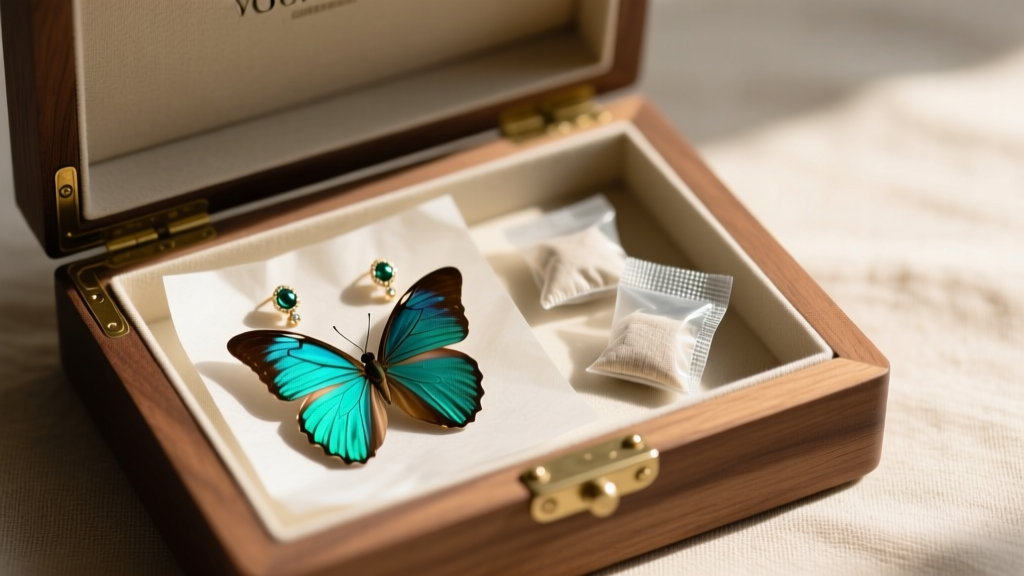
To maintain the ideal 45% RH, store your collection in an airtight archival acrylic box equipped with conditioned silica gel packets or Art-Sorb beads. You must use a digital hygrometer to monitor the environment, reconditioning the silica beads in a low-heat oven every three months. Never store these pieces in standard plastic zip-lock bags, as polyethylene can trap harmful off-gassing from other jewelry components.
Sealing the Bezel with Microcrystalline Wax
To proactively prevent moisture intrusion and tarnish, apply a microscopic layer of Renaissance Wax to the silver bezel and the seam where the metal meets the glass. Renaissance Wax is a highly refined, non-yellowing microcrystalline wax developed by the British Museum. Using a soft lint-free cloth, apply a barely visible film over the metal and the bezel edge. This creates an inert, oxygen-blocking barrier that stabilizes the micro-environment inside the jewelry piece.
When to Seek Professional Conservation
While routine polishing and climate-controlled storage can be managed at home, certain scenarios require the intervention of a professional objects conservator. If the glass cover of your Thomas L. Mott brooch is cracked, the wing is immediately exposed to ambient humidity and physical contact. Do not attempt to glue the glass yourself; cyanoacrylate (Super Glue) fumes will cause a phenomenon known as "blooming," leaving a permanent white haze over the iridescent scales.
Similarly, if you notice the celluloid cover warping or emitting a sharp, vinegar-like odor, the piece is actively off-gassing nitric acid. A conservator can safely dismantle the setting, neutralize the acidic residue on the silver, and fabricate a custom-cut, UV-filtering museum-grade acrylic replacement cover that mimics the original domed profile without the chemical instability.
"The preservation of composite organic jewelry is an exercise in restraint. The instinct to 'clean' must always be subordinate to the imperative to 'stabilize.' With morpho wing pieces, doing nothing in a controlled environment is often the most aggressive and effective conservation strategy available."
By respecting the biological fragility of these pieces and adhering to strict, chemical-free maintenance protocols, you can ensure that the structural brilliance of vintage butterfly wing jewelry survives for another century. Treat every piece not merely as an accessory, but as a delicate, sealed terrarium of natural history.


