What Is Estate Jewelry? A Technical Guide to Eras & Hallmarks
Discover what is estate jewelry through a technical lens. Learn to identify eras via hallmarks, metallurgical testing, and gemological cut analysis.


When collectors, appraisers, and gemologists ask, 'what is estate jewelry,' the answer extends far beyond the simplistic retail definition of 'previously owned.' In the secondary market, estate jewelry serves as an umbrella term for any piece that has had a prior owner, regardless of its age. However, distinguishing a genuine 1920s Art Deco piece from a 1980s reproduction requires a rigorous, technical approach to metallurgical composition, fabrication signatures, and gemological proportions. This guide deconstructs the forensic markers that define estate, vintage, and antique jewelry, providing a framework for accurate identification and valuation.
The Chronology Matrix: Estate, Vintage, and Antique
While 'estate' simply denotes provenance (i.e., originating from an estate or previous owner), the terms 'vintage' and 'antique' are strictly bound by chronology and stylistic eras. Misapplying these terms can lead to significant valuation errors, particularly when dealing with insurance appraisals or auction estimates.
| Classification | Age Requirement | Technical Definition & Market Application |
|---|---|---|
| Estate | Any age | Any secondary-market jewelry. Includes modern signed pieces (e.g., a 2015 Tiffany & Co. ring) and historical artifacts. |
| Vintage | 20 to 99 years | Pieces reflecting specific mid-century, Retro, or late-Art Deco design motifs. Often features early lost-wax casting and synthetic stones. |
| Antique | 100+ years | Strictly pre-1926. Encompasses Victorian, Edwardian, and early Art Deco. Characterized by hand-fabrication and specific alloy limitations. |
Understanding these boundaries is critical. A piece manufactured in 1910 is antique; a piece manufactured in 1935 is vintage. Both, however, are estate jewelry if they are being sold on the secondary market.
Metallurgical Forensics: Alloys and Solder Signatures
The metallurgical profile of an estate piece is one of the most reliable indicators of its true age. The evolution of metal refining and alloying practices provides distinct chronological markers.
The Platinum Shift and Iridium Alloys
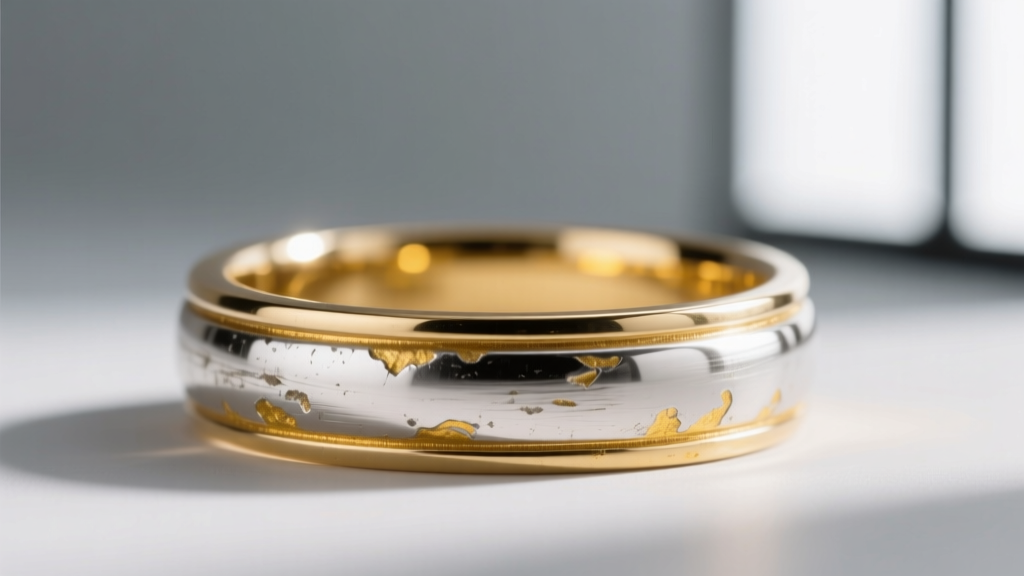
Prior to 1890, platinum was rarely used in jewelry due to its exceptionally high melting point (1,768°C). The invention of the oxyhydrogen torch allowed jewelers to work with platinum, sparking the Edwardian era's signature 'white-on-white' lace-like filigree. However, early platinum was often alloyed with copper or gold, making it brittle. By the 1920s, the standard became 900/1000 Platinum-Iridium (90% platinum, 10% iridium). If an estate piece features platinum that tests with a high copper content via X-ray fluorescence (XRF), it likely predates 1910 or is a later regional imitation.
White Gold and Rhodium Deception
White gold was patented by David Haynes in 1912. Early white gold alloys relied heavily on nickel, which caused skin irritation and resulted in a slightly yellowish-gray hue. To mask this, jewelers applied rhodium plating. When examining estate white gold from the 1920s and 1930s, wear on the shank or prongs will reveal the underlying nickel-gold alloy. Post-1940s palladium-white gold alloys appear naturally whiter. Furthermore, the presence of rhodium plating over prongs on a piece claimed to be from the 1890s is an immediate red flag, indicating either a later remount or an outright forgery.
Hallmark Anatomy and Assay Office Codes
Hallmarks are legally mandated stamps that certify metal purity. While the United States relies largely on maker's marks and karat stamps (e.g., 14K, 18K) enforced by the FTC, European estate jewelry features complex, government-regulated assay marks. According to the Victoria & Albert Museum, decoding these marks is essential for establishing geographic and chronological provenance.
- French Eagle's Head (Tête d'Aigle): Introduced in 1838, this mark guarantees a minimum of 18-karat (750) gold. If a piece features a French eagle's head but tests at 14K, the shank has likely been replaced or the piece is a modern counterfeit.
- French Dog's Head (Tête de Chien): Used for platinum (950 purity) from 1912 until the mid-20th century.
- UK Date Letters: The British assay system pairs a purity mark (e.g., a crown and '750' for 18K gold) with a letter indicating the year of assay, and a symbol for the city (Anchor for Birmingham, Leopard's Head for London). The font, shield shape, and case of the letter change annually, allowing appraisers to pinpoint the exact year of manufacture.
- 'Plumb' Gold Stamps: In the US, prior to 1981, a piece stamped '14K' could legally be 13.5K. The introduction of the '14KP' (Plumb) stamp guaranteed the piece was exactly 14/24 parts gold. Finding a 'KP' stamp on an estate piece generally dates it to the mid-20th century or later.
Gemological Diagnostics: Diamond Cuts and Proportions
The cutting style of diamonds and colored gemstones in estate jewelry provides a definitive timeline, as lapidary technology evolved significantly between 1850 and 1950. The Gemological Institute of America (GIA) notes that facet arrangements and culet sizes are primary indicators of a stone's era.
The Evolution of the Brilliant Cut
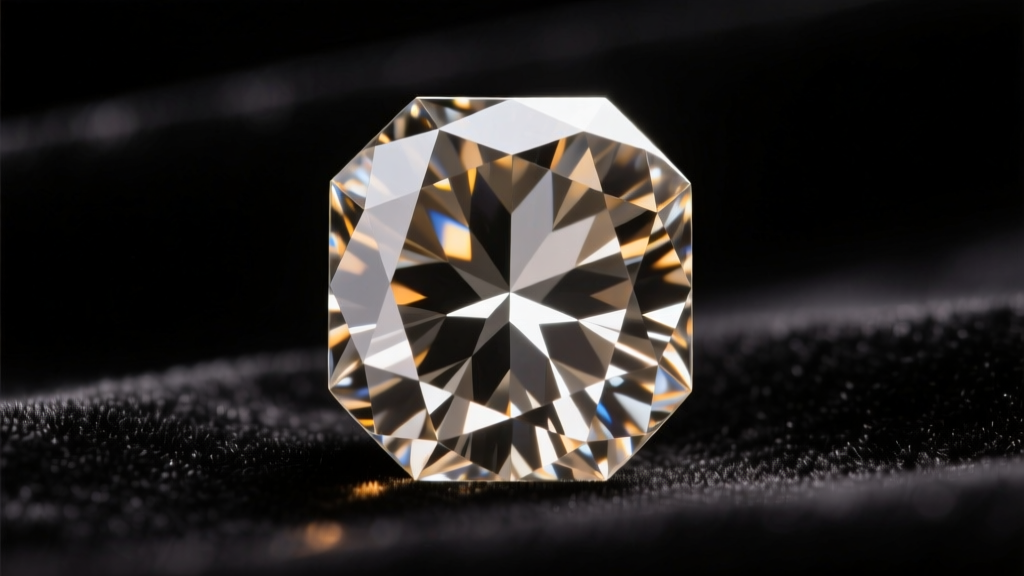
- Old Mine Cut (Circa 1700s–1890s): Characterized by a squarish or cushion-shaped girdle, a very high crown, a deep pavilion, and a large, visible open culet. These were cut by hand to retain maximum carat weight from the rough crystal, resulting in asymmetrical facet patterns.
- Old European Cut (Circa 1890s–1930s): The advent of the power-driven bruting machine allowed cutters to create perfectly round girdles. Old European cuts retain the high crown and open culet of the Old Mine cut but feature a round outline and 58 facets. They exhibit a 'chunky' scintillation pattern, often described as a 'flower' or 'checkerboard' effect under the table.
- Transitional Cut (Circa 1920s–1940s): A bridge between the Old European and the Modern Round Brilliant. Transitional cuts feature a larger table, a smaller culet (sometimes closed), and lower crowns. They lack the precise mathematical proportions of Marcel Tolkowsky's 1919 ideal cut but move away from the heavy, light-trapping pavilions of the 19th century.
Expert Note: If an estate ring features a mounting with 1910s Edwardian filigree but is set with a laser-inscribed, modern ideal-cut diamond with a medium-to-thick faceted girdle, the original stone has been upgraded. This drastically alters the piece's historical value and shifts its appraisal basis from 'antique artifact' to 'scrap metal plus modern gem value.'
Construction Techniques: Hand-Forged vs. Cast
Examining the underside and gallery of an estate piece under 10x magnification reveals its fabrication method, which is tightly correlated to its age.
Die-Striking and Hand-Fabrication
Pieces from the Georgian, Victorian, and Edwardian eras were entirely hand-fabricated or die-struck. Die-striking, which became popular in the 1920s Art Deco period, involved forcing sheets of gold or platinum between hardened steel dies under immense pressure. This process compresses the metal's molecular structure, resulting in exceptionally dense, durable, and lightweight filigree. Under magnification, die-struck edges appear sharp, crisp, and entirely free of porosity.
The Lost-Wax Casting Revolution
While casting has ancient roots, the lost-wax centrifugal casting method was not widely adopted in commercial jewelry manufacturing until the late 1940s, following World War II. If a piece purported to be from the 1920s exhibits rounded, slightly soft edges, microscopic porosity (tiny surface pits), or visible sprue marks (where the molten metal entered the mold), it is almost certainly a later reproduction. As noted by Antique Jewelry University, the presence of casting seams or porosity in 'antique' platinum filigree is a primary diagnostic tool for identifying modern counterfeits.
The Appraiser's Maxim: 'Estate' is a condition of ownership; 'Antique' is a condition of time. True valuation relies not on the seller's narrative, but on the empirical evidence left in the metal's alloy, the diamond's culet, and the maker's hallmark.


