Estate Jewelry: What Is It? A Material Properties Guide
Discover the true definition of estate jewelry and explore a deep-dive comparison of vintage metals, plastics, and gemstone material properties.

Defining the Term: Estate Jewelry vs. Antique and Vintage
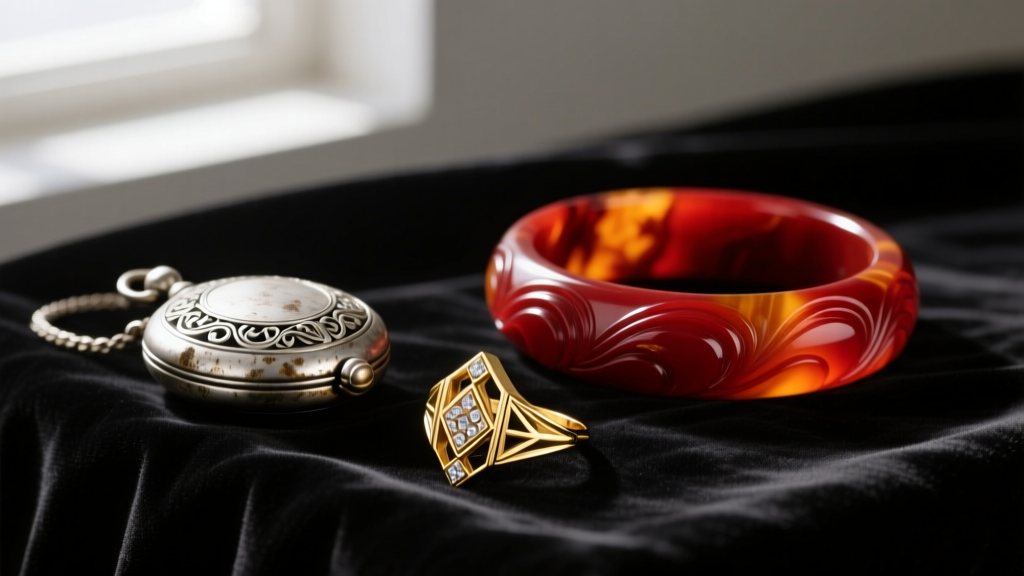
When collectors first search for estate jewelry what is, they are often met with conflicting definitions. In the gemological and auction sectors, 'estate' simply means previously owned. It is an umbrella term indicating that a piece has had at least one prior owner, regardless of its age. A five-year-old modern diamond solitaire and a 200-year-old Georgian mourning brooch are both technically estate jewelry. However, 'vintage' refers to pieces at least 20 to 99 years old, while 'antique' strictly denotes items crafted 100 years or more ago.
Understanding these distinctions is only the first step. The true value, longevity, and wearability of any estate piece are dictated by its material properties. Historical jewelers utilized specific alloys, early synthetic polymers, and unique gemstone setting techniques that behave vastly differently than modern equivalents. Below, we dissect the metallurgical and chemical properties of estate jewelry materials to help you authenticate, preserve, and value your collection.
Precious Metal Alloys: Hardness, Patina, and Wear
The survivability of estate jewelry is heavily dependent on the Vickers Hardness (HV) and alloy composition of its precious metals. Historical alloys often differ from modern standards due to varying refining capabilities and regional preferences.
Yellow and Rose Gold: Copper Content and Color Shifts
Gold purity is measured in karats, with 24k being pure gold. Pure gold is far too soft for jewelry (approx. 25 HV), so it is alloyed with copper, silver, and zinc. In estate jewelry, you will frequently encounter 14k (58.5% gold) and 18k (75% gold) pieces.
- 18k Yellow Gold: With a hardness of roughly 125 HV, 18k gold is highly prized for its rich, buttery color. However, it is prone to shank thinning. An 18k Edwardian ring worn daily for a century will often require a half-shank replacement, a factor that can reduce its numismatic value by 15-20%.
- Vintage Rose Gold: The pink hue of rose gold comes from copper. Early 20th-century Russian and American 14k rose gold often contained up to 30% copper and 12.5% silver, yielding a deep, reddish-brown tone. Modern 'champagne' rose gold uses less copper and more zinc, making vintage pieces highly distinguishable by color and slightly more brittle due to the high copper content.
Platinum vs. White Gold: The Patina Debate
Platinum emerged as the premier metal for fine jewelry during the Edwardian era (1901-1915) and the Art Deco period (1920-1935). Most estate platinum is alloyed with 10% iridium (900/100 Pt/Ir) to increase its workability.
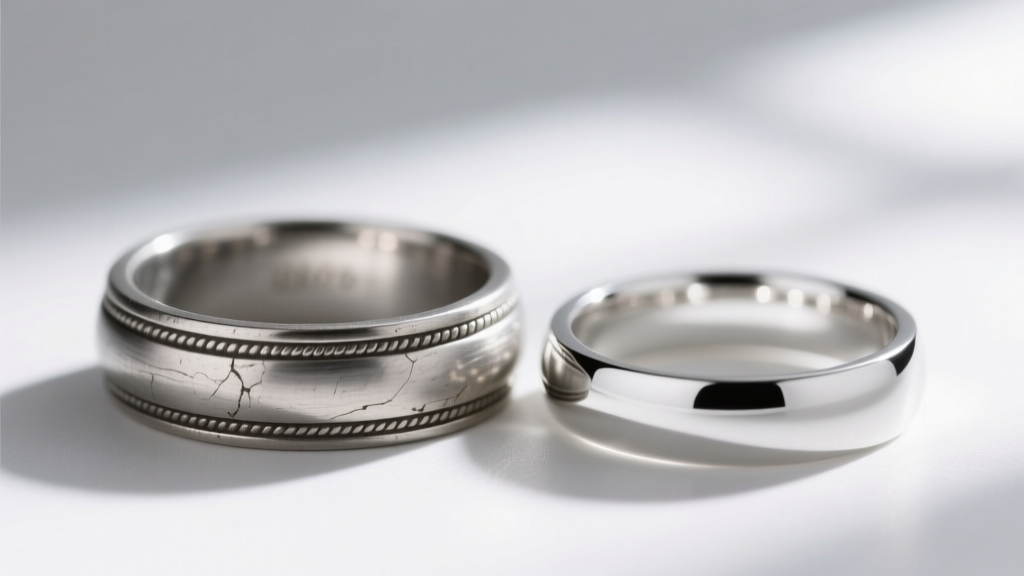
Unlike white gold, which is an alloy of gold and white metals (like nickel or palladium) plated with rhodium, platinum does not lose metal when scratched. Instead, the metal displaces, creating a soft, frosted patina over time. While a modern rhodium-plated white gold ring will show yellowish 'strike-through' as the plating wears off (requiring $50-$100 for re-plating), a 1920s platinum filigree ring simply develops a desirable antique luster. According to the Lang Antiques University, this patina is often preferred by serious collectors and should not be aggressively polished away.
Early Synthetics and Organics: Polymer Chemistry in Jewelry
The late 19th and early 20th centuries saw the introduction of the first synthetic plastics and the widespread use of organic materials. Identifying these materials is critical, as their chemical instability can destroy both the piece and adjacent items in your jewelry box.
Bakelite vs. Celluloid: Identification and Degradation
Bakelite (polyoxybenzylmethylenglycolanhydride) was the first fully synthetic plastic, heavily used in 1930s Art Deco costume jewelry. It is a thermosetting phenol formaldehyde resin, meaning it will not melt when heated. Authentic Bakelite is dense, produces a distinct 'clack' when two pieces are tapped together, and will yield a yellow stain when rubbed with Simichrome metal polish.
Celluloid, an earlier thermoplastic made from nitrocellulose and camphor, poses a severe threat to estate collections. Over time, celluloid off-gasses its camphor plasticizer. The remaining nitrocellulose reacts with ambient moisture to form nitric acid. This phenomenon, known as 'celluloid rot,' causes the material to crack, warp, and emit a harsh acidic odor. Critical Warning: The nitric acid off-gassed by decaying celluloid will aggressively corrode and pit any silver or gold jewelry stored in the same enclosed space. Always store celluloid pieces in open-air, acid-free archival boxes.
Vulcanite and French Jet: The Mourning Era
During the Victorian mourning period, black materials were in high demand. Genuine Jet (fossilized wood) is lightweight and leaves a brown streak on unglazed porcelain. To meet demand, jewelers used Vulcanite (hardened rubber) and French Jet (black glass). Vulcanite can be identified by gently rubbing it until warm; it will emit a faint sulfur or rubber odor. French Jet, being glass, is significantly heavier and colder to the touch, with a higher refractive index.
Gemstone Properties: Historical Cuts and Foil Backing
The physical cutting and setting of gemstones in estate jewelry differ fundamentally from modern practices, directly impacting how the stones must be cleaned and maintained.
The Danger of Foil-Backed Settings
Prior to the invention of modern brilliant-cutting mathematics in the early 20th century, lapidaries relied on closed-back settings lined with thin sheets of silver or copper foil to enhance a gemstone's refractive index and color. This is incredibly common in Georgian and early Victorian estate jewelry.
Failure Mode: If moisture breaches the setting, the foil will instantly oxidize and blacken, turning a vibrant ruby or aquamarine into a dull, opaque stone. Never submerge foil-backed estate jewelry in water, ultrasonic cleaners, or chemical dips. Cleaning must be restricted to a dry, soft-bristled brush and a barely damp cloth on the crown (top) of the stone only.
Old Mine and Old European Cuts
Estate diamonds frequently feature Old Mine cuts (cushion-shaped with high crowns and small tables) or Old European cuts (round with a small open culet). Because these stones were cut by hand to maximize carat weight retention rather than optical brilliance, they exhibit a 'chunky' scintillation pattern. When evaluating these stones, the Gemological Institute of America (GIA) notes that standard modern cut grades do not apply; value is instead driven by symmetry, historical provenance, and the preservation of the original, unpolished girdle.
Material Comparison and Valuation Matrix
The following table summarizes the primary materials found in estate jewelry, their common eras, specific failure modes, and general market impact.
| Material | Common Era | Key Property / Composition | Primary Failure Mode | Market Impact |
|---|---|---|---|---|
| 18k Yellow Gold | Victorian, Edwardian | 75% Au, soft (125 HV) | Shank thinning, prong wear | Moderate deduction if re-tipped |
| Platinum (900/Ir) | Edwardian, Art Deco | 90% Pt, develops patina | None (metal displaces, not lost) | High premium for original patina |
| Bakelite | Art Deco (1930s) | Thermosetting phenol resin | Surface crazing, UV fading | High value if deeply carved/color |
| Celluloid | Victorian, Art Nouveau | Nitrocellulose + camphor | Celluloid rot (acid off-gassing) | Low value, high storage risk |
| Foil-Backed Gems | Georgian, Early Victorian | Closed-back with Ag/Cu foil | Moisture ingress, foil oxidation | Severe value loss if foil blacks |
Authentication and Testing Methodologies
When acquiring estate jewelry, relying on visual inspection alone is insufficient. Professional authentication requires non-destructive testing to preserve the piece's historical integrity.
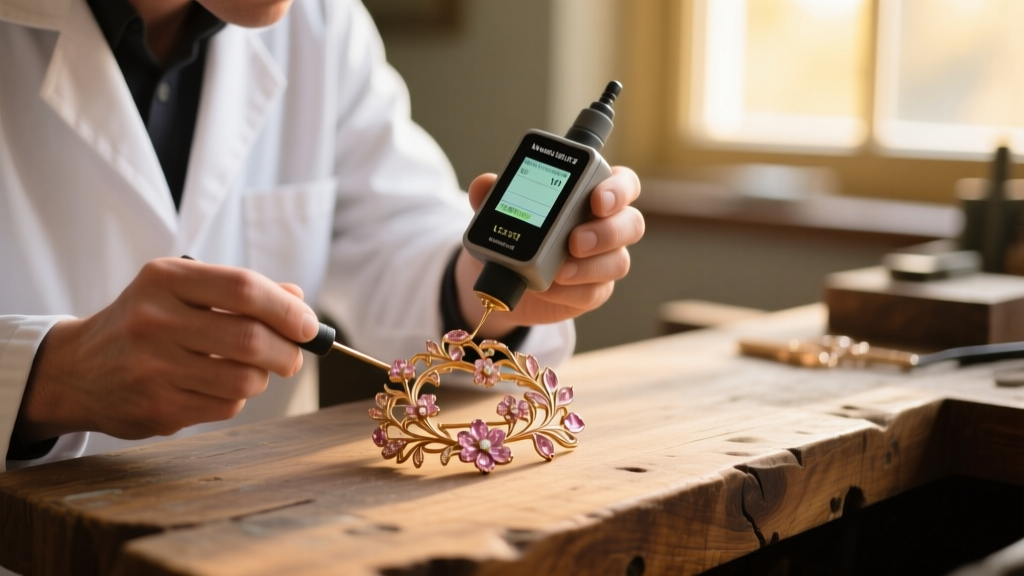
For precious metals, X-Ray Fluorescence (XRF) spectrometry is the gold standard. Unlike traditional acid testing, which requires filing a deep notch into the metal (destroying historical tool marks and patina), XRF provides an exact elemental breakdown in seconds. It can easily differentiate between a modern 14k white gold alloy (using palladium) and a vintage 1940s Retro-era nickel-white gold alloy, which is crucial for buyers with metal allergies.
For early plastics, the hot pin test is widely considered destructive and should be avoided by serious collectors, as it leaves permanent burn marks and can ignite celluloid. Instead, utilize long-wave UV light (which causes certain Bakelite dyes to fluoresce) and the aforementioned Simichrome polish test on an inconspicuous area. By mastering the material science behind these historical artifacts, collectors can accurately assess risk, ensure proper preservation, and build a highly authentic estate jewelry portfolio.


