Navigating Yans Antique Jewelry NYC: A Buyer's Guide
Master the art of estate buying with our step-by-step guide to shopping Yans Antique Jewelry NYC, from hallmark authentication to negotiation.

Why NYC’s Antique Market Demands a Strategic Approach
The Manhattan estate jewelry market is a high-stakes ecosystem where generational heirlooms and polished reproductions sit side-by-side in the same display cases. When planning your visit to specialized dealers like Yans Antique Jewelry NYC, it is crucial to understand that you are not merely shopping; you are conducting a real-time metallurgical and gemological audit. The density of the New York Diamond District and its surrounding boutique enclaves means that inventory turns over rapidly, often sourced from private estate liquidations, auction house buyouts, and international trade networks.
To succeed in this environment, buyers must abandon passive browsing and adopt a rigorous, step-by-step authentication framework. This guide will walk you through the exact methodologies used by seasoned estate buyers to verify provenance, assess structural integrity, and negotiate effectively on pre-war and mid-century pieces.
Step 1: Pre-Visit Preparation and Hallmark Research
Before stepping foot into any Manhattan antique showroom, you must familiarize yourself with international hallmarking systems. Unlike modern jewelry, which is often stamped with simple purity marks (e.g., "14K" or "750"), antique pieces rely on complex, region-specific pictorial stamps that reveal both metal purity and geographic origin.
- French Tête d'Aigle (Eagle Head): Indicates 18k gold (750 purity). Found on most high-end European pieces from the late 19th century onward.
- French Tête de Chien (Dog Head): A rare and highly desirable hallmark indicating a mix of platinum and 18k gold, heavily utilized during the transitional Edwardian era when platinum was difficult to cast independently.
- British Anchor & Lion Passant: The anchor denotes the Birmingham Assay Office, while the lion confirms sterling silver (925) or 18k gold depending on the accompanying crown mark.
According to the Lang Antique Jewelry University, understanding these micro-stamps is your first line of defense against later-period reproductions that mimic Victorian or Art Deco aesthetics but lack the correct period-specific assay marks.
Step 2: In-Store Authentication and Metallurgical Analysis
Once you have identified a piece of interest, request to examine it outside the display case under natural or neutral LED lighting. Never rely on the warm, halogen showcase lighting designed to maximize diamond scintillation and mask metal porosity.
Evaluating Prong Wear and Rhodium Plating
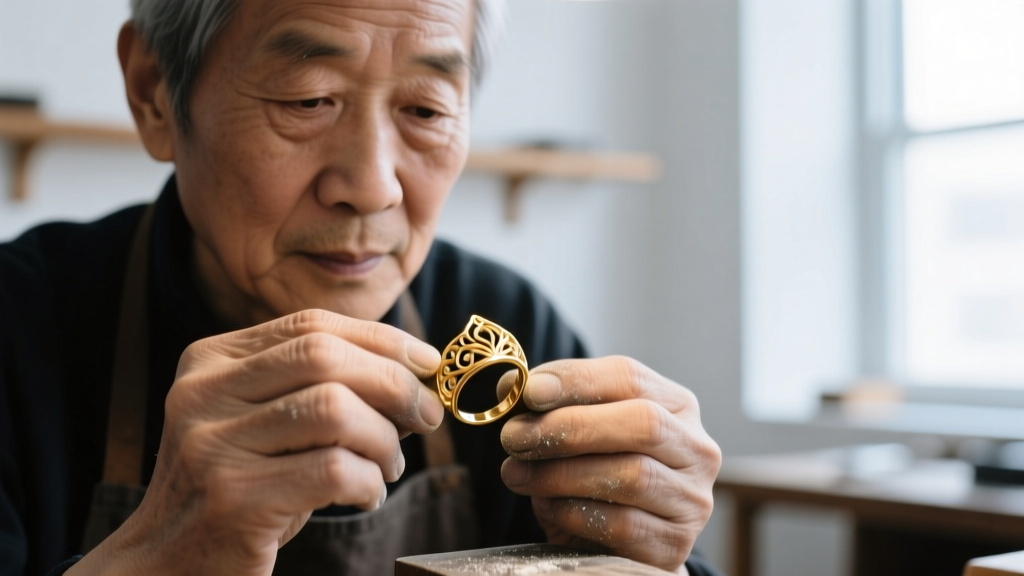
For rings, inspect the prongs using a 10x triplet loupe. Pre-1940s platinum prongs should show a dense, gunmetal-grey wear pattern. If you see bright white, reflective flaking, the piece has been heavily rhodium-plated—a common modern practice used to mask degraded white gold or porous early-cast platinum. Furthermore, check the gallery (the underside of the setting). Authentic Edwardian and Art Deco pieces feature hand-pierced galleries with knife-edge struts, whereas cast reproductions will show rounded, muddy edges and microscopic gas bubbles indicative of lost-wax casting.
| Era | Primary Gold Alloy | Visual Characteristics & Wear Patterns |
|---|---|---|
| Victorian (1837-1901) | 15k - 18k Yellow/Rose | High copper content in rose gold leads to a dark, oxidized patina in crevices; highly resistant to modern polishing. |
| Edwardian (1901-1915) | Platinum over 18k Gold | Laminated construction; look for yellow gold bleeding through on the inner shank due to decades of friction wear. |
| Retro (1935-1950) | 14k - 18k Rose/Yellow | Massive, hollowed-out gold constructions; lower copper content than Victorian rose gold, yielding a lighter, peachier hue. |
Step 3: Evaluating Provenance and Gemological Reports
When dealing with high-carat center stones, verbal assurances are insufficient. You must cross-reference the diamond's facet structure with its purported age. The Gemological Institute of America (GIA) notes that Old European Cuts (OEC), prevalent from 1890 to 1930, feature 58 facets, a high crown, and a remarkably small table (typically 53% or less). Conversely, Old Mine Cuts (OMC) are cushion-shaped with a high crown and a large, open culet that is visible to the naked eye through the table.
If a dealer presents a piece as "1920s Art Deco" but the center stone is a modern Round Brilliant with a 57% table and a laser-inscribed girdle, you are looking at a period-style mounting that has been retrofitted with a modern stone. While not inherently a dealbreaker, this drastically alters the valuation, as collectors pay a premium for original, matched parures.
"Always request the original estate receipt or a modern GIA report for any center stone over 1.50 carats. In the NYC market, undocumented high-carat antique stones carry a 20-30% liquidity discount due to the buyer's assumption of risk."
Step 4: The Art of Negotiation in Manhattan's Diamond District
Negotiating at Yans Antique Jewelry NYC or similar high-end estate dealers requires an understanding of their margin structures. Unlike modern retail jewelry, which often carries 100% to 300% markups, authentic antique jewelry operates on much tighter margins, typically 20% to 40% over the dealer's acquisition cost, except for signed pieces.

Negotiation Framework by Category
- Unsigned Estate Pieces (Victorian/Edwardian): Expect a 10% to 15% discount from the ticket price. Dealers have flexibility here based on how long the piece has sat in inventory.
- Signed Designer Pieces (Cartier, Boucheron, Tiffany): Margins are rigid. You may secure a 5% courtesy discount, but the provenance and brand premium leave little room for aggressive haggling.
- Damaged or "As-Is" Pieces: If a piece requires significant restoration (e.g., rebuilding shattered enamel or replacing missing calibre-cut sapphires), use the estimated restoration cost as leverage to negotiate a 20% to 30% reduction.
Pro Tip: Offering immediate payment via wire transfer or cashier's check often unlocks an additional 2% to 3% cash discount, as it saves the dealer credit card processing fees and provides immediate liquidity to reinvest in estate buyouts.
Post-Purchase Care for Pre-War and Mid-Century Pieces
Once you have secured your piece, the preservation phase begins. The most common mistake new collectors make is applying modern cleaning techniques to antique structures. Never place Victorian or Edwardian jewelry in an ultrasonic cleaner. The high-frequency vibrations can shatter foil-backed stones (common in Georgian and early Victorian pieces), fracture emeralds that have been treated with centuries-old cedar oil, and dislodge the delicate millegrain detailing on early platinum settings.
Instead, clean your acquisitions using a soft, natural-bristle baby toothbrush, lukewarm distilled water, and a single drop of pH-neutral dish soap. For pieces featuring porous gemstones like opals, turquoise, or lapis lazuli, avoid liquid immersion entirely; simply wipe them with a dry, untreated microfiber cloth. By adhering to these meticulous preservation standards, you ensure that the historical integrity of your Manhattan estate acquisition survives for the next century.
For further reading on consumer protections and accurate metal stamping laws, refer to the Federal Trade Commission Jewelry Guides, which outline the legal requirements for precious metal marketing in the United States.


