What Is Art Deco Jewelry? A Material & Gemstone Guide
Discover what is Art Deco jewelry through its defining materials. Compare platinum, white gold, calibre-cut gems, and early synthetics in this expert guide.

Defining the Era: What Is Art Deco Jewelry?
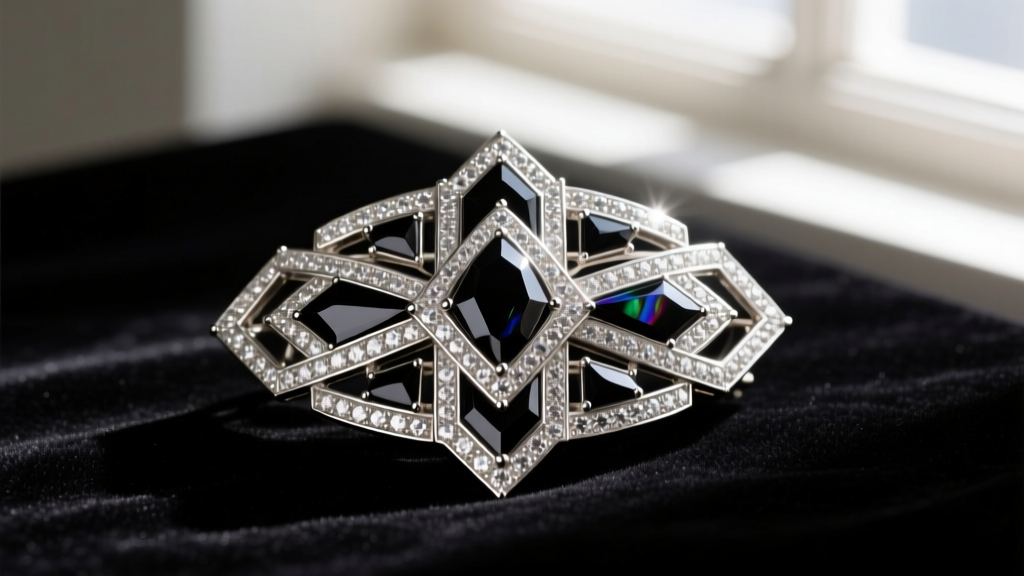
When historians, appraisers, and collectors ask, 'what is art deco jewelry,' the answer extends far beyond the bold, geometric silhouettes of the 1920s and 1930s. True Art Deco jewelry is defined by a radical departure from the soft, lace-like floral motifs of the Edwardian era, replacing them with architectural precision, high-contrast color blocking, and an obsession with modernity. However, from a gemological and metallurgical perspective, the era is best understood through its materials. The shift toward linear, step-cut designs required metals with unprecedented tensile strength and gemstones cut to exact, custom millimeter specifications.
As we evaluate estate pieces in the 2026 market, understanding the specific material properties of authentic Art Deco jewelry is critical. It is the only reliable way to distinguish true 1920s hand-fabricated masterpieces from the flood of modern cast reproductions that attempt to mimic the aesthetic without the structural integrity.
The Platinum Standard vs. The Rise of White Gold
The defining metal of the high Art Deco period (1920–1929) was platinum. Specifically, jewelers utilized 900 Platinum (90% platinum, 10% iridium or ruthenium). Platinum’s high melting point and exceptional tensile strength allowed master jewelers to create 'pierced openwork' (ajouré) and ultra-fine milgrain edges that would easily snap if executed in gold. Because platinum is relatively malleable before work-hardening, it could be drawn into microscopic wires to secure diamonds without obscuring the stones.
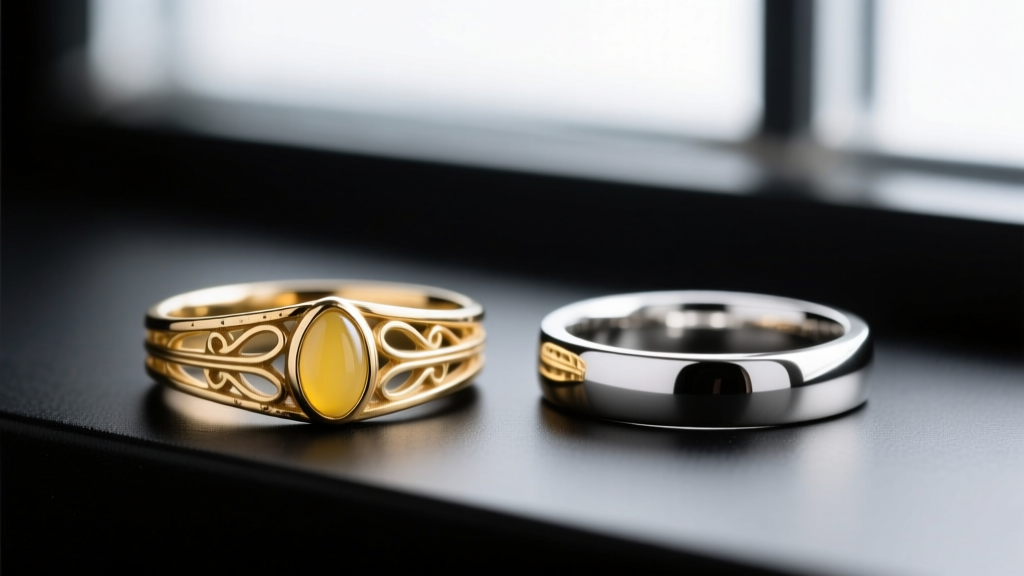
Following the 1929 stock market crash, the economic realities of the 1930s necessitated a more affordable white metal alternative. This led to the widespread adoption of 18k and 14k White Gold. Early white gold alloys, such as those pioneered by David Belais, utilized nickel, zinc, and copper to bleach the yellow hue of pure gold. However, these alloys were inherently brittle and possessed a slight yellowish-gray undertone, necessitating the heavy application of rhodium plating—a practice that remains standard today but complicates modern authenticity assessments when the plating wears away to reveal the warm alloy beneath.
Metallurgical Properties: Platinum vs. White Gold
| Property | 900 Platinum (Iridium Alloy) | 18k Nickel-White Gold | 18k Palladium-White Gold |
|---|---|---|---|
| Vickers Hardness (HV) | 80 - 110 (Work-hardens to 140+) | 120 - 150 | 100 - 125 |
| Malleability | High (Ideal for hand-piercing) | Low (Brittle, prone to cracking) | Medium (Good for casting) |
| Era Prevalence | 1920 - 1935 (High-end pieces) | 1930 - 1940 (Depression-era) | Rare in era, common in modern replicas |
| Patina / Wear | Develops soft patina, no metal loss | Wears down, loses rhodium plating | Retains white color, scratches easily |
Gemstone Properties: Old European Cuts and Calibré Faceting
To truly grasp what is art deco jewelry, one must examine the diamonds. The era predates the modern Round Brilliant (MRB) cut standardized by Marcel Tolkowsky in 1919, which didn't achieve market dominance until the late 1930s. Instead, Art Deco pieces predominantly feature Old European Cut (OEC) and Transitional Cut diamonds.
Under a 10x loupe, an OEC diamond reveals a distinctly different facet architecture than modern stones. They possess a round girdle, a high crown (often exceeding 35 degrees), a small table facet (typically 40% to 53% of the diameter), and a large, open culet that is visible to the naked eye face-up. These proportions were optimized for candlelight and low-light environments, yielding a 'chunky' scintillation pattern rather than the splintery brilliance of modern cuts.
The Lapidary Marvel of Calibré-Cut Stones
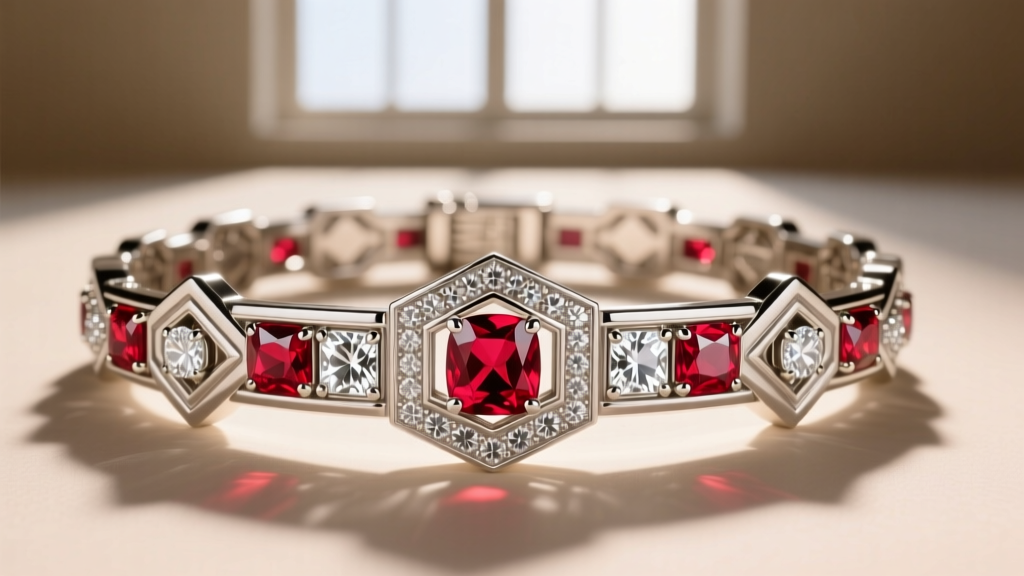
Perhaps the most labor-intensive material technique of the era was the use of calibré-cut gemstones. Unlike standard commercial cuts, calibré stones (typically sapphires, rubies, emeralds, and onyx) were custom-faceted to fit into specific geometric channels or form continuous, gapless mosaics. Lapidaries had to account for the exact thickness of the platinum bezel walls, cutting stones with tapered edges so they could be slid into a rub-over or channel setting. This required immense precision; a deviation of even 0.2 millimeters would result in visible gaps or structural stress fractures in the brittle colored gems.
Early Synthetics and Carved Exotics
The Art Deco era coincided with significant advancements in synthetic gemstone production. The Verneuil flame-fusion process, invented in 1902, allowed for the mass production of synthetic rubies and sapphires. Chemically, these are identical to natural corundum (Al2O3). However, under gemological microscopy, Verneuil synthetics reveal curved striae (growth lines) and microscopic spherical gas bubbles, whereas natural corundum exhibits angular color zoning and crystalline inclusions. According to the Gemological Institute of America (GIA), the presence of Verneuil synthetics in a piece is actually a strong indicator of 1920s authenticity, as high-end houses like Cartier and Van Cleef & Arpels occasionally utilized them for their perfect color consistency in geometric color-blocking designs.
Beyond synthetics, the era saw a massive influx of exotic, carved materials. Type A Jadeite (untreated, naturally translucent jade) was imported from Burma, carved in China with Art Deco motifs, and shipped to Paris to be mounted in platinum with diamond accents. Additionally, Rock Crystal Quartz became a favored material for designers like Suzanne Belperron. Valued for its Mohs hardness of 7 and optical clarity, rock crystal was often frosted, carved into geometric blocks, and paired with pavé diamonds to create a striking monochromatic contrast.
Enameling Techniques: TailLE d'Épargne and Guilloché
Color in Art Deco jewelry was not solely reliant on gemstones; vitreous enamel played a crucial structural and aesthetic role. The most prominent technique was taille d'épargne (cut-away enamel), where linear channels were carved into the platinum or gold base metal and filled with opaque black, red, or blue enamel. This created stark, high-contrast outlines that emphasized the architectural geometry of the piece.
Because vitreous enamel is essentially glass fused to metal at temperatures exceeding 1,200°F (650°C), it requires a metal substrate that can withstand extreme heat without melting or warping. Platinum and 18k yellow gold were ideal for this. When examining black enamel on platinum today, authentic pieces will show a glass-like, non-porous surface. Reproductions often use cold enamel (epoxy resin), which will show microscopic pitting, lack the depth of vitreous glass, and will fluoresce brightly under UV light, whereas true fired enamel remains inert.
Identifying Authentic Construction in the Modern Market
As the vintage jewelry market continues to mature in 2026, distinguishing authentic Art Deco fabrication from modern reproduction is paramount for valuation. Authentic pieces from the 1920s and 1930s were either hand-fabricated (sawn, soldered, and assembled from sheet metal and wire) or die-struck. Die-striking involves forcing a sheet of metal into a steel mold under hundreds of tons of pressure. This compresses the grain structure of the metal, resulting in an incredibly dense, non-porous, and highly polished surface that is virtually impossible to replicate with modern casting methods.
Expert Appraisal Tip: Examine the milgrain edges and the back of the setting (the under-gallery). Authentic hand-fabricated or die-struck pieces will have sharp, crisp milgrain and clean, open under-galleries with file marks from hand-finishing. Modern cast reproductions will exhibit microscopic porosity (tiny pits on the metal surface), rounded or 'mushy' milgrain edges, and a uniform, slightly textured surface indicative of a rubber mold and wax injection process.
Ultimately, understanding what is art deco jewelry requires looking past the striking visual design and examining the microscopic evidence of its creation. The marriage of 900 platinum, old European cut diamonds, custom calibré lapidary work, and die-struck metallurgy created a category of jewelry that remains structurally and aesthetically unmatched in the history of adornment. For deeper historical context on the design movements of this era, the Victoria and Albert Museum's archive on Art Deco provides excellent primary source documentation on the transition from Art Nouveau to the geometric modernism of the 1920s.


